

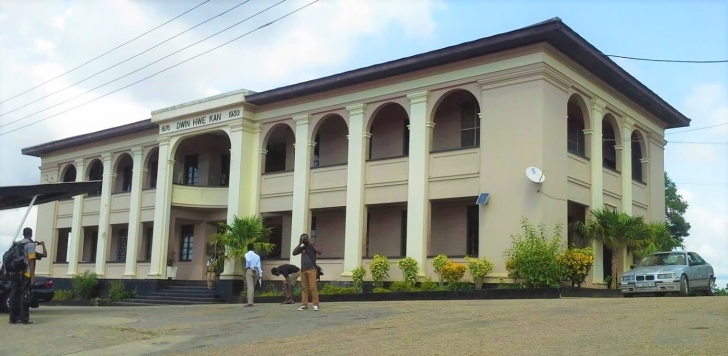
My first shock when I entered Mfantsipim School in September 1987 was not the discipline. Not the academic pressure. Not even the intimidating architecture that seemed to breathe history.
It was the nicknames of members of staff.
In the official register, they were respectable men with proper titles and credentials. But in the unofficial student archive, they had already been renamed, reinterpreted, and absorbed into folklore.
I arrived armed with institutional expectations: “Mr.” this, “Sir” that, formal address, procedural decorum. Within days, I discovered that the student body operated a parallel registry of identity. Masters were not merely teachers; they were characters in a living oral tradition.
We had names like Corrosive, Ostrich, Doboo, Black Sammy, Hope Man, Shakar, and several others.
At first, I was scandalised. How could students reduce respected masters to such irreverent labels? The reaction was naive. I soon realised these nicknames were not casual mockery; they were coded language. An internal anthropology of power.
“Corrosive,” our Headmaster, was not named for volume. He rarely raised his voice. But his sarcasm was surgical. His words did not explode; they dissolved. Slowly. Efficiently. Corrosively.
“Ostrich,” the Assistant Headmaster (Academic), was tall and distinctive in appearance. The boys exaggerated certain features in private commentary, and the name attached itself with speed. It was observational rather than malicious. Mfantsipim boys are ruthless ethnographers of physical detail.
Then there was “Doboo,” the Assistant Headmaster (Domestic). His imposing height earned him the label “Double man,” which, through the natural erosion of schoolboy slang, evolved into “Doboo.” Language, like tradition, adapts.
“Black Sammy,” the Senior Housemaster at the time, derived his name plainly from his dark complexion. It was adolescent bluntness, unfiltered and unvarnished.
“Hope Man” required less invention. “Man” was simply appended to his surname, Hope. It reflected the school’s instinct for masculine amplification. Titles re-engineered in dormitory conversation.
And then there was “Shakar”, the school chaplain. His name was borrowed from a popular Indian film protagonist known for firmness and moral clarity. The comparison was deliberate. The chaplain carried himself with disciplined gravity; the cinematic reference captured that energy in a single stroke.
“Slippe Man” was a study in unpredictability. Lenient one moment, lethal the next. Like a slipper skidding across a polished corridor, you never quite knew where you stood.
Some names were affectionate. Others defensive. A few were pure satire. But all of them functioned as coping mechanisms within the rigid architecture of boarding school life.
Founded in 1876 and steeped in Methodist discipline and academic rigour, Mfantsipim School has always demanded much of its boys. Humour became our pressure valve.
As adolescents navigating hierarchy, fear, ambition, homesickness, and testosterone, we needed a language that restored balance. The nicknames levelled the field. They reminded us that authority, however formidable, was still human.
Nearly four decades later, what strikes me is not the irreverence, but the creativity. We were archivists without knowing it. Each name captured an essence: temperament, physique, speech pattern, hometown, or one unforgettable incident. They were ethnographic shorthand.
They also bound us together. To know the nickname was to belong. It signified initiation into the fraternity of shared experience. You were no longer a bewildered Greenhorn; you were a Kwabotwe boy who understood the code.
In hindsight, those names were part of the hidden curriculum of Mfantsipim. Beyond Mathematics, Science, and Literature, we learned:
• How to interpret power
• How to survive scrutiny
• How to build solidarity
• How to laugh under pressure
Institutions endure for 150 years not only because of formal structures, but because of informal cultures that make endurance possible. The nicknames were small acts of authorship in a long institutional narrative.
Today, when I hear “Corrosive” or “Ostrich,” I do not hear mockery. I hear adolescence finding its voice. I hear boys rehearsing adulthood. I hear memory compressing complexity into symbol.
I entered Mfantsipim as Philip Creech-Jones, officially reformatted as Creech-Jones, P. But among my mates, I became Creech. Dizzy Kay. Santana. And the less flattering Shasha Marley.
Perhaps that was my true initiation in September 1987.
Not when the school registered my name.
But when it renamed me.
What was your first shock?
The writer is Philip Creech-Jones of MOBA 1992 (Mfantsipim Old Boys Association).
