

I have always been exceptionally excited about female traditional leaders in our set up. To me, they embody the model of all round excellence entrusted naturally to women.
As a woman and girls advocate with a bias towards the advancement of women in every sphere, I have keenly observed and admired the role of queenmothers as a respected function needed to help develop and transform a community.
They sanitise the air with an aroma of peace, reconciliation and tranquility. Chiefs and elders of a community tap into the wisdom of queenmothers knowing they command the power of influence.
The news at the beginning of July this year, on the installation of a new queenmother for the Ashanti kingdom, tickled my excitement beyond reasonable doubt.
It has been almost a year now since the last Asantehemaa, affable and approachable Nana Ama Konadu Yiadom III left to join her ancestors.
I have since then been looking forward to her successor, keen to know which of the Manhyia family lineage she was going to emerge from.
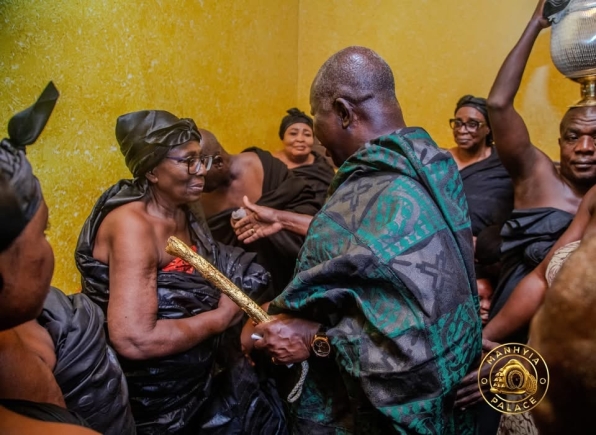
Official outdooring
Then I heard about Nana Ama Bonsu’s official outdooring by Otumfuo Osei Tutu II at the Manhyia palace in Kumasi. The stool name conferred on her, Nana Yaa Akyaa II, bonds with me as she carries my Ashanti name, Akyaa. According to the records, she is the 15th in line to the position.
The beauty of the rich Ashanti history that characterised the queenmother’s official unveiling was followed to the letter as per the centuries old Ashanti customs and traditions.
It is a process signaling the commencement of her reign. The task ahead of her may not be easy, but there is everything to show that she has the right demeanour and potential to rise to the task.
As Asantehemaa, Nana Yaa Akyaa II, has become the new spiritual and cultural mother of the people of Ashanti, a position considered as one of the highest traditional institutions in the country.
Her role, apparently, includes being the principal traditional adviser to the Asantehene, Otumfuo Osei Tutu II.
History has been made as a new Asantehemaa has been unveiled to the Asanteman and the general public. It is a joy to watch videos of Ashanti queenmothers, wives of Nananom and many other well-wishers taking turns at Manhyia to congratulate and welcome Nana Asantehemaa to the revered stool. The respect and cordiality are in order.
Per the Ashanti tradition, family inheritance is matrimonial and so it is for the chieftancy institution, including that of Asantehene and Asantehemaa. This means therefore that chiefs and queenmothers ascend their stools by virtue of their biological mothers or grandmothers link to the royalty.
In short, merely being the son or daughter of a chief, though referred to as Oheneba, does not give one an entitlement to a stool. However, a queen mother’s biological child or grandchild, maternal niece or nephew, all can have access, down the line, to be considered for the stool whenever it becomes vacant, either as chief or queen mother.
That is how important a recognition that the matrimonial tradition gives to women in the Ashanti culture.
With this traditional custom in mind, one is eager to know who Nana Yaa Akyaa II is and how she fits into the Asantehemaa lineage in Manhyia.
Who is Nana Yaa Akyaa II?
A bit of research done, shows that Nana Yaa Akyaa is a first cousin of Otumfuo Osei Tutu II and the late queen mother, Nana Ama Konadu Yiadom III. In Ashanti tradition, a matrineal cousin is generally seen and referred to as a sister or brother so she qualifies to be described as Otumfuo’s sister.
She is the biological sister of the late Nana Akwasi Agyeman, the former Mayor or Chief Executive Officer of the Kumasi Metropolitan Assembly.
In terms of her placement in the Manhyia royalty in Kumasi and indeed, to the Asantehemaa stool, She is said to be a direct granddaughter of Otumfuo Agyeman Prempeh I.
In the history of the Ashanti kingdom, Nana Agyeman Prempeh I, together with the famous Nana Yaa Asantewaa, the queen mother of Ejisu, led one of the Anglo-Asante wars and were both exiled to the Seychelles Island.
The Asantehemaa is also said to be a niece of Otumfuo Sir Osei Agyeman Prempeh II. So, there is no dispute regarding her ascension to the stool at Manhyia.
Born as Margaret Serebour, she is said to have a commitment to education, culture and the welfare of the people. No wonder her role as Asantehemaa includes preserving customs, resolving disputes and championing the welfare of women and children, a role that her immediate predecessor, Nana Konadu Yiadom III executed flawlessly with passion during her short time on the stool.
One joins the people of Ashanti, particularly all the queen mothers and the women in general, to extend a warm Akwaaba to Nana Yaa Akyaa II, the 15th Asantehemaa to the Ashanti stool.
Nana, “wo tri nkwas so”.
Writer’s E-mail:
