

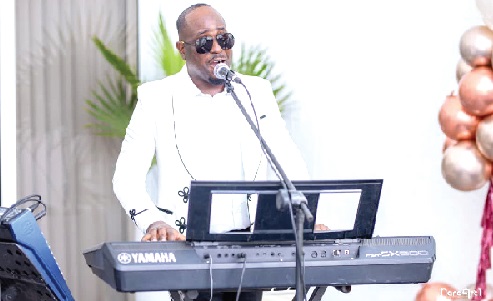
Prof Alfred Patrick Addaquay has built a career through which performance and scholarship continuously inform each other.
He is a celebrated classical and arts musician, keyboardist, tenor soloist, composer and choral musician.
Prof Addaquay’s rise to Associate Professor of Musicology at the University of Ghana is the latest milestone in a journey that began with the piano, and has taken him in quest of African music, musical identity, education and the professional lives of musicians.
When The Mirror profiled Prof Addaquay in August 2020, he had just completed his doctorate and was looking towards a future in university teaching. Six years later, that ambition has led to the acquisition of a new title.
He joined the University of Ghana as a Lecturer in November 2021, became a Senior Lecturer in February 2024 and was promoted to
Associate Professor with effect from April 1, 2026 — an interval of just four years and five months.
The academic acceleration, however, sits on decades of musical preparation.
From the piano to the university
Born in Kumasi, Prof Addaquay began learning the piano during his years at KNUST Primary School. His early public musical activity dates back to 1994, when his years at Mfantsipim School brought recognition through the Discovery of the Year, Initiative and Drive awards.
At the University of Cape Coast, he pursued a Bachelor of Music, an MPhil and eventually a PhD in Music Theory and Composition, which he completed in 2020.

But behind the academic qualifications was a musician deeply involved in the practical business of music — learning, rehearsing, composing, accompanying and performing.
His compositions include the oratorio Laudateur Christus, the African cantata Afe Nsakrae, Kyekyekule Sonata and Sanku Concerto. His doctoral work explored a concerto combining the piano with African percussion and drawing on different Ghanaian rhythmic idioms.
That blend of European concert forms and Ghanaian musical resources remains a defining feature of his work.
When music becomes a question
For Prof Addaquay, music is not simply something to be performed; it is something to be questioned.
His research has examined the relationship between text and melody, Ghanaian choral composition, musical structure, vocal performance, accompaniment and singing styles.
His study Sounding Identity, for instance, considers features such as vocal timbre, nasal resonance and vibration within their musical and cultural settings.
Reclaiming the African Voice goes further, arguing that the human voice cannot be understood through sound-production categories alone when language, identity and communal meaning are also involved.
He also challenges the authority of the music analyst. In The Analyst’s Dilemma, he examines praise, criticism and the limits of analytical authority, arguing for musical interpretation that is more accountable to evidence and open to the possibility that an analyst may be wrong.
The questions are, therefore, as important as the answers: What makes a performance convincing?
Who decides what constitutes African music? Can a composition itself produce knowledge? And how can years of musical training translate into a sustainable livelihood?
Making room in the classroom
At the University of Ghana, those questions feed directly into his teaching.
His courses span aural skills, musicianship, composition, orchestration and advanced analysis. His classroom approach brings together listening, singing, clapping, improvisation, analysis and composition, using both African and Western musical materials.
His scholarship also questions whether university structures are sufficiently flexible to accommodate different forms of musical knowledge.
In Beyond the Blueprint, he argues for research frameworks that can accommodate performance, composition, analysis and portfolio-based work.

Other studies examine the role of Ghanaian languages in music education, critical thinking in musical analysis and the relationship between curriculum and musical genres.
His underlying concern is practical: What do students actually gain from the way universities organise musical study?
That question becomes even more important when students and parents ask what a music degree can lead to after graduation.
From classroom to career
Addaquay’s work does not end with academic qualifications.
In From Classroom to Career in Ghana, he examines the relationship between music education, economic aspiration and professional opportunity.
His argument recognises a concern familiar to many families: musical education should prepare students not only for teaching or church work but also for careers in composition, arranging, production, performance and related creative fields.
In Challenging the Stigma, he examines the artiste’s autonomy and the relationship between musicians and managers, arguing that artistes can benefit from specialist management without surrendering overall authority over their careers.
His research into creative artistes and traditional cultural tourism in Ghana similarly explores the intersection of artistic work, cultural heritage and economic activity.
Tradition without a cage
Another recurring concern is how Ghana preserves its musical heritage without freezing it in time.
In Traditional Music and Dance Preservation in Ghana, Addaquay proposes the idea of contextual fidelity — assessing continuity through cultural meaning, narrative and sound rather than assuming preservation requires every detail to remain unchanged.
His historical study of Kwame Nkrumah and the artistic nation examines music during Ghana’s First Republic and its cultural institutions, while other work explores African musical influence, recognition and participation in African choral music.
His own performance experience also informs his scholarship. His study of multi-keyboard orchestration examines how several keyboardists share instrumental roles in Ghanaian choral performance, bringing together technology, ensemble decisions and cultural expectations.
Still a musician
Even after his promotion, Addaquay continues to ask questions about how music is created, classified, heard and valued.
His recent work examines musical genres, amplified sound and the systems through which music reaches audiences. His concept of the “Loudness Trap”, for example, explores how background noise, technology and expectations can encourage musicians to increase volume — shifting attention from simply blaming performers to considering the room, equipment, audience and competing uses of a space.
Musicology has given him room to examine musical structures, histories, meanings, practices and institutions, while his experience as a performer keeps those questions connected to the realities of making music.
For readers who encountered him in The Mirror in 2020, his return is a satisfying one.
The musician who wanted to take his experience into the university has become an Associate Professor in the Department of Music at the University of Ghana.
