

Reviewed by Hadiza Nuhhu-Billa Quansah
Author: Dr Albert Antwi-Boasiako
Pages: 338
Publisher: G-Pak Ltd
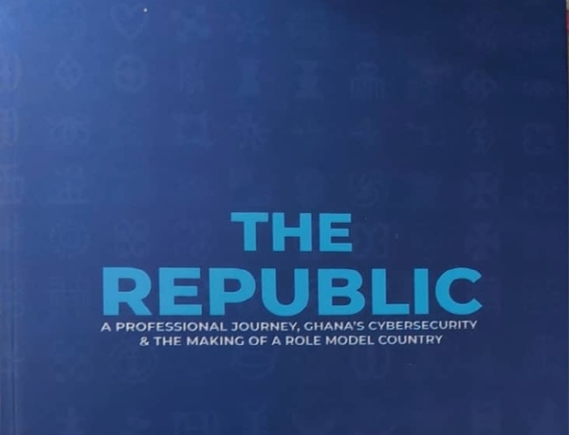
Ghana's name stood tall at the 15th United Nations Congress on Crime Prevention and Criminal Justice, held in Abu Dhabi, United Arab Emirates, from September 26 to October 1, 2026, where a professional autobiography by Dr Albert Antwi-Boasiako, former Director-General of the Cyber Security Authority (CSA), received international recognition.
The book was among a select group of publications featured in the Congress book exhibition, which attracted more than 5,000 participants from about 97 countries. Its inclusion followed a recommendation by members of the Commission on Crime Prevention and Criminal Justice (CCPCJ) community.
The Republic traces Dr Antwi-Boasiako's professional journey and offers a first-hand account of Ghana's cybersecurity development, including the contributions of key actors and the evolution of the institutions, policies and initiatives that have shaped the country's cybersecurity landscape.
Volume
The 338-page hardcover is organised into five parts. It covers close to 15 years of the author's work in cybersecurity in the private and public sectors, in Ghana and beyond, and explores several critical themes and historical events in the country's cybersecurity journey.
Part One: The Origins follows the author's early professional experience abroad, particularly his work with DFLabs, and reflects on his motivation to build something innovative and impactful in Ghana and on the African continent after identifying gaps in the private and public sectors. It also examines the establishment and pioneering work of the e-Crime Bureau, the firm that became his route back to Ghana, and unveils the precursor activities and key factors that shaped the early cybersecurity ecosystem.
Its five chapters are: "How My Journey into Cybersecurity Began", "Apprenticeship Abroad: Skills, Mentors, Perspective", "Founding the e-Crime Bureau: Building Capacity in Ghana", "From Forensics to National Readiness: The Bureau's Contribution" and "Foundation Before the Mandate".
On how his journey began, the author writes that he started when he returned to Ghana in 2011 and founded the e-Crime Bureau, a private digital forensics and cybersecurity consultancy that became the gateway to public service. He was unaware that cybersecurity existed as a professional field when he entered the University of Trento in Italy, where he had wanted only to study Philosophy. His encounter with the discipline, he says, was by chance or divine providence.
Part Two: The Formative Phase (chapters six to 11) covers topics including "The Context and Epoch of the Formative Phase", "The Call to Service and Public Sector Lessons Learnt", "The Ministerial Oversight Debate and Ghana's Chosen Path", "The Policy Owner: Persona and Leadership", "Ghana's Cybersecurity: A Path of Inclusivity and Continuity", "Domestic Cooperation: Leadership in a Fragmented Ecosystem" and "Rationalising International Cooperation".
Writing on his motivation to serve and his conflicted reactions, the author says the call was deeply personal and challenging. Having just settled in Ghana after business ventures across the African continent, he was focused on building his consultancy practice when he was invited to lead the institutionalisation and development of Ghana's cybersecurity. He accepted.
Part Three: The Institutionalisation Phase (chapters 12 to 18) includes "Ghana's Cybersecurity Act, 2020: Origin, Key Actors and Impact", "The Birth of the CSA and the Authority's Founding Identity", "Workforce Development and Retention: Our Approach", "Regulatory Directives and Industry's Contributions", "The Republic's Global Role Model Status" and "ANCA and the Republic's Continental Leadership".
On the impact of the Cybersecurity Act, 2020, the author says that within two years of its passage, the Critical Information Infrastructure (CII) provisions were implemented, affecting about 189 institutions across the public and private sectors.
Part Four: The Transition Phase (chapters 19 to 22) includes "The Context and Epoch of the Transition Phase", "Government Commitments: Gaps and Lessons Learnt", "The Uncertainties of Political Transitions", "The Exit Strategy" and "My Personality, My Shortcomings and the Making of a Man".
In "Government Commitments: Gaps and Lessons Learnt", the author states that despite Ghana's remarkable progress in cybersecurity, particularly in legislation and industry development, stronger action in one crucial area could have further consolidated these gains. The foundation, though established, is weaker than it ought to be, and specific vital steps are still needed to strengthen it.
Part Five, the last, includes "Prevailing Sentiments and Disbelief", "Public Sector Leadership: A Privileged Opportunity to Serve", "A Note to My Successors and Public Sector Leaders" and "The Republic's Cybersecurity Utopia".
The book closes with a profile of the author, his educational background and his professional career path.
The author believes government must foster nationwide cybersecurity awareness, backed by high-level political commitment, to drive citizen awareness and engagement. According to him, this is not merely policy implementation but a fundamental re-imagining of government's role in the digital age: as guardian, enabler and catalyst for cybersecurity growth and excellence.
