
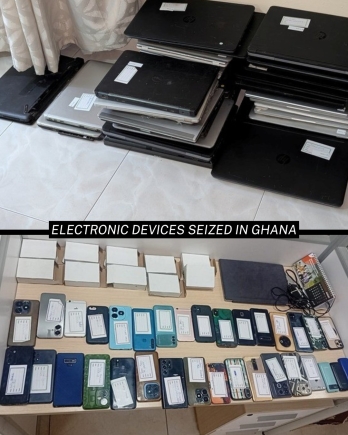
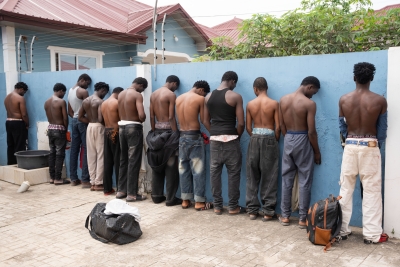
The United States Department of Justice has disclosed that 19 individuals were arrested and 303 electronic devices seized during a cybercrime enforcement operation in Sasaabi, a suburb of Accra, as part of a coordinated international effort targeting online scam networks operating in West Africa.
In a press release issued on Tuesday, October 13, 2026, the department said the operation, dubbed "Joint Disruption Week," produced dozens of arrests, the removal of more than 3.7 million fraudulent social media accounts and the rescue of more than 100 trafficking victims.
"The millions of bogus social media accounts taken down and dozens of arrests that took place as part of Joint Disruption Week are just the beginning," said Assistant Attorney General A. Tysen Duva of the Justice Department's Criminal Division. "I am especially grateful to the courageous law enforcement officers in Ghana and Nigeria who put themselves in harm's way to seize evidence and arrest the criminals who prey on innocent people."
According to the department, authorities in Ghana identified 117 victims of human trafficking who are now pending repatriation to Nigeria. An additional 89 victims of the scam were identified with an approximate loss of US$8.3 million. During the last week of September alone, authorities made scores of arrests at six locations, identified 34 trafficking victims and seized 129 electronic devices.
The Ghana operation was led by the Cyber Security Authority, the Ghana Police Service Criminal Investigation Department and the National Security Service, with support from the United Kingdom's National Crime Agency, the FBI and Nigeria's Economic and Financial Crimes Commission.
In Nigeria, authorities arrested nine individuals and seized 53 electronic devices during the enforcement period.
International cooperation
The operation included members of the US Department of Justice, the Scam Center Strike Force under the US Attorney's Office for the District of Columbia, the FBI, the US Secret Service, the US Department of the Treasury, Homeland Security Investigations, the Homeland Security Task Force, the UK's National Crime Agency, the Nigerian Joint Case Team on Cybercrimes, the Nigeria Police Force National Cybercrime Center and the Cyber Security Authority.
Additional participants included law enforcement agencies from Australia, Canada, Ghana, India, New Zealand and Nigeria, along with INTERPOL and additional cybercrime units. Several technology companies, including Meta, Adobe, Binance, Coinbase, Google, Microsoft, OpenAI, Starlink and TRM Labs, collaborated with international law enforcement and voluntarily took action on their own networks to disrupt scammers.
The department said the companies removed more than 3.7 million accounts, pages and groups targeting people in the United States, the United Kingdom and beyond, and shared leads on over 30 suspected scam centres with law enforcement, resulting in dozens of arrests, the rescue of trafficking victims and cryptocurrency seizures. In total, over US$11 million in potentially freezable funds were identified by private sector partners.
FBI Director Kash Patel said the operation had resulted in the arrest of dozens of criminal actors, the seizure of hundreds of devices and the identification of at least US$11 million in potentially freezable funds. "We are demolishing Scam Centers across the globe and crushing a criminal industry preying on American citizens," he said.
Nick Sharp, Deputy Director of Fraud at the National Crime Agency, said fraud is a global problem that requires partnership across international boundaries. "Collaborating in this way sends a clear signal to criminals that the combined capabilities of law enforcement and industry means that we will relentlessly pursue them and the infrastructure they rely on no matter where they operate," he said.
Scale of the scam industry
According to the FBI's Internet Crime Complaint Center, investment scams were reported 72,984 times in 2025, with cryptocurrency investment fraud comprising 72 per cent of that category. Reported losses from these scams rose from US$3.96 billion in 2023 to US$5.8 billion in 2024. Reported losses for investment scams with a cryptocurrency nexus rose 24 per cent in 2025 to over US$7.2 billion. According to one government report, a conservative estimate of the annual value of funds stolen by scam syndicates worldwide approached US$64 billion as of the end of 2023.
The department said criminal scam centres operating in West Africa mirror those uncovered in Southeast Asia, describing them as highly organised enterprises that recruit workers, train them in social engineering and deploy multi-platform fraud campaigns targeting global victims. The disrupted schemes included law enforcement impersonation scams, digital "arrest" extortion schemes, cryptocurrency investment fraud, also known as pig butchering, and other online fraud operations targeting global victims.
120 trafficked Nigerians repatriated
Meanwhile, the Minister for Communication, Digital Technology and Innovations, Mr Samuel Nartey George, has expressed gratitude to the Ghana Air Force and the Ministry of Defence for facilitating the repatriation of 120 Nigerian nationals who were arrested during the operation.
In a post on X on Tuesday, October 13, 2026, Mr George said the sting operation, led by the Cyber Security Authority in conjunction with other intelligence and security agencies locally and in the United Kingdom, Nigeria and the United States, led to the rescue of the 120 persons who had been trafficked to Ghana and forced to work in cybercrime setups.
"The operation seized 136 mobile phones, 130 laptops, internet connection devices, four motor vehicles, one of which was stolen from Canada, and other digital equipment. The search team also recovered high-value items, including jewellery and ten Nigerian passports," he said.
The minister said the team is processing eight other persons for prosecution, adding that Ghana under President John Dramani Mahama will remain an unfavourable destination for cyber criminals.
