
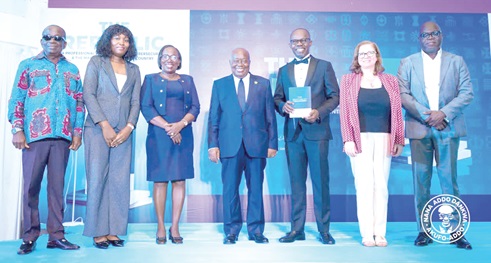
Ghana’s cybersecurity status celebrated in new book
A book which captures the nation’s remarkable rise from having a modest digital security architecture to a world-class tier one cybersecurity nation at par with developed countries has been launched in Accra.
Titled, “The Republic: A Professional Journey, Ghana’s Cybersecurity and the Making of a Role Model Country,” it was authored by Dr Albert Antwi-Boasiako, the founding Director-General of the Cyber Security Authority (CSA) and a central figure in the nation’s digital security transformation.
The over 300-page literature also provides the first comprehensive account of the country’s cybersecurity evolution, tracing the institutional reforms, leadership decisions, policy milestones and personal sacrifices that enabled the country to progress from a modest digital ecosystem into a globally recognised cybersecurity leader.
Blending memoir, policy documentation and strategic insight, the five-part book recounts Dr Antwi-Boasiako’s journey from studying philosophy in Italy to working in digital forensics in the United Kingdom, and later returning home to establish e-Crime Bureau, West Africa’s first private digital forensics laboratory.
Political commitment
Former President Nana Addo Dankwa Akufo-Addo described the book as a blueprint for future progress as it captured the country’s national cybersecurity journey, built across successive administrations through policy continuity, institutional strengthening and strategic collaboration.
“Ghana's rise in cybersecurity did not begin with any single administration. It was built on the foundations laid by successful governments, whose vision and initiatives created the framework upon which further progress could be made,” he said, emphasising the role of political commitment, technical leadership, and resilience in achieving these gains.
Dr Antwi-Boasiako emphasised that the book distilled his lessons from public service, rooted in intellectual curiosity, philosophy and collective leadership.
He reflected on how the nation’s cybersecurity progress emerged from institutional alignment, strategic planning, and courageous leadership decisions rather than individual effort.
He stressed the need for empowered institutions, integration across agencies, and strong policy foundations to sustain national digital resilience.
He urged policymakers to pass the pending cybersecurity bill and expressed hope that the work will inspire future leaders.
Challenging stereotypes
The reviewer, a Justice of the Court of Appeal, Afia Serwah Asare-Botwe, described the book as groundbreaking because it was the first comprehensive, insider-level documentation of how a developing African nation deliberately built a world-class cybersecurity ecosystem.
She said it dismantled the long-held stereotype that African technology systems are inherently behind, showing instead that the country achieved reforms, institutional maturity, global partnerships and a Tier-1 international ranking through homegrown expertise.
“This book is a very veritable who is who and who did what to get our dear nation this far over the years in our cybersecurity journey and has nothing to do with politics.
The book is intended for us to learn lessons for the good and the bad, and for us to make our nation the best it can be. It is a model of African innovation and development,” she said.
The Italian Ambassador to Ghana, Laura Ranalli, said the author’s time in Italy brought about a deeper understanding between both countries, showing the countries' hardworking families and dispelling prevailing stereotypes.
