
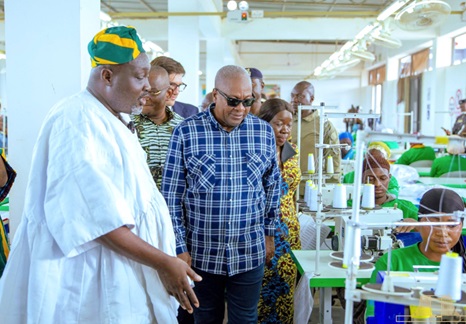
President John Dramani Mahama has commissioned the Northshore Apparel Hub at Savelugu in the Northern Region, a major garment manufacturing facility expected to boost local production, create jobs and increase the export of apparel.
The facility, which is wholly Ghanaian-owned, is the country’s first regenerative, zero-waste apparel manufacturing hub.
The factory has already created more than 2,300 direct jobs.
It is designed to operate on a 24-hour basis, with workers operating in shifts to maximise production and create more employment opportunities for young people, while contributing to positioning the country as a competitive player in the global garment market.
The facility, funded by the Ghana Export-Import Bank (GEXIM), German Development Bank (KfW) and the Agricultural Development Bank (ADB), produces products intended for both the local and international markets.
It also incorporates sustainable production practices aimed at reducing waste and promoting environmentally responsible manufacturing.
Major investment
President Mahama, inaugurating the facility last Friday, said the factory was an example of what the 24-Hour Economy initiative was intended to achieve, particularly in the areas of job creation and accelerated exports.
He pointed out that Northshore Industrial Hub had the potential to become a major employment centre for Northern Ghana and, when operating at full strength, could provide jobs for at least 30,000 young people.
Beyond that, President Mahama expressed the optimism that it would contribute to reducing the rampant exodus of young people from the north to the south in search of greener pastures.
Local manufacturing
The President announced plans to amend the public procurement framework to create a market for locally manufactured products.
He said the government would work with the Ghana Standards Authority to identify licensed Ghanaian products that public institutions, including government agencies, schools and hospitals, would be required to procure from.
The move, he said, would help promote local manufacturing, create jobs and reduce the country’s dependence on imported products.
President Mahama said the Northern Region had several comparative advantages that should attract investors, including peace and stability, security, abundant litigation-free land, reliable electricity, affordable labour and improving road and air transport.
“I remember in secondary school, I did economics, and I remember what they call the ‘factors of production’ that I believe should attract investors here, and I'm sure many will follow in the footsteps of Northshore,” he stated.
Rural-urban migration
In his remarks, the Chief Executive Officer (CEO) of Northshore Apparel Hub, Alhaji Nurideen Mohammed, said the idea to establish the factory in the area was born out of his desire to help address rural-urban migration by creating employment opportunities for young people.
He said the factory would create jobs for the teeming youth in the area and demonstrate that establishing a major manufacturing facility outside the country’s traditional industrial centres should not be a disadvantage.
Alhaji Mohammed indicated that the location of the factory would not pose a challenge to exporting its products to foreign markets, citing the availability of labour and the company’s proximity to neighbouring countries as some of its advantages.
He said the company had so far trained and deployed about 2,300 workers, including 40 with hearing impairment, as part of its commitment to inclusive employment.
Alhaji Mohammed announced that the company’s first export shipment was expected to take place in October.
He charged the workers to take ownership of the factory, work hard and contribute to making the facility a successful model of local manufacturing.
For his part, the CEO of GEXIM, Sylvester Mensah, said the bank signed a Memorandum of Understanding (MoU) with the company to establish the factory as part of efforts to promote industrialisation.
The Minister of Trade, Agribusiness and Industry, Elizabeth Ofosu-Adjare, said industrialisation was critical to transforming the Ghanaian economy, creating decent jobs and reducing the country’s dependence on imported goods.
She reiterated the government’s commitment to continue to support investments that added value to local resources, created employment and strengthened productive capacity.
Land allocation
The Paramount Chief of the Savelugu Traditional Area, Yoo Naa Andani Yakubu Abdulai, who made 50 acres of land available to the company for the establishment of the facility, said the investment would help empower young people and reduce rural-urban migration in the area.
He expressed his continued support for the company to ensure its effective operation and called for improved infrastructure to support businesses in the area.
He also appealed to the government to prioritise the construction of the Tamale-Bolgatanga highway to help reduce road crashes.
Writer’s email:
