
TUC condemns withdrawal of subsidies
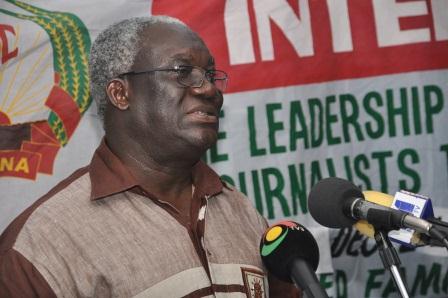 The Trades Union Congress (TUC) has condemned the withdrawal of fuel
subsidies, saying the total withdrawal leads to fuel price hikes and the
attendant ripple effect on the economy.
The Trades Union Congress (TUC) has condemned the withdrawal of fuel
subsidies, saying the total withdrawal leads to fuel price hikes and the
attendant ripple effect on the economy.
It said the TUC was not against increases in the prices of petroleum
products, saying, "What we have been protesting against is the total
removal of subsidies which leads to hikes in fuel prices, with ripple
effects throughout the economy."
This was contained in the TUC's proposals to the government on the 2013
Budget Statement and Economic Policy which was released at the time of
the withdrawal of some subsidies on petroleum products.
The Secretary General of the TUC, Mr.
Kofi Asamoah, told the Daily Graphic that the submissions in the
proposal, though coincidental to the fuel price hikes, were the general
position of the labour union.
However, he noted that the specific increases announced on Saturday,
February 16, 2013 would be discussed in the course of the week.
The TUC noted in the proposals that subsidies were an important tool for
curbing the spillover effects petroleum prices had on a wide range of
goods and services, saying subsidies were used by all governments,
including the current one, to mitigate the negative effects of petroleum
price hikes on the vast majority of Ghanaians who earned very low
incomes or had no incomes at all.
It therefore, urged the government to take into account the needs of the millions of Ghanaians living in poverty.
"We would like to serve notice that the magnitude of fuel price
adjustments will inform our demands for pay increase for the working
people of Ghana.
We need genuine consultations on fuel pricing in Ghana," it said.
The proposals to the government, titled, "It is Time for Genuine Social
Dialogue on Economic Policy in Ghana", while commending the government
for inviting suggestions in the preparation of the budget and
incorporating some, noted the absence of no genuine dialogue between the
government and stakeholders, including unions and employers, on
economic policy.
The TUC said the distinctive nature of the country's economic policy had
not changed in the past three decades, despite resistance to some of
them by trade unions and other civil society organisations.
"For example, governments, over the years, have continued to implement
inflation-targeting as a core macroeconomic policy in the name of
stability.
We have, on various occasions, criticised the inflation-targeting
policy because that policy framework treats job creation as a residual
outcome of macroeconomic policy," it said.
The TUC said it was of the view that "the number one policy challenge
has to do with employment creation.
That is why in all our submissions we propose to government to
genuinely involve the key social partners in employment policy-making
and implementation".
The proposals focused on employment, as in previous submissions, but
also covered other key economic policy areas with direct and indirect
impact on employment creation, such as economic policy, support for the
private sector, trade policy, natural resource management and taxation,
as well as public sector pay.
On economic policy, the TUC said it did not "believe that structural
transformation of our economy can be achieved when government's economic
policy is stuck perpetually in a state of the so-called 'Stabilisation
and Fiscal Consolidation'".
It suggested that the inflation-targeting framework should be abandoned
for "reasonably low and stable inflation" that was presently needed in
the country's economic situation and not necessarily single digit
inflation.
On the private sector, the TUC asked the government to reappraise its role in the private
sector development initiative, suggesting further that the government
build a strong private sector necessary for long-term growth and
employment, while taking charge of the domestic private sector.
It mentioned the exorbitant interest rates being charged by the banks as
another challenge and again urged the government to intervene directly
but strategically to ensure that the banks did not hold the rest of the
country to ransom.
On trade policy, the TUC asked the government to use safeguards to
protect jobs in Ghana, as the international trading system, as
constraining as it might appear, had enough safeguards for countries
like Ghana to shield its fledgling industries from unsustainable
competition.
It asked the government to be bold in its management of natural resources and not buckle under pressure from mining companies.
On public sector pay, the TUC took strong exception to comments by
government officials characterizing public sector pay as windfall for
undeserving public sector workers.
"The way public officials portray public sector pay in the media gives
the impression that the state does not derive any service from the
public service and that payment to them is an unnecessary drain on the
national purse.
We believe that this is a deliberate effort on the part of the
government to whip up public sentiments against public sector workers,"
it noted.
It pledged the TUC's support for the ongoing public sector pay reform
agenda, saying it would work to ensure that workers received their fair
share of national income.
Story by Caroline Boateng
Writer's email:
