
The petitions to remove OSP and EC officials
The country is bracing itself for the possibility of another Article 146 process.
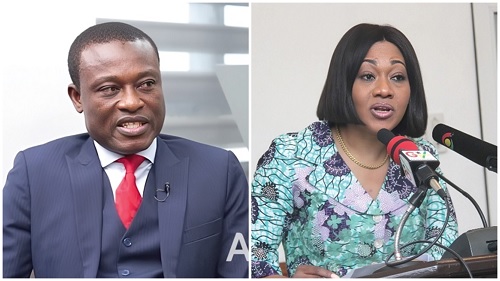
This time it involves petitions to remove the Special Prosecutor (SP), and officials of the Electoral Commission (EC Chair and two deputies).
The news report provides no details of what is contained in the petitions except to say the President, to whom they were submitted, has forwarded them to the Chief Justice.
This conforms with the rules of procedure prescribed in the constitution in the case of the EC officials and Section 15 of the Office of the Special Prosecutor Act, 2017 (Act 959) in the case of the Special Prosecutor.
The country just witnessed an Article 146 process, which resulted in the removal of a Chief Justice.
The partisan and deeply polarising response to the process and its outcome remains with us.
In fact, it was very evident during the vetting of the current Chief Justice that it may take a while before there is partisan reconciliation, if ever, about the removal.
The prospect of another Article 146 process, and the possibility of a partisan and deeply polarising response, must concern us all.
There are two issues we must confront.
First, protecting independent constitutional bodies while holding them accountable.
Second, the political precedents we set because of electoral turnover.
How we answer these has consequences for our democracy.
Independent Constitutional Bodies
Independent constitutional bodies play a vital role in democracies.
They are designed to be fair and impartial arbiters, especially on matters that result in disputes.
For example, when there is concern about how the executive or legislature is exercising a given constitutional power, it becomes the responsibility of the judiciary through judicial review to provide clarity on whether such exercise of power is permissible or not under the constitution.
Alternatively, take the case of the EC.
This is an institution set up to manage and oversee one of the critical activities of our democracy – elections.
Their role is akin to that of a referee in a football game who must apply the rules in a fair and impartial manner so as not to give undue advantage to any of the contestants in an election.
What is key to these bodies is the fact that their independence enables them to carry out their duties without fear or favour to anyone.
In addition, even though persons who carry out the work (Supreme Court Justice, EC Chair, SP, etc.) are politically appointed by an elected president, the expectation is that they will not be subjected to political control.
These petitions, however, create a dilemma for our democracy. Independent does not mean unaccountable and that is why the constitution makes provisions for how (process) and when (basis) persons holding office in independent constitutional bodies can be held accountable.
How do we balance the need for accountability without undermining the independence of these institutions?
We cannot ignore the need to carefully balance these two imperatives.
The political precedents
During the Article 146 proceedings that led to the removal of the former Chief Justice, whenever some partisans of the main opposition party, the New Patriotic Party (NPP) raised concerns, some partisans of the ruling party the National Democratic Congress (NDC), reminded them of the precedent set with the removal of the former Chair of the EC and her two deputies.
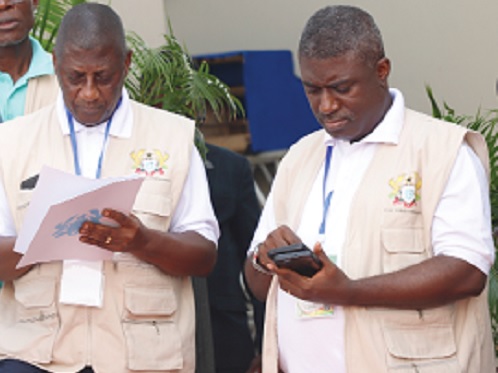
Samuel Tettey (left), Deputy EC Chairman, Operations, and Dr Bossman Eric Asare, Deputy EC Chairman, Corporate Services
The unintended consequence of this partisan framing of the proceedings conveyed a message of “precedent set must be followed” without consideration of the potential merits of the petitions.
This is also worrying because it overlooks the constitutional imperative to hold these officers accountable through a process that, though imperfect, has inbuilt checks to ensure that it is not deployed in politically mischievous ways.
More importantly, if “precedent set must be followed”, does it mean that the guiding political principle and practice now is that every turnover election will result in an Article 146 proceeding aimed at removing independent constitutional officers from office? I hope not.
Points for reflection
I conclude with two points for reflection.
First, we must ask ourselves why there is increasing and deepening political suspicion about the EC and its role in our elections.
In the lead-up to the 2016 election, there were several narratives suggesting the former EC Chair was picked to help the NDC win the election.
In 2020 and 2024, the same suspicions swelled around the current EC Chair and the NPP.
Second, the Office of the Special Prosecutor was created because there was a prevailing narrative that the Attorney-General lacked the independence to prosecute corruption cases in a government they were a part of.
Lately, there are voices from both sides of the political aisle, calling for the abolition of the office.
If this office is not the answer to independently fighting corruption in government, then what is our alternative?
Interesting and challenging times for our democracy.
The writer is the Project Director, Democracy Project.
