


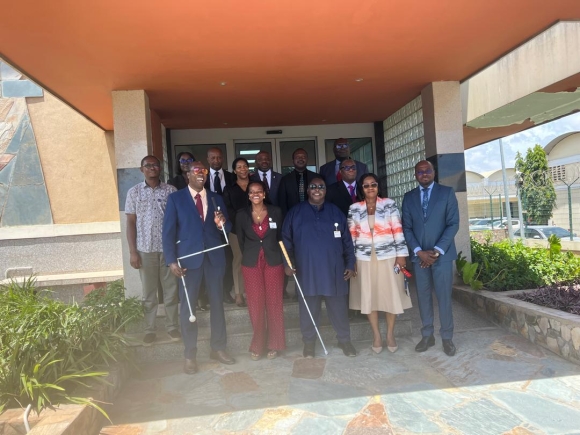
The Bank of Ghana has reaffirmed its commitment to making the country's currency accessible, secure and convenient for all users, including persons with disabilities, as it prepares to unveil the Heritage Series banknotes on November 12.
At a stakeholder engagement at the Currency Management Department in Spintex, Accra, the Director of Currency Management, Mr Dominic Owusu, said cash continued to play an important role in the daily lives of Ghanaians and must be usable by every segment of society.
"The Bank of Ghana recognises the important role that cash continues to play... and remains committed to ensuring that the cedi is accessible, secure, durable and convenient to use by all segments of society, including persons with disability," he said.
Mr Owusu recalled previous engagements with the disability community, including a meeting in 2012, and said the Bank had taken the needs of persons with disability into account in designing the Heritage Series. He explained that the new notes maintain different sizes for different denominations, a feature that helps the visually impaired to distinguish them, and have enhanced tactile marks to improve touch identification.
"In the new series, you will realise that these tactile marks have been well enhanced to improve your tactility and the way of sensing," he said. He added that the Bank was exploring digital solutions, including a mobile application that can scan a banknote and announce its denomination.
Mr Owusu, however, said suggestions for uniquely shaped notes, such as triangular or circular corners, were not technologically feasible at the moment. He said such features could be considered in future as technology, including artificial intelligence, advances.
He clarified that November 12 would be the unveiling of the Heritage Series and not the date for issuing the notes into circulation. He said the Bank would invite the disability groups again before actual issuance to test the notes and provide feedback.
Calls for continuous education
The Deputy Executive Director of the Ghana Federation of Disability Organisations, Mr Moses Fordjour, commended the Bank for the engagement and called for continuous public education, especially for persons with disability in deprived communities. He appealed for a specialised rollout of the education programme so that no one would be left behind.
Mr Alexander Bankole Williams, Head of the Assistive Technology Unit at the University of Ghana and a member of the Ghana Blind Union, gave a candid assessment of previous currency features. He said although efforts had been made to differentiate coins and notes, practical challenges remained.
"To determine a note from the size, you always needed all the bills on you to size them up... especially when the bills become old," he said. He noted that tactile embossments on old notes often wear out, reducing their usefulness.
Mr Williams and his colleagues demonstrated a third-party mobile application, "Cash Reader," which identifies banknote denominations audibly. They suggested that the Bank could adopt a similar tool or introduce a low-tech "Currency Guide," a physical template with cutouts matching the sizes of different denominations, to assist those without smartphones.
"If my phone has gone off in the middle of a truck ride, the mate cannot cheat me because I have my currency guide with me," Mr Williams illustrated.
The Executive Director of the Ghana Blind Union, Dr Peter Obeng Asamoah, said that while discussions were useful, tangible experience was necessary for accurate feedback. "We need to hold these notes and experience them before we can give you feedback," he stated.
Bank pledges sustained collaboration
In response, Mr Owusu assured the delegation that their input was being taken seriously. He said the Bank was working on a robust authentication application that would go beyond simple identification to verify the authenticity of notes.
"We are thinking about you... We want to make sure that in terms of currency accessibility, Ghana becomes the last one [to have issues]," he assured.
The engagement ended with a consensus on sustained collaboration. The Bank of Ghana pledged to invite the Federation for another session after the official unveiling on November 12 to test the notes firsthand before they are released into general circulation.