
The Electoral Commission (EC) is the most important institution in our democracy.
Parliament makes laws, the Executive implements them and the Judiciary interprets them.
But it is the Electoral Commission that decides who gets to occupy the seat of power in the first place.
When the EC fails, democracy fails.
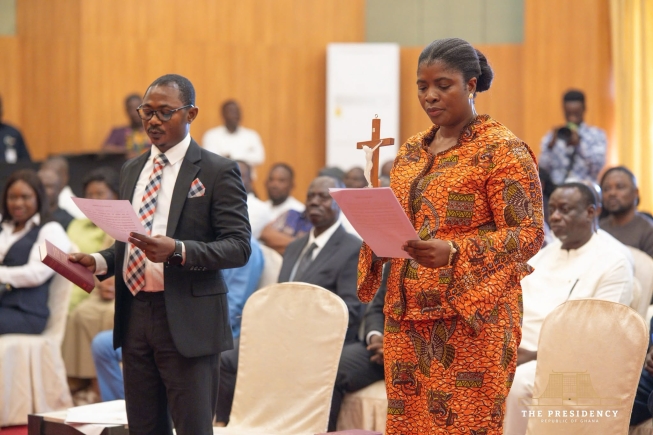
That is why the swearing-in of Dr Joseph Kwaku Asamoah and Ms Emilia Afi Agbenyo as Deputy Chairpersons of the Electoral Commission yesterday must mark a turning point.
Not just a change of personnel, but a renewal of purpose.
The EC has a clear constitutional mandate under Article 45 of the 1992 Constitution: to compile the register of voters and revise it, to demarcate electoral boundaries, to conduct and supervise all public elections and referenda, to educate the people on the electoral process, and to make regulations for its functions.
On paper, it is simple. In practice, it is enormously complex and politically sensitive. Today, that mandate faces three immediate tests.
The first test is now: the district-level elections.
These elections are often treated as low-profile, but they are the foundation of local democracy.
Assembly members and unit committee members are the closest to the people.
Yet, turnout has been historically low, often below 40 per cent because citizens feel disconnected, uninformed, or unconvinced that their vote matters at that level. The EC must deliver a well-organised, well-publicised district assembly election that reverses voter apathy.
The second test is close: the constitutional review referendum.
The country is engaged in a national conversation about reviewing aspects of the 1992 Constitution.
If the review process recommends a referendum — whether on entrenched clauses, the election of Metropolitan, Municipal and District Chief Executives, or other reforms — the EC will be called upon to conduct it.
A referendum is not like a general election.
It requires clarity of question, neutrality of explanation, and absolute public trust that the process will not be manipulated to achieve a pre-determined outcome.
The new deputies must help the Commission prepare now, not when the law is passed.
The third test is beyond: Election 2028.
It may sound far, but in electoral management, 2028 is already here.
Credible elections require sustained preparation, as President Mahama rightly said.
The voters' register must be credible and auditable.
Electoral officers must be recruited, trained and retrained.
Logistics and technology — biometric verification devices, results transmission systems, storage of ballot paper — must be tested and secured long before the campaign heats up.
It reaffirms the independence of the EC.
But independence is not given by the President; it must be lived by the Commission itself.
In recent election cycles, the EC has been bedevilled with perceptions.
Some political parties have accused it of bias.
Civil society has questioned its procurement process.
Citizens have questioned its communication style, which has sometimes appeared combative rather than consultative.
The result is a steady erosion of trust, which is more dangerous than any logistical failure.
When people do not trust the EC, they do not trust the outcome, even before voting begins.
The EC's mandate is not just to count votes, but to ensure that all eligible citizens can vote with dignity.
The Commission must map polling stations for accessibility, provide adequate voter education for women and young people, and ensure that no Ghanaian is disenfranchised because of geography, disability or poverty.
Above all, the EC must re-embrace stakeholder engagement.
The Inter-Party Advisory Committee (IPAC) must not be a talk shop or a battleground, but a genuine forum for consensus-building.
Civil society and observer groups must be engaged early.
Transparency is not a favour the EC does for political parties; it is the price it must pay for legitimacy.
Ghana has conducted eight successful general elections under the Fourth Republic.
We have become a model in Africa.
But that model is not self-sustaining.
It depends on an EC that is professional, impartial, transparent and courageous enough to do what is right even when it is inconvenient, as President Mahama urged.
To Dr Asamoah and Ms Agbenyo, we say: you have been given a rare opportunity to serve your country at a critical time.
Your success will be measured by how much public confidence you build in the ballot.
The EC must deliver now — in the district elections and the referendum preparations — and beyond, in 2028 and the elections after that.
Ghanaians are watching.
The credibility of our democracy is in your hands.
