
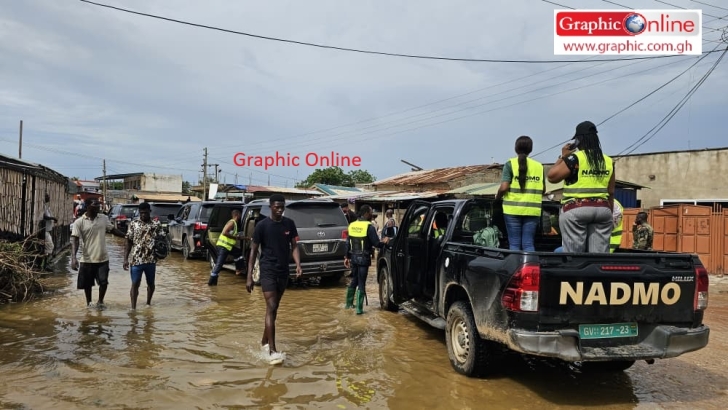
Every rainy season in Accra follows a painfully familiar script.
Dark clouds gather, heavy rains fall for a few hours, roads disappear under water, homes and shops are submerged, traffic grinds to a halt, and lives are lost. Politicians issue condolences, city authorities promise action, and then, somehow, we move on, until the next flood.
But Accra’s flooding problem is no longer a natural disaster. It is a man-made crisis fuelled by poor planning, greed, weak enforcement of regulations, and a dangerous disregard for nature and the environment.
Wet lands
For decades, wetlands, water retention areas, and natural drainage systems have been sacrificed in the name of “development.”
Areas that were once buffers against flooding have been filled with sand and concrete to make way for estates, shopping centres, fuel stations, and luxury homes.
In many parts of Accra, buildings now sit directly on watercourses that nature designed to carry excess rainwater safely into the sea.
One of the clearest examples is the Sakumono Ramsar Site.
This internationally recognised wetland was created by nature to absorb floodwaters, support biodiversity, and regulate the local ecosystem.
Yet over the years, encroachment around the Ramsar area has intensified. Sections have been reclaimed, built upon, and degraded with alarming speed.
What should serve as a protective ecological sponge is gradually being suffocated by human activities.
The consequences are now impossible to ignore.
Communities around Spintex, Sakumono, and adjoining areas frequently experience severe flooding after relatively short periods of rainfall.
Similar stories can be told about the
Weija wetlands, the Odaw Basin, and portions of the Densu floodplains, where unchecked construction and poor urban planning have disrupted natural water flow systems.
Flooding
Accra’s flooding is also deeply connected to structural and architectural choices that ignore climate realities.
We have replaced trees with tiles, wetlands with concrete, and green spaces with unchecked urban sprawl.
Water remembers its path. When watercourses are blocked, floodwaters eventually reclaim them — often violently.
Every collapsed wall, submerged vehicle, flooded home, or destroyed market is nature reminding us that no amount of wealth or political influence can permanently override ecological laws.
Compounding the problem is weak governance.
Ghana has no shortage of environmental regulations, building codes, or planning laws.
The challenge is enforcement. Illegal structures continue to emerge along watercourses with little consequence.
Permits are issued recklessly or ignored entirely.
Meanwhile, drains are poorly maintained, waste management systems remain inadequate, and plastic pollution continues to choke watercourses across the capital.
When rain falls, drains clogged with plastic waste become death traps instead of drainage systems.
Climate change is certainly intensifying rainfall patterns, but climate change alone cannot explain why Accra floods so catastrophically.
Cities across the world experience heavy rainfall. What determines the severity of flooding is how cities are planned, governed, and managed.
Accra is flooding because we have systematically destroyed the very ecosystems that once protected us.
The solution must therefore go beyond emergency dredging exercises and political rhetoric after every disaster.
Ghana urgently needs a new urban philosophy, one that places nature at the centre of development rather than treating it as an obstacle to economic growth.
Wetlands and Ramsar sites must be fiercely protected, not casually traded away for short-term profit.
Illegal structures on watercourses should be removed regardless of who owns them.
Urban planning authorities must enforce building regulations without fear or political interference.
Most importantly, we must rethink our relationship with nature.
A city cannot survive by endlessly replacing rivers with roads and wetlands with concrete.
Development that destroys ecological systems is not progress; it is a slow-moving disaster.
Until Accra learns to respect nature again and people change their attitude, the floods will continue to keep pushing back.
The writer is the Project Lead for Africa Centre for Nature-Based Climate Action
