
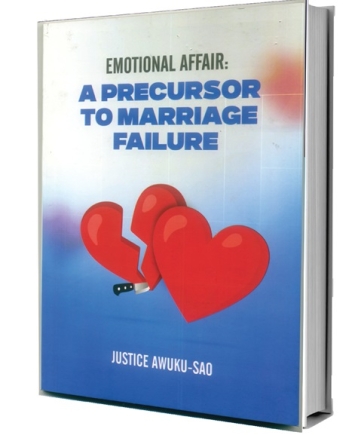
Emotional Affair: A Precursor To Marriage Failure dares to diagnose the silent plague of our modern age.
I state a truth that sits at the intersection of my two worlds. In the corporate sphere, we speak endlessly about risk management. In the spiritual sphere, we warn about the "slippery slope”; “Therefore, let him who thinks he stands take heed lest he fall” 1 Corinthians 10:12 (NKJV).
This book identifies the "emotional affair" as the ultimate risk management failure in the domestic space. It is not the crash that kills; it is the silent erosion of the foundations.
Visual sermon: Picture’s prophetic voice
Before I delve into the doctrinal depth of the text, I commend the Author on a stroke of sheer genius: the use of pictures.
In an age where attention spans are fracturing, this book utilises visual aids not as mere decoration, but as exegesis.
We often forget that the Greatest Teacher used the lilies of the field and the birds of the air as visual aids.
The imagery in this book serves as a prophetic voice, showing the reader the warmth of connection in one frame and the chilling distance of a couple lost in their own digital worlds in another.
This is not just a book to be read; it is an exhibition to be experienced.
Returning to manufacturer’s manual
As a Minister of the gospel of our Lord and Saviour Jesus Christ, I was particularly impressed by the copious references to Biblical literature as the origin of marriage and its standards.
In a world that tries to redraw the lines of morality, this book boldly returns to the Manufacturer's Manual. It rightly posits that marriage is not a human invention, but a Divine institution.
By grounding its arguments in Scripture, the book provides an anchor.
It reminds us that the standards for marriage are not cultural constructs that shift with the winds of political correctness, but eternal truths designed for our flourishing.
Let us turn now to the heart of the matter: the titular subject.
The decision to dedicate a whole chapter to "Emotional Affairs" is not just relevant; it is prophetic.
We have lived through an era where physical infidelity was the obvious villain.
This book drags the subtle assassin out of the shadows.
It exposes the "work spouse," the late- night texter, the confidant who knows our secrets, while our legal partner knows only our schedule.
In the corporate governance world, we are obsessed with the distinction between the "letter of the law" and the "spirit of the law."
An emotional affair is a violation of the spirit of the covenant. The book brilliantly categorises the "Types of Affairs" not to give the reader a morbid curiosity, but to act as a diagnostic tool.
It forces us to ask: Are you having an "in-person affair" with a colleague, or are you trapped in a "cyber affair" with a ghost on a screen? It identifies the "escapist affair" and the "intimacy avoidant affair."
By naming them, the book disarms them.
Feminism, function, changing of guard
A book that seeks to address modern marriage cannot ignore the elephant in the room: the changing roles of women in society, or feminism.
This section is handled with remarkable dexterity.
It acknowledges the God-given equality of worth while navigating the tricky waters of differing roles.
It addresses the tension of the Proverbs 31 woman who manages a household and engages in commerce, balanced against the need for emotional connection.
The book wisely suggests that the rise of the "emotional affair" coincides with the rise of female empowerment in the workplace.
As men and women now collaborate as intellectual equals in high-pressure environments, the boundaries that once existed physically have become blurred emotionally.
The book does not lament this progress; rather, it calls for a new ethic of emotional intelligence to match our professional ambition.
Dos, don’ts: Guardrails
As a Chief Executive Officer, I appreciate standard operating procedures.
As a Reverend Minister, I appreciate the Law.
The section on Dos and Don'ts serves as the guardrails on the mountain pass.
We don't put guardrails there because we want to restrict the driver; we put them there because we value the view and we value the life of the driver.
The "Don'ts" in this book are not killjoys; they are life preservers.
Don't engage in competition among yourselves.
Don't keep secrets. Do say nice things to each other. Be each other’s number one.
It is practical, actionable wisdom.
Guideline: Audit, heart
In Corporate Governance, we cannot manage what we cannot measure.
We conduct annual audits, risk assessments, and board evaluations.
So, how brilliant is the inclusion of a "Marriage Guideline"?
This framework allows a couple to take the temperature of their marriage.
It prescribes some rules for healthy spousal relationships.
This self-regulation moves the discussion from the abstract to the personal.
It turns the reader from a passive observer into an active participant in their own healing.
Sustainability mandate
Finally, we reach the chapter that elevated this book from a marriage manual to a governance document: "Grandchildren; Future/Sustainability or Cradle-to-Cradle Concept."
In the Environmental, Social, and Governance (ESG) framework that drives modern investment, we speak of "intergenerational equity", the idea that we must meet our needs without compromising the ability of our children to meet theirs.
This book applies that principle to the family. It introduces the concept of a "cradle-to-cradle" marriage.
This is not a marriage that simply survives until death; it is a marriage that regenerates. It produces children and grandchildren who know how to love because they saw it modelled.
A marriage that ends in the emotional or physical departure of a parent is not just a personal tragedy; it is a breakdown of social sustainability. It leaves a carbon footprint of pain on the next generation.
This book argues that the greatest inheritance you can leave your grandchildren is not a financial trust fund, but the spiritual and emotional capital of a loving, faithful marriage.
Parallel
To my colleagues in the corporate world, let me leave you with this thought.
We spend millions on board evaluations, yet we spend nothing on marriage retreats.
We demand transparency in financial reporting, yet we tolerate secrecy in our communication at home.
The pillars of good governance are accountability, transparency, fairness, and responsibility.
This book demands accountability for our emotions, transparency with our spouses, fairness in our division of labour at home, and responsibility for the legacy we leave.
Even though this is not a Corporate Governance manual, it teaches corporate governance where it matters most; in the heart of the CEO, because a leader who cannot govern his own heart cannot govern a company.
A leader who breaks a covenant at home will eventually break trust in the boardroom.
Conclusion
In conclusion, Emotional Affair: A Precursor to Marriage Failure is more than a book; it is amovement; diagnostic tool; theological treatise; Governance framework, and love letter to the next generation, all rolled into one.
It exposes the enemy at the gate, it honours the God of the covenant, and it provides a road map home for the wanderer.
It is my distinct honour and privilege to confirm this book well and truly launched.
May this book go forth to heal homes, strengthen families, and build a legacy of love for generations to come.
The reviewer is Chief Executive Officer, Africa Corporate Governance Network (ACGN) and Immediate Past President, Institute of Directors-Ghana (IOD-Gh).
