
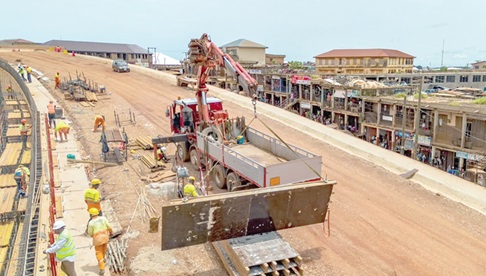
Ghana’s road and infrastructure sector is entering a critical phase of transformation under the government’s “Big Push” agenda. Across the country, roads are being reconstructed, highways expanded, and urban transport systems improved in an effort to accelerate national development.
However, recent events within the sector have exposed a major issue that policymakers can no longer ignore: Ghana must deliberately empower young Ghanaian contractors through targeted government policy if the country truly wants to achieve efficient and timely infrastructure delivery.
For many years, major government contracts have largely been concentrated among a few established construction firms often described as the “giants” of the industry.
The assumption has been that bigger contractors automatically possess greater technical competence and delivery capacity. Yet recent project delays and underperformance on several key road projects have challenged that long-standing belief.
Young contractors
During a recent inspection tour, the Minister of Roads and Highways publicly praised a young Ghanaian contractor for working ahead of schedule and demonstrating a strong commitment to delivery.
Significantly, the minister reportedly stated that the first contractor likely to complete a project under the “Big Push” initiative was not one of the traditional industry heavyweights, but rather an upcoming Ghanaian contractor. He further described many of these younger contractors as being more aggressive and highly committed to project execution.
That statement should shape the future direction of government policy.
The truth is simple: many young Ghanaian contractors are hungry to succeed.
They are ambitious, hands-on and determined to build credible businesses that can compete at the highest level.
Unlike some larger firms that may become overstretched due to multiple project allocations, younger contractors often focus intensely on every project because their reputation and future survival depend directly on performance.
Decentralise
Government policy must, therefore, move beyond simply awarding a few massive contracts to a handful of dominant firms. Instead, there should be deliberate decentralisation of opportunities.
For example, instead of awarding a single 100-kilometre road project to one contractor, the government could strategically divide the project into smaller sections and allocate them to multiple capable young Ghanaian contractors.
A 100-kilometre stretch could be shared among five or more emerging contractors, each handling a defined portion under strict supervision and performance benchmarks.
Such an approach will produce several national benefits.
First, it will accelerate project delivery. Multiple contractors working simultaneously on different sections will naturally speed up completion timelines.
Second, it will reduce the risk associated with the over-concentration of projects in the hands of a few companies.
When one contractor delays an entire project, the economic consequences can be enormous.
Diversifying project allocation spreads risk and improves accountability.
Third, it would build long-term local capacity. Every developed nation intentionally nurtured indigenous construction firms over time.
Ghana cannot build a sustainable infrastructure industry if young local contractors are denied meaningful opportunities to grow.
However, empowerment must be practical and not symbolic.
Mobilisation
One of the biggest challenges confronting young contractors is inadequate mobilisation.
Construction requires significant upfront investment in equipment, fuel, materials, logistics and skilled labour.
Many emerging firms possess the technical ability to execute projects but struggle financially due to delayed payments and limited access to affordable financing.
With adequate mobilisation and prompt payment systems, many young Ghanaian contractors can perform exceptionally well.
In fact, because they are eager to establish themselves, they often demonstrate greater urgency and efficiency than some of the more established firms.
Their competitiveness becomes an advantage for the state.
This is where institutions such as the Ghana Highway Authority, the Department of Urban Roads and the Department of Feeder Roads become critically important.
These agencies must provide stronger technical guidance, supervision and engineering support to help emerging contractors deliver projects that meet national and international standards.
The objective should not simply be to create contractors, but to create competent Ghanaian construction champions capable of executing world-class infrastructure projects.
Big Push agenda
The government’s “Big Push” agenda presents a historic opportunity to redefine Ghana’s construction industry.
Beyond building roads, it can also build a new generation of empowered Ghanaian contractors who are disciplined, technically capable and committed to national development.
The future of Ghana’s infrastructure delivery may not lie solely in the hands of a few established giants.
It may very well depend on the young Ghanaian contractors who are ready to work harder, move faster and prove that with the right support, they can deliver quality projects on time and help transform the nation’s development landscape.
