
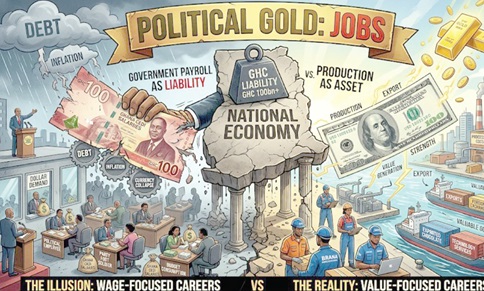
Let’s drop the politeness and say it exactly as it is: in Ghana, “job creation” has become a political scam dressed in national pride.
Every election cycle, politicians stand on stages, beat their chests and promise jobs.
After winning power, they flood the system with employment numbers tens of thousands hired, new agencies formed, payrolls expanded.
The headlines celebrate.
The people clap.
The illusion grows. But the economy bleeds.
Because what Ghana calls “job creation” is, in reality, budget consumption disguised as productivity.
The brutal truth no one wants to say
A job that does not generate value beyond its cost is not an asset it is a liability.
Yet, the majority of jobs created by successive governments are exactly that: liabilities.
They do not produce exportable goods.
They do not attract foreign currency.
They do not expand industrial capacity.
They simply exist to be paid.
nd paid with what? Borrowed money.
Over-taxed businesses.
Or a weakening currency.
This is not economics.
This is survival politics.
The Payroll State: A Nation Eating Itself.
Ghana is slowly transforming into a payroll state where a significant portion of national energy is spent sustaining salaries rather than generating wealth.
Think about it carefully.
If government employs thousands who: Do not produce goods.
Do not deliver globally competitive services.
Do not bring in foreign exchange…then every cedi paid to them must come from somewhere else in the system.
And increasingly, that “somewhere else” is debt.
So you end up with a dangerous cycle: Government creates jobs to reduce pressure. Wage bill increases.
Revenue cannot sustain it. Government borrows.
Debt rises. Currency weakens.
Cost of living explodes Then what happens?
They promise more jobs again
The dollar reality Ghana refuses to face. Let’s stop pretending.
The Ghanaian cedi does not survive on patriotism. It survives on dollars.
And dollars do not come from government offices.
They come from: Exporting goods.
Selling services internationally.
Attracting investment. If a job does not contribute to any of these, then it is not strengthening the economy, it is feeding on it.
You can employ one million people in offices, ministries and agencies.
But if none of them are bringing in foreign exchange, the cedi will still collapse.
Because internally circulating money without external inflow is like breathing without oxygen.
Jobs for the Boys, Not Jobs for the Economy.
Let’s be even more direct
Many of these jobs are not created because the economy needs them.
They are created because politics demands them.
Party footsoldiers must be rewarded. Loyalists must be placed.
Campaign promises must be fulfilled.
So new roles appear. New departments are formed.
Old structures are duplicated.
Not because they are necessary but because they are politically useful.
And the cost?
The entire nation pays for it through: Inflation.
High taxes. Currency depreciation.
Declining purchasing power
This is not governance.
This is organised economic sabotage disguised as leadership.
The 90 per cent Problem: Consumption without production.
Say it boldly: Most government-created jobs in Ghana are consumption jobs.
They consume resources but do not produce proportional value.
They: Increase spending without increasing output.
Expand payroll without expanding exports. Create dependency without creating capacity.
So while employment numbers look good on paper, the economy underneath is hollow.
It is like building a beautiful house on a weak foundation eventually, it will collapse.
Where real jobs come from (And Why Ghana Avoids Them).
Real jobs are not created by announcements.
They are created by production. They come from: Factories.
Farms with processing capacity. Technology hubs serving global markets. Industrial supply chains.
These are not easy jobs to create.
They require: Infrastructure. Stable policy. Long-term thinking.
Discipline. And that is exactly why they are neglected.
Because they do not win elections quickly.
The Manufacturing Failure. Ghana exports raw materials and imports finished goods.
That alone tells you everything.
Building industries
Instead of building industries that: Process cocoa into chocolate.
Convert raw minerals into finished products. Manufacture goods for export…the country remains stuck at the bottom of the value chain.
And then tries to compensate by hiring more people into non-productive roles.
That is not strategy.
That is avoidance.
The Dangerous Illusion of Employment.
Here is the uncomfortable truth: Employment without productivity is just organised poverty.
You can pay salaries, but if those salaries are not backed by real economic output, they lose value over time.
That is why: Prices keep rising.
The currency keeps falling.
And people feel poorer despite being “employed” Because the system is not creating wealth it is redistributing scarcity.
The shift Ghana must make.
Or collapse trying.
If Ghana is serious about survival not even prosperity, just survival then it must redefine job creation completely.
A job must now mean: Contribution to exports.
Participation in industrial production.
Generation of foreign exchange.
Anything else is secondary.
Government must stop being the largest employer and become the largest enabler of production.
That means: Fewer political jobs.
More industrial investment.
Aggressive export strategy. Ruthless efficiency in public spending.
Yes, it will be painful. Yes, it will be unpopular. But the alternative is worse.
Ghana does not have a job problem.
Ghana has a truth problem.
The truth is that most of what is celebrated as job creation is actually economic burden.
The truth is that a country cannot pay salaries it has not earned.
And the truth is this: Until Ghana stops creating jobs for politics and starts creating jobs for production, every “solution” will only deepen the crisis.
This is not harsh.
This is reality.
