
The recent uncertainty surrounding the venue for the 27th Telecel Ghana Music Awards must have come off as a minor kerfuffle, but it has once again exposed a structural challenge Ghana continues to avoid — the absence of fit-for-purpose, large-scale event venues capable of supporting globally competitive productions.
The TGMA venue crisis
Charterhouse Productions, organisers of the TGMA, initially announced the Palms Convention Centre at La Palm Royal Beach Hotel as the venue for the 2026 edition after being informed that the Grand Arena at the Accra International Conference Centre (AICC) would be unavailable due to planned renovations of the AICC.
The Palms Convention Centre, while elegant and functional, is a significantly smaller space and not designed for the scale, broadcast complexity and audience size associated with Ghana’s biggest music awards event.
Following public outcry, sustained industry pressure and reported intervention from headline sponsor Telecel Ghana through sector ministries, Charterhouse later confirmed that approval had been granted for the use of the Grand Arena after all. Crisis averted — but the underlying issue remains unresolved.
A history of outgrowing spaces
The TGMA venue journey itself tells a story.
From the National Theatre, to the AICC auditorium, to the now-decommissioned Dome and finally to the Grand Arena, the awards have consistently outgrown available infrastructure.
That is not a failure of the organisers — it is evidence of growth without corresponding investment in venues.
Ghana today does not have a globally competitive convention or events centre.
That reality should worry any destination that claims ambition in Meetings, Incentives, Conferences and Exhibitions (MICE).
Continental benchmarks: MICE success stories
Across Africa, leading destinations have long understood that MICE success begins with infrastructure.
In South Africa, the Sandton Convention Centre, Cape Town International Convention Centre and Durban ICC are not one-off projects — they are part of a deliberate national strategy.
These venues can host multiple events simultaneously, accommodate tens of thousands of delegates annually, and support complex staging, broadcast and exhibition requirements.
As a result, South Africa consistently attracts global summits, trade shows, concerts and political gatherings.
Rwanda offers an even more instructive example.
Barely a decade ago, Kigali was not considered a major events destination.
Today, the Kigali Convention Centre anchors the country’s business tourism strategy, supported by a national airline, aligned visa policy and government-backed destination marketing.
Rwanda now hosts continental and global conferences with ease — and reaps the economic benefits that come with them.
Morocco has taken a similar route. With world-class venues in Marrakech, Casablanca and Rabat, the country positions itself as a gateway between Africa, Europe and the Middle East.
Others, such as Egypt, Botswana and Ethiopia have also invested heavily in large-capacity convention and exhibition infrastructure, recognising that venues are not optional extras – they are economic tools.
Kenya’s "mega-precinct" ambition
Kenya has convention centres such as the Kenyatta International Convention Centre.
However, in 2023, the Government of Kenya revealed its ambitious intentions to construct a new global standard convention centre in Nairobi.
This strategic move aims to solidify Kenya’s role as a significant player in the MICE industry, while also enhancing its diplomatic and commercial prominence within the East African region.
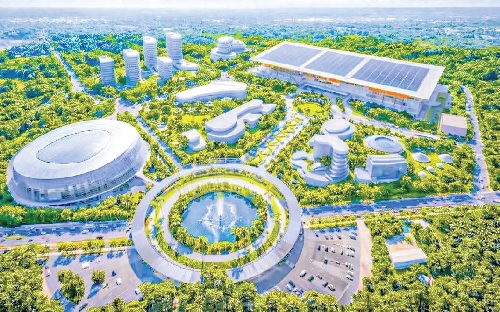
Named Bomas International Convention Centre (BICC), it was planned to be completed for use in 2026. Located at the historic Bomas of Kenya site, this "mega-precinct" has a total precinct area of 323,500m² and it has a state-of-the-art complex with a massive 11,000 delegates and a 5,000-seat main auditorium.
The limitations of Ghana’s current assets
Ghana, by contrast, has relied almost entirely on the AICC complex for decades. While historically significant, the facility is overstretched, ageing and increasingly unfit for the demands of modern events.
The Grand Arena, though impressive by local standards, is still a single large indoor venue serving music awards, political rallies, conferences, exhibitions and religious events alike. That is not sustainable.
The situation is further complicated by the fact that the AICC is not managed primarily as an events asset but as part of a broader government property portfolio.
Decisions around access, renovations and usage often sit outside the creative, tourism and events ecosystem – creating uncertainty for organisers planning major productions years in advance.
The proposed renovation of the National Theatre only heightens concern.
While necessary, it will temporarily remove one of the few mid-sized performance venues available in Accra, affecting theatre productions, concerts and cultural events with capacities of up to 1,500. Once again, organisers will scramble for alternatives – and once again, the conversation will resurface.
Big events are not just about entertainment.
They drive hotel occupancy, airline traffic, transport services, catering, production services and informal sector income.
They create jobs, showcase national identity and strengthen destination branding. In MICE terms, they are economic multipliers.
Yet Ghana continues to speak about building world-class convention centres without moving beyond announcements and concept speeches.
For over a decade, proposals for new convention and exhibition facilities have been floated, re-announced and quietly shelved. Meanwhile, peer destinations move ahead.
This is the conversation that must be had — honestly and urgently.
A warning signal for the future
If Ghana intends to compete seriously in MICE, host global summits, scale up festivals, or even sustainably grow its own flagship events, it must invest in purpose-built venues — plural, not singular.
Venues that can host multiple events at once.
Venues with integrated exhibition halls, breakout rooms, broadcast infrastructure and flexible seating.
Venues that are professionally managed with events as the core business.
The TGMA venue episode is not a failure. It is a warning signal.
The question now is whether Ghana will listen — or wait for the next major event to once again expose the same gap.
In a continent where tourism, culture and business events are increasingly strategic economic drivers, venue infrastructure is no longer a luxury.
It is a statement of intent.
