
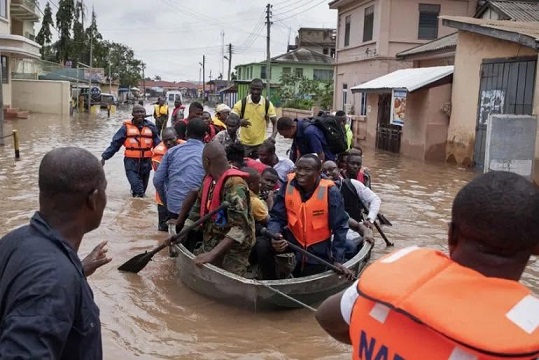
Last week’s flooding in parts of Ghana on Wednesday was not only another seasonal inconvenience. It came on a deeply symbolic day: exactly 11years after the June 3, 2015 flood and fire disaster that claimed more than 150 lives, with many others injured and livelihoods destroyed at Kwame Nkrumah Circle in Accra.
That horrific event should have been the turning point, permanently changing the way Ghana thinks about flooding, urban planning, sanitation, emergency response, preparedness, and public accountability. Yet eleven years later, the country continues to watch homes, roads, markets and lives threatened whenever the clouds gather.
President Mahama, speaking at a Diaspora Town Hall Meeting in London, attributed the flooding in the capital to “just a problem of indiscipline”. He isn’t the only one with perspective. Former President, Nana Addo Dankwa Akufo-Addo, also at a Diaspora Town Hall meeting with the Ghanaian community in Toronto, Canada, in 2022 strongly argued that no amount of state expenditure could solve the perennial flooding in Accra if citizens continued their undisciplined waste habits. The President of Ghana’s Institution of Engineers also shares similar views by attributing the annual canker as a “self-inflicted” issue.
This argument is not entirely wrong. There is indeed a problem with public indiscipline, as citizens continue to dump refuse into gutters, and it is even more appalling when people do so during the rains. Some estate developers and contractors build in unauthorised places such as wetlands. Many households treat drains as waste bins. Businesses in the Accra Central Business District and other business centres, such as Lapaz, block pedestrian paths, drainage channels, and public spaces in pursuit of private convenience. These practices contribute to flooding and must be condemned.
Such an argument or viewpoint, however, tells only half the story. The bigger and more uncomfortable truth is that Ghana’s flooding crisis is also a governance failure, especially at the level of local governance. In the absence of laws and their enforcement, humans behave irrationally. Citizens may act irresponsibly where rules are weak, but that is precisely why government exists: to set standards, enforce laws and make wrongdoing costly. Human beings will do what serves their best interests if they can get away with it. A functioning society isn’t built on the assumption that everyone will be virtuous. If that’s the case, then there wouldn’t be the need to have a “government”. Functioning societies are built on systems that make doing the right thing easy and doing the wrong thing costly.
Citizens may be indisciplined, but indiscipline grows where enforcement is weak, selective or absent. Buildings do not appear overnight on waterways without the knowledge, negligence or complicity of public authorities. Choked drains do not remain choked for years without institutional failure. Unplanned settlements do not expand endlessly without the failure of assemblies, planning departments and political authorities to act.
The Metropolitan, Municipal and District Assemblies must take a large portion of the blame. MMDCEs, physical planning officers, building inspectors, sanitation officers and assembly authorities are not powerless spectators. They are legally and administratively responsible for local development control, sanitation enforcement and protection of public spaces. When people build on waterways, the question should not be: why are citizens indisciplined? The question should also be: who approved the development, who failed to inspect the site, who ignored the warning signs, and what institutional failure allowed such development to continue unchecked?
For years, political leaders and state officials have continued to talk about demolishing structures on waterways, desilting drains, enforcing sanitation by-laws and prosecuting offenders. Yet the pattern remains the same with no proper plan in place to tackle the problem head-on. After every flood, officials from NADMO and other state officials visit affected areas, make strong statements, promise action and wait for the next rainy season. This cycle of reaction without prevention is itself a national indiscipline, but it is an institutional one. It reflects a state that knows the problem but lacks the courage, consistency and discipline to solve it.
The June 3 disaster should have taught us that flooding is not simply a natural event. Rainfall becomes a disaster when it meets poor planning, weak enforcement, blocked drains, unsafe fuel infrastructure, inadequate emergency response and political complacency. The rain may be natural, but the scale of destruction is often man-made. Blaming citizens alone is too convenient and politically evasive. It shifts attention away from the harder questions of governance, accountability and urban management.
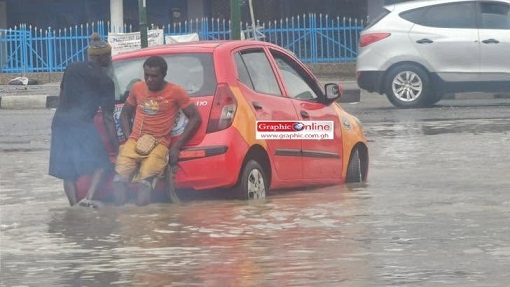
Going forward, Ghana must stop treating floods as annual surprises. The country knows its flood-prone areas. The assemblies know the illegal structures. NADMO knows the vulnerable communities. The Ghana Meteorological Agency provides frequent warnings. Engineers and planners have repeatedly identified drainage weaknesses. What is missing is not knowledge, but it is implementation.
The MMDAs must conduct a serious audit of all structures on waterways, wetlands, floodplains and drainage reserves. This audit must not be a public relations exercise. It must identify when the structures were built, whether permits were granted, who granted them, and whether public officers failed in their duties. Where permits were wrongfully issued, sanctions must not end with demolition. The officials involved must face administrative and legal consequences.
Again, sanitation laws must be enforced consistently. Ghana cannot continue to allow citizens to dump refuse into drains and then spend public money desilting the same drains every year. Assemblies must prosecute offenders, improve waste collection systems and make sanitation enforcement visible. But enforcement must be fair. It should not target only the poor and politically powerless while wealthy developers and influential businesses are protected.
Similarly, building permits must be digitised and made transparent. A public digital platform should show approved developments, zoning classifications, drainage reservations and restricted areas. This would reduce corruption, improve citizen monitoring and make it harder for illegal approvals to hide behind bureaucracy.
It is equally important for drainage infrastructure to be redesigned for today’s urban realities. Accra and other growing cities are no longer the settlements they were decades ago. Population growth, paved surfaces, reduced green spaces and climate variability mean that old drains cannot carry new volumes of stormwater. Ghana needs modern stormwater systems, retention ponds, green spaces, flood buffers and proper maintenance regimes. Engineering still matters. It is not enough to say flooding is not an engineering problem. It is both an engineering and governance problem.
Again, political leaders must stop interfering with enforcement. One reason assemblies fail is that difficult decisions are often blocked by political calculations. When demolitions affect party supporters, influential developers, traditional authorities or business interests, enforcement suddenly becomes complicated. If Ghana is serious about preventing floods, the law must be stronger than political convenience.
In this vein, flood prevention must become a year-round responsibility. Desilting drains in May or June is not planning; it is panic management. Assemblies must maintain drains throughout the year, remove obstructions early, educate communities continuously and prepare emergency shelters before the rains begin.
In conclusion, citizens must also change. Public discipline is not optional. No government can build enough drains if citizens continue to fill them with refuse. No assembly can protect every waterway if developers are determined to bribe their way through the system. Civic responsibility matters. But civic responsibility must be matched by state responsibility.
11 years after June 3, Ghana owes those who lost their lives and had their lives destroyed more than wreaths, speeches and anniversary reflections. The country owes them reform. It owes them enforcement. It owes them a planning system that protects life over profit. It owes them assemblies that work, accountable officials and governments that act before disaster strikes.
The floods will not end because leaders blame the citizens. They will not end because citizens blame politicians. They will end only when Ghana confronts the full chain of failure: personal indiscipline, weak local government, corrupt permitting, poor sanitation enforcement, inadequate drainage and political unwillingness.
Yesterday’s flooding should therefore be treated not as another unfortunate event, but as another warning. The lesson of June 3 is clear: when a nation refuses to plan, enforce and maintain, rain becomes a killer. Ghana must act now, not after the next tragedy.
Writer’s email:
