
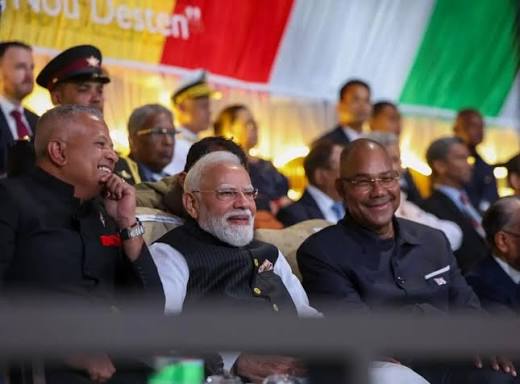
Seychelles on Sunday night marked 50 years of independence with a grand National Day Parade at Stade Linite, capping a year-long Golden Jubilee programme that deliberately placed culture, people and tourism at the centre of national identity.
Thousands of Seychellois filled the national stadium on Mahé for the three-hour spectacle, widely regarded as the climax of celebrations marking independence from British colonial rule on 29 June 1976. The event combined military precision, cultural storytelling and modern production, reflecting how the island nation continues to frame tourism as both an economic pillar and a tool for nation-building.
Held under the national theme “Our People, Our Identity, Our Destiny”, the parade traced Seychelles’ evolution from a small island state to one of Africa’s most recognisable high-value tourism destinations.
To enable citizens to fully participate in the historic milestone, the Office of the President declared Tuesday, 30 June, as an additional public holiday, underscoring the emphasis on collective reflection and national pride.
A global stage in the Indian Ocean
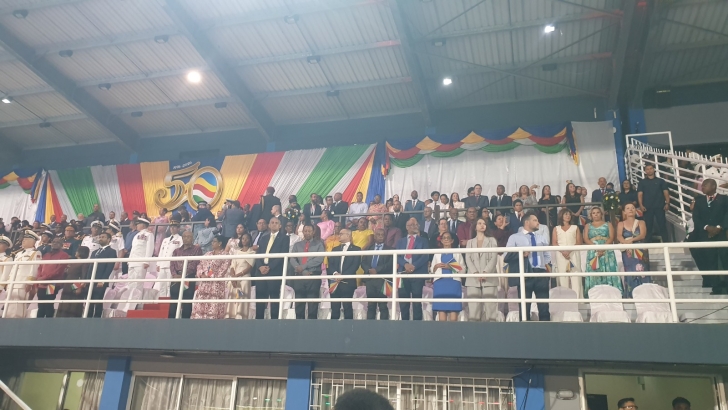
Proceedings opened with the arrival of senior government officials, service commanders and international dignitaries, reinforcing Seychelles’ long-standing diplomatic and tourism partnerships. A combined musical performance by military bands from Seychelles, India, the United Arab Emirates and the United States set an unmistakably international tone.
Among the high-profile guests were the Prime Minister of Mauritius, Dr Navinchandra Ramgoolam, and the Prime Minister of India, Narendra Modi, attending as guest of honour. Also present were Vice-President Sebastien Pillay; Speaker of the National Assembly, Azarel Ernesta; Chief Justice Rony Govinden; former President Danny Faure; Principal Minister Wallace Cosgrow, who chairs the National Celebrations Committee; and Minister of Tourism and Culture Amanda Bernstein, co-chair of the committee.
International representation included Liu Wei, Special Envoy of President Xi Jinping and China’s Minister for Transport; Mahmoud Ali Youssouf, Chairperson of the African Union Commission; and Maxim Oreshkin, Special Envoy of President Vladimir Putin and Deputy Chief of Staff of the Russian Presidential Executive Office. Their presence underscored Seychelles’ soft power and visibility beyond its geographical size.
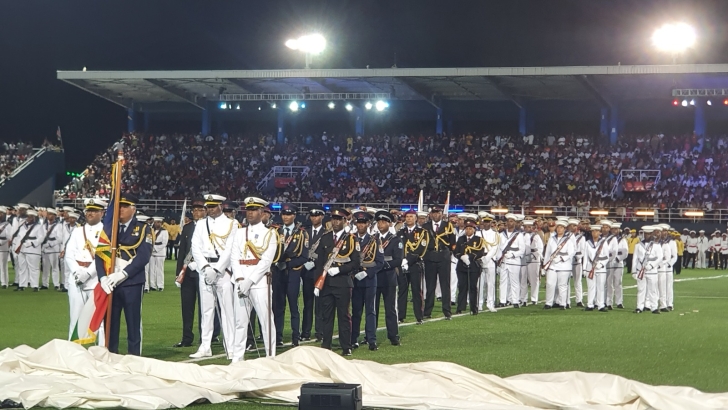
President Dr. Patrick Herminie and First Lady Veronique Herminie were received with a 21-gun salute, followed by the national anthem, formally opening the parade.
Ceremony, symbolism and spectacle
One of the evening’s most dramatic moments came with a parachute display, as local and international officers descended into the stadium, unfurling the Seychellois flag against the twilight sky – a powerful visual symbol of sovereignty and unity.
The military parade featured units from the Seychelles Defence Forces, Coast Guard, Air Force, Police and Prison Services, alongside contingents from China, India, Mauritius and Russia. The participation of foreign platoons highlighted Seychelles’ strategic international relationships, many of which also underpin aviation links, cruise tourism and trade.
Youth groups, including the Seychelles National Youth Council and scouting organisations, closed the marching displays, reinforcing the generational continuity of the independence message.
Culture as tourism capital
In his address, President Herminie reflected on Seychelles’ journey over five decades, linking national development directly to tourism, education and environmental stewardship. Speaking partly in Kreol Seselwa, he recalled the country’s early decision to open itself to the world with the construction of Seychelles International Airport – a move that transformed isolation into opportunity.
He highlighted free education, universal healthcare and social protection as foundations that enabled tourism growth to translate into broad-based development rather than narrow economic gain. The President also reaffirmed Seychelles’ leadership on the Blue Economy and climate advocacy, positioning sustainability not as a constraint but as a competitive tourism advantage.
“Let us go forward together – one people, under one sky, with one unshakeable conviction: that these islands and the people who call them home are, and will always remain, something rare and precious in this world,” he encouraged the Seyshellois.
From parade ground to tourism showcase
As the formal ceremony gave way to performance, Stade Linite transformed into a cultural stage. Traditional dance, historical music and a large-scale multimedia production traced Seychelles’ journey from colonial rule to modern nationhood.
A synchronised drone display lit up the night sky, mapping five decades of independence before culminating in a fireworks finale in the national colours – a modern visual language increasingly associated with destination branding and global events.
Beyond the stadium, celebrations extended into community spaces. Throughout the long weekend, the Local Food Fest at Roche Caiman operated as a live tourism village, celebrating Creole cuisine, music and artisan enterprise, while drawing both residents and visitors into shared cultural experiences.
Tourism confidence into the next chapter
The independence celebrations come as Seychelles prepares to host the 69th meeting of the UN Tourism Regional Commission for Africa from 2 to 4 July, bringing African tourism ministers and industry leaders to Victoria.
“The UN Tourism conference is extremely important for us,” said Minister Bernstein. “We have lessons to share and we are equally willing to learn. Conversations around human resource development, meaningful careers and value-driven impact are critical. Tourism, for us, has always been about values – and ensuring those values translate into real benefits for our communities.”
The seamless execution of the Golden Jubilee programme – from logistics and security to cultural presentation – offers a timely demonstration of Seychelles’ growing confidence as a host destination for high-level international events.
Fifty years after independence, Seychelles is signalling that its tourism future will remain rooted in people, culture and environmental responsibility – values that have helped transform a small island state into one of Africa’s most distinctive and resilient tourism brands.
