

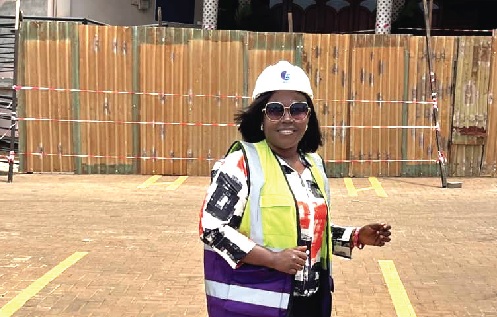
From the Ashaiman Fire Service Station and police stations to schools, market facilities, judges' residences and major government infrastructure, Betty Ansabah Sawyerr Ako has quietly left her imprint on Ghana's built environment.
For nearly two decades, the architect who is the Managing Director and Creative Lead of her own firm, Ebbet Consult Ltd, has moved between the drawing board and construction sites, helping turn concepts into structures that serve thousands of Ghanaians every day.
Her portfolio spans some of the country's notable public projects, including the Court of Appeal Judges' Residential Complex (recognised by former President Nana Addo Dankwa Akufo-Addo), the Accra Regional Coordinating Council building, healthcare facilities, educational infrastructure and several developments for both government and private institutions.
As she reflected on her journey during an interview with The Mirror in Accra last Tuesday, Mrs Betty Ansabah Ako said architecture is more than the design of buildings; it is about creating environments where people can live, thrive, build communities and preserve Ghana's cultural identity.
That philosophy has taken her from aspiring to become a doctor to becoming a respected architect, advocating sustainable design and better urban planning.
In her coffers are also commercial shops for traders, as well as the Ashaiman Slum Upgrading Project and the E-block school project at Community 22 in Tema, all located in Accra.

Since moving into private consultancy, she has contributed to other landmark projects, including the Accra Regional Coordinating Council headquarters, projects at Akumadan University, and developments under the Jospong Group of Companies, including recycling facilities and transfer stations.
“I have also worked on the rehabilitation of Nyaho Medical Centre's Paediatrics Unit, proposals for Korle Bu Children's Hospital, the Sinlab Ghana head office and more than 30 private residential projects across the country,” she added.
From medicine to architecture
As a science student at the Yaa Asantewaa Senior High School in Kumasi, Ashanti Region, medicine seemed like the obvious career path.
However, after discovering that her line of studies involved working with dead bodies, she opted out.
“They told me medical students sometimes have to dissect ‘dead bodies’ and examine them; carry them to me. So, a career seminar introduced me to architecture, a profession that blended science with creativity, and I picked it,” she explained.

This led her to earn a BSc and an M.Arch in Architecture in 2006 and 2008, respectively, from the Kwame Nkrumah University of Science and Technology (KNUST).
For Mrs Ako, architecture school was far from easy. Long lectures during the day were followed by countless nights in design studios, often leaving students with little sleep.
"It was one of the toughest periods of my life. But I had already decided that whatever the profession demanded of me, I was ready."
She was among a handful of women in a class of more than 80 students, a reality that meant she would be competing in a field dominated by men.
Breaking barriers
After graduating, Mrs Ako began her career during her national service at the Ashaiman Municipal Assembly in Accra. At the time, the assembly had no architects and what started as national service turned into a decade-long career in local government.
However, proving herself was not easy. She recalled times she arrived at work only to sit through the day without being assigned a project while her male colleagues handled site inspections and construction supervision.
“I had to remind people that I was there and capable of doing the work. "I wanted to do more than sit in the office, so I requested opportunities to visit construction sites and supervise my own projects,” she noted.
Even then, she continued to face doubts from some male artisans and contractors who struggled to accept instructions from a woman.
When asked how she managed, she noted that she chose professionalism instead of confrontation.
“I will just approach them and tell them we are all here to share ideas. Once they realise you know your work and can explain every decision technically, the respect comes naturally,” she stated.
Misconceptions
One of Mrs Ako's goals is to change how people perceive architecture. She believes many Ghanaians think architects only draw building plans.
“Beauty actually comes last,” she said. “The first things we consider are functionality, sustainability and cost.”
According to her, every line on an architectural drawing has a purpose, from ensuring proper ventilation and lighting to improving safety, comfort and cost efficiency.
“I always advocate sustainable designs that suit Ghana's climate instead of copying foreign styles, as well as sourcing Ghana-made materials."
In addition, she challenged the notion that hiring an architect is expensive. In her view, engaging a qualified architect at the beginning of a project saves clients far more money than trying to fix mistakes later.
Ghana's cities need a plan
For the architect, the nation still underutilises the profession, arguing that architects should play a central role in urban planning, not just individual building design.
“Ideally, every metropolitan, municipal and district assembly should have architects. Architects are visionaries and should work alongside planners and other professionals to ensure our communities are well planned and sustainable,” she noted.
She pointed to issues such as traffic congestion, flooding, disappearing green spaces and poor land use planning as evidence of what happens when communities develop without proper planning.
Balancing work and family
Away from construction sites and design meetings, Mrs Ako holds her family dear. She is married to Mr Ernest Papa Kwesi Ako and mother of three daughters: Akosua Ohenewaa Ako, Nana Akua Nkunim Ako and Ewurabena Nyamepe Ako.
Balancing family with a demanding profession has not always been easy. Earlier in her career, she experienced burnout after juggling deadlines, late-night work and family responsibilities.
Those experiences taught her the importance of boundaries. Today, weekdays are dedicated to work, while evenings and weekends belong to her family.
She avoids taking work calls outside agreed hours and believes effective time management is essential to maintaining both professional excellence and personal well-being.
Designing for people
Despite the challenges she has encountered, Mrs Ako has never regretted choosing architecture over medicine.
Her fulfilment comes not simply from completing buildings but from watching people live, work and flourish within the spaces she creates.
She describes architects as extensions of God's creation, professionals entrusted with shaping environments that improve lives. She is optimistic about an upcoming international ECOWAS-related project.
