
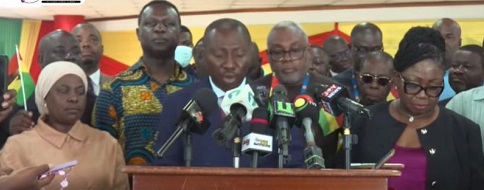
The Minority Caucus in Parliament on Thursday boycotted the vetting of three nominees for consideration for appointment to the Supreme Court bench.
They had called for a postponement of the vetting of the three nominees, which had been scheduled for Thursday, August 27, 2026.
- Related articles
- Minority objects to 3 days notice for public to submit inputs for vetting of 3 new Supreme Court judges
Attached below is a copy of the full address by the Minority in Parliament
STATEMENT BY THE MINORITY CAUCUS OF PARLIAMENT
Ladies and gentlemen of the media,
Fellow citizens of Ghana.
Thank you for coming on short notice. We wish we did not have to call you this early. But
tomorrow, this House rises. And before it rises, the Majority is plotting something that should
alarm every Ghanaian who still believes in this Constitution.
Let us tell you exactly what happened, and exactly what the law says.
On Monday, the Rt Hon Speaker Alban Bagbin referred five names to the Appointments
Committee. Two nominees for ministerial office. Three nominees for the Supreme Court of
Ghana. That referral came on the very first day of this emergency recall. The recall ends
tomorrow, Friday. The Majority now wants all five nominees vetted, reported on, and approved
before this House rises.
Five nominees. Two ministries. Three additional Justices for our final court. All squeezed into
four days.
We say no. And we say it with the Constitution and our own Standing Orders in our hands.
What we will accept, and what we will not
On the two ministerial nominees, we are ready to engage. The Honourable Mahama Ayariga,
Member of Parliament for Bawku Central, has been nominated for Local Government,
Chieftaincy and Religious Affairs. Dr Zanetor Agyeman Rawlings, Member of Parliament for
Korle Klottey, has been nominated for Environment, Science and Technology. Article 78(1) of
the Constitution gives Parliament the duty to approve Ministers. We take that duty seriously.
We will vet them fairly, and within a sensible timetable.
But on the three Supreme Court nominees, our answer is firm. Justice Sophia Bernasko Essah.
Justice Amoako Asante. Former Ghana Bar Association President, Tony Forson. Article 144(2)
of our Constitution governs their appointment. That article requires the President to act on the
advice of the Judicial Council. It requires consultation with the Council of State. It requires
Parliament's genuine approval. That is not a mere formality. That is a constitutional command.
It cannot be met in four days, and we will not pretend that it can.
The rules the Majority is trampling on
Let the country hear the actual words of our own Standing Orders, because the Majority has
not been honest about them.
Order 217(11) requires the Appointments Committee to report to Parliament within three days.
But read it correctly. Three days after the Committee concludes its proceedings. Not three days
from referral. Not three days total. The Committee decides when it has finished. Nobody can
decide that for it in advance.
Order 267(4) tells us how long a Committee normally has to report on any matter referred to
it. Up to three months. Not three days. Thirty times longer than what the Majority is allowing
here.
Order 217(2) requires the Chairperson, the Ranking Member, and two other Members of the
relevant subject (matter) Committee to join the Appointments Committee for every single
nominee. Three different Supreme Court nominees. Two different ministries. That means
multiple different Committees must properly join, sit, and be heard, all inside four days, all
while respecting the fifteen Member cap fixed by Order 217(3).
Order 217(10) requires nominee names to be published so the public can send in memoranda.
Order 265 sets quorum at one-third of the Committee. Order 266 lets a Committee decide to sit
in public or in private, and requires it to reconvene when business is not finished at one sitting.
None of these rules have been suspended. And that brings us to the most serious point we must
make today.
Nobody voted to suspend anything
Our own Standing Orders, at Order 3, do allow the House to suspend a rule, or part of a rule.
But look at what Order 3 demands before that can happen. A motion must be moved. The House
must give its leave. Reasons must be stated, openly, before the suspension takes effect.
None of that has happened here. No motion. No vote. No reasons given on the record. The
safeguards in Order 217 are sitting in our rulebook today exactly as they did last week, fully
alive, fully binding.
So what is the Majority actually doing? They are not suspending the rules. They are ignoring
them, while pretending they still apply. They want to use their numbers alone to force a result
the rules do not permit, without ever paying the small democratic price of standing up, moving
a motion, and defending their reasons in the open.
That is bad parliamentary practice. That is a crass affront to the constitutional duty this House
owes the people of Ghana. If the Majority believes four days is enough, let them say so on the
record. Let them move the motion. Let them face that debate in daylight. Anything less is
government by ambush, not government by law.
Even if they try to suspend the rules, hear us clearly on the danger
We say this so that it pricks the conscience of every Member of this House, and every citizen
listening today. Suppose the Majority does what it has so far refused to do. Suppose it finally
moves a motion under Order 3 to suspend the vetting safeguards for these three judicial
nominees. Even then, we say, this must not be done. Here are three dangers that should stop
any patriot in their tracks.
First, the danger of an unqualified or compromised person sitting on our highest court for life.
Once a Justice takes the oath, Article 146 makes removal almost impossible, reserved only for
the gravest stated misbehaviour, incompetence, or infirmity, and only after an elaborate
committee process. If something is missed in a four-day rush, that mistake is not corrected in
four days. It is corrected, if ever, only after years or decades, or not at all.
Second, the danger of a Supreme Court that carries a permanent shadow over its legitimacy.
Every ruling those three Justices ever make, on every dispute that matters to this nation, will
be met by the question: Were you properly vetted, or were you installed in a hurry to suit one
government's convenience? That question will not go away. It will follow every judgment they
sign for the rest of their careers.
Third, the danger of a precedent that no future Ghana can undo. If this Majority can suspend
the vetting safeguards today for its own nominees, tomorrow's Majority, of whatever party, will
most likely do the same. Once we accept that Supreme Court seats can be filled in four days
when it is politically convenient, we have converted the highest court in the land into a prize
to be raced for, not a noble institution to be protected. That is a wound this Constitution may
never fully heal.
Any one of these three dangers should be enough to stop this dangerous plan. Together, they
are a warning we cannot afford to ignore.
Why deferral costs nothing, and haste costs everything
We must say this plainly, because the country deserves plain speech.
Deferring the vetting of these three nominees by a few weeks harms no one. Yes, the courts are
presently in vacation. But vacation is not closure. Where a matter is truly pressing, the Supreme
Court sits during vacation and rules on the urgent questions of law before it, exactly as our practice has always allowed.
The administration of justice in this country has not come to a
halt for a single day. No case that genuinely cannot wait has been left to wait. There is no queue
of litigants whose justice is delayed because these three have not yet taken the oath. Anyone
who tells you the Supreme Court have gone silent is asking you to believe a fiction.
Now weigh that against what haste costs. A Justice confirmed in four days, without proper time
for the public to raise concerns under Order 217(10), without the subject Committee Members
properly seated under Order 217(2), carries that shadow onto the bench for the rest of a working
life. That is not a cost this nation pays once. It is a cost we pay every single time that Justice
signs a judgment that shapes this country's future.
Deferral also protects the nominees themselves. Justice Bernasko Essah, Justice Amoako
Asante and Mr Tony Forson deserve a process that gives their appointment unquestioned
legitimacy, not one that hands their critics, fairly or not, a talking point about how quickly they
arrived on the bench. A nominee who is properly vetted enters that courtroom with the authority
of a process the whole nation can respect. A nominee rushed through in four days enters
carrying a question mark no ruling can ever fully erase. If we truly believe these three are equal
to the task, then we should want them vetted properly, precisely so that no one can ever say
otherwise.
And deferral costs the Majority nothing either, except the small inconvenience of doing this
right. Nothing in our Constitution or our Standing Orders penalises a Committee for taking the
time Order 267(4) already contemplates. Three months is the ordinary rule. Nobody loses a
single privilege of government by allowing this Committee the weeks it needs. The only thing
anyone loses is the political convenience of announcing three new Justices before this recall
closes tomorrow. That convenience is not worth what it costs the country.
This is why we say, respectfully but firmly, that the responsible course is not to rush. It is to
defer. Let the Committee take the time our own rules already allow. Let the public speak under
Order 217(10). Let the relevant Committees be properly seated under Order 217(2). Let these
three nominees arrive on our highest bench carrying the full, unquestioned legitimacy that only
a proper process can give them. That is not obstruction. That is this House doing its
constitutional duty.
There is no vacancy, and there is no emergency
Let us correct an impression that has been allowed to take root, because plain speech demands
it. These three nominees are not filling vacancies on the Supreme Court. There is no vacancy
on that bench today. The Supreme Court currently sits with its full complement of Justices,
hearing cases and handing down judgments as it should. _What the President is proposing is
not to urgently replace anyone who has left._ It is to add three further Justices to the numbers
already sitting there. If there is no vacancy to fill, there is certainly no emergency compelling
anyone to fill it inside four days.
Compare that with what happened only last year. Ghana lost Ministers of State in a tragic
helicopter crash in the Ashanti Region. Those were real vacancies, in real ministries, at the
heart of government. The President waited one full year before naming replacements. One full
year. If filling those two genuine ministerial vacancies had truly been an emergency, he would
not have waited that long.
So we ask again. If a full year was acceptable for real vacancies in government, why is four
days now being treated as an emergency for seats on the Supreme Court that are not even
vacant? There is no fire here. Yes, this is the judicial vacation. But the administration of justice
has not entirely come to a halt. Where it is absolutely necessary, the Supreme Court is sitting
and deciding the questions of law that cannot wait. Nothing about our justice system is on life
support because three additional Justices have not yet joined the bench. Nobody should be
made to believe otherwise.
Still, we repeat our offer in good faith. We are ready to vet the two ministerial nominees fairly
and promptly. What we will not accept is the three Supreme Court nominees being rushed
through as though the courts cannot function another week without them.
A promise broken again
When this government returned to power with its commanding majority in this House, its own
leaders stood before Ghana and promised restraint. They promised the country they would not
abuse the numbers the people had given them. That promise did not survive long. It has been
tested, and broken, again and again, since this government took its seat. What the Majority is
pressing to do with these three Supreme Court nominations is not a new departure. It is simply
the latest chapter in that broken promise. And it is a terrible culture that must end. It betrays
the mandate of the Ghanaian people. A Majority that keeps finding new ways to bend the rules
to its convenience should not be surprised when the country stops believing its next promise of
restraint.
The real emergencies sitting untouched
While the Majority races to install three new Justices in four days, two matters of genuine
national emergency sit untouched, ignored, ready, and waiting.
This country is still waiting for answers on one point seven billion dollars in losses connected
to GoldBod and the Bank of Ghana. That is public money. That is the nation's money. A loss of
that scale threatens the fiscal health of our economy, the strength of our currency, and the
confidence of every Ghanaian who depends on a sound banking system. If anything deserves
the word emergency, it is a hazard of that size to our national purse.
This country also lived through nationwide power outages that put lives at risk and exposed
our national security to real danger. Hospitals depend on steady power. Security installations
depend on steady power. Water systems depend on steady power. In one instance, it took our
engineers several days, running one into the next, to restore power fully across the country.
That is not an inconvenience we can shrug off. That is a hazard to the safety of every Ghanaian,
and to the security of this Republic itself.
Those are emergencies in the truest sense of the word. A threat to our economy measured in
billions. A threat to our security measured in days without power, and in lives placed at risk.
We are grateful that the Speaker admitted our motion on the loss of one point seven billion
dollars for the consideration of this House. We commend him for that. But we must place
something on the record today, honestly and respectfully. The Speaker has, in his own wisdom,
decided not to allow that motion to be moved during this special sitting. We have very serious
reservations about that decision. A matter of this magnitude, a matter that touches the very
integrity of our economy and our financial institutions, deserves to be heard without delay.
And yet, we are Members who respect this Chamber and the authority of its Presiding Officer.
We accept his ruling. We are prepared to wait for our day to raise that matter properly, in the
fullness of time, in the proper sitting.
That is exactly our point to the Majority today. If the Minority can be asked to wait, and can
agree to wait, for action on a matter that is a genuine emergency, a loss of one point seven
billion dollars and a national power crisis that threatened lives, then surely the Majority can
wait a little longer to add three further Justices to a Supreme Court that is not even short a
single seat. If patience is demanded of us on the real emergency, patience can certainly be
demanded of them on a matter that carries no urgency whatsoever. Let the Majority show the
same restraint they are asking of this Caucus. Let them give the Appointments Committee the
time it needs to do a thorough and reasonably competent job.
The Speaker has already given the Majority its answer
Honourable Speaker Bagbin, in his own remarks opening this recall, drew a distinction every
Member of this House should hold onto. He told us plainly that his decision to recall Parliament
was not, and must not be read as, a decision on the merits of the matters placed before us. He
said the evidence behind a recall request is not conclusive. He said it does not dictate what
Parliament must decide. He told us, in his own words, that the responsibility to weigh these
matters properly belongs to this House, and to this House alone.
The Speaker also made clear that he would not admit any business beyond what the President
specifically requested, precisely because a recall sitting is not an ordinary sitting. And he asked
us, all of us, to show firm conviction without needless hostility, honest disagreement without
disrespect, and rigorous scrutiny that never tips into obstruction.
We honour that call today. Rigorous scrutiny is exactly what we are demanding. It is the
Majority's plan, not our resistance to it, that risks obstruction, because it obstructs the very
purpose Order 217 exists to serve. The Speaker himself has told this House that recalling
Parliament settles nothing about the merits. It is this House's duty to test these nominees
properly. A Majority that treats the Speaker's own words as an inconvenience, and rushes past
them regardless, is not showing scrutiny. It is showing contempt for the very distinction the
Speaker asked us to respect.
Our call to the nation
To the Ghana Bar Association, to retired Justices, to the Judicial Service, to CHRAJ, to every
professional body that cares about our courts. Speak now. Tell the country whether four days
is enough to vet three Supreme Court nominees.
To civil society, to our faith leaders, to our chiefs and queens, to every Ghanaian watching this
broadcast. This is not Majority against Minority. This is whether we still believe our highest
court deserves more care than ninety-six hours can give it.
To the media. Keep asking the one question the Majority has not answered. What is the real
emergency here?
And to the Majority. It is not too late to step back. Work with us on the two ministerial
nominees, on a fair and sensible timetable. But abandon this plot to force through three
Supreme Court vettings before tomorrow's close.
In closing
If this plot goes ahead regardless, we will not treat it as the end of the matter. Every objection
we raise this week goes onto the permanent record of this House. And should it become
necessary, any Ghanaian, not only a Member of Parliament, has the right under Article 2 of our
Constitution to ask the Supreme Court itself whether this process was lawful. We say that as a
fact about our Constitution, not as a threat.
We did not choose this fight. It was brought to the doorstep of this Parliament, and to the
doorstep of the Supreme Court of Ghana itself, by a plot that puts speed ahead of scrutiny and
convenience ahead of the Constitution.
We are asking this Parliament to choose the Constitution instead.
We are asking Ghana to stand with us.
Thank you. God bless our homeland, Ghana.
