
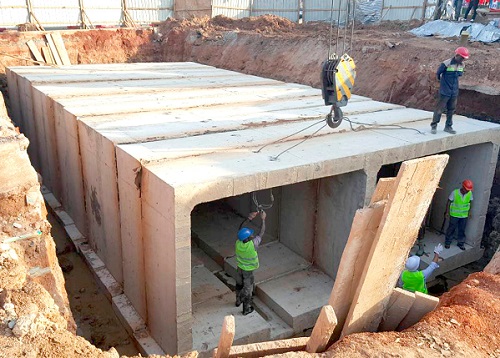
The Ministry of Works, Housing and Water Resources has announced that it will close sections of the Dr Busia Highway at Kaneshie in Accra from September 7, 2026, to pave the way for the construction of a new underground drain.
The closure follows the flooding of June 29, 2026, which caused extensive damage to properties, disrupted livelihoods and resulted in loss of life in Accra and other coastal towns.
The Minister for Works, Housing and Water Resources, Ahmed Ibrahim, announced the road closures at a media briefing on Wednesday as part of a media sensitisation campaign on the Traffic Management Plan for the Kaneshie drainage improvement works.
The project, being undertaken under the Greater Accra Resilient and Integrated Development (GARID) Project, involves replacing the existing drainage system in the Kaneshie area with a much larger underground drain.
The GARID Project Coordinator, Dr Kwadwo Ohene Sarfoh, said the existing system comprised two pipes, each 1.2 metres in diameter.
He said the pipes would be replaced with a double-cell underground rectangular drain measuring about 10 metres wide and extending 1.5 kilometres from Pamprom Junction to First Light Junction.
The new drain will connect at one end to a recently completed section within the Accra Academy campus and at the other end to the existing drain at Pamprom Junction.
Traffic plan
The Traffic Management Plan for the project will be implemented in two phases.
The first phase will begin on September 7, 2026, with the closure of the westbound carriageway of the Dr Busia Highway from Pamprom Junction.
The closure is expected to continue until the end of November, 2026.
The affected routes will include those used by motorists travelling from Korle Bu-Mortuary Road, Graphic Road, Obetsebi Lamptey Circle and Kwame Nkrumah Circle towards Pamprom Junction, First Light Junction and beyond.
Alternative routes
Affected motorists will be directed to use the Awudome Cemetery Road, the New Times Corporation-Awudome Roundabout route and the Oblogo-Mataheko route to reach First Light Junction.
Dr Sarfoh said Pamprom Junction was expected to reopen to traffic in the first week of December, 2026.
He said motorists from the affected corridors would then be able to turn right at the junction and use the designated alternative routes towards First Light Junction.
He said the remaining westbound section of the highway, from Kaneshie Station to First Light Junction, would remain closed until August, 2027, to allow the drainage works to continue.
Second phase
The second phase of the traffic restrictions will cover the stretch from First Light Intersection to the Cocoa Clinic Roundabout.
It is scheduled to run from September to the end of October, 2027.
The second phase will affect vehicles travelling from the Russia Community and the Flamingo Traffic Light, as well as motorists coming from Kasoa and Odorkor.
Throughout the construction period, road users will also be able to use the Obetsebi Lamptey Interchange to Oblogo Traffic Light route, opposite the ICGC Christ Temple, and connect through Mataheko to First Light Junction.
Traffic control
Dr Sarfoh said the Motor Traffic and Transport Department (MTTD) of the Ghana Police Service had been engaged to control traffic during the road closures.
He said the MTTD would work with the contractor and city guards from the Accra Metropolitan Assembly and the Ablekuma Central Municipal Assembly.
The project has also established two toll-free lines, 0800 800 900 and 0800 500 600, both on the MTN network, for public enquiries, complaints and traffic-related information.
Mr Ibrahim said arrangements were being made to extend the service to the Telecel network.
He urged members of the public who were dissatisfied with the pace of the works or felt mistreated by traffic officials to lodge their complaints through the toll-free lines.
Mr Ibrahim and Dr Sarfoh appealed to motorists, commuters, transport unions and traders to cooperate with the traffic diversions.
They also urged road users to avoid the affected corridors unless they had legitimate business within the construction zone.
The ministry acknowledged that the restrictions would cause inconvenience but said the works were necessary to provide permanent drainage infrastructure and reduce flooding in Kaneshie and surrounding communities.
