
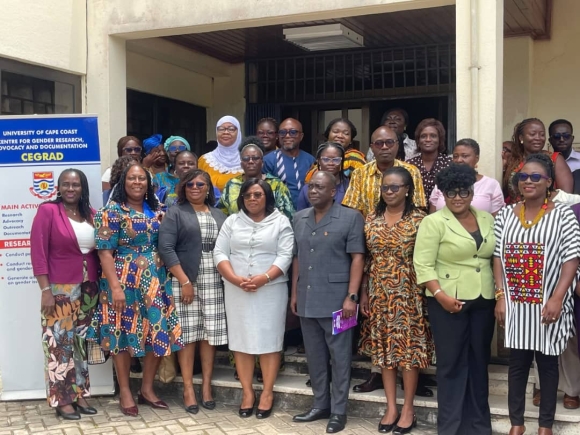
The University of Cape Coast (UCC) has launched a free digital skills and artificial intelligence (AI) training programme aimed at equipping women educators and institutional leaders with the competencies needed to take up greater leadership roles in the digital era.
The initiative, dubbed “Women Leading Change in Africa,” was expected to train more than 2,000 participants across Ghana and was being implemented by the Institute for Educational Planning and Administration (IEPA), in partnership with the Centre for Gender Research, Advocacy and Documentation (CEGRAD).
The programme comes against the backdrop of concerns about the limited representation of women in leadership positions within the education sector and the growing influence of AI on teaching, administration and institutional decision-making.
Speaking at the launch, the Acting Pro Vice-Chancellor of UCC, Prof. Christine Adu-Yeboah, said the rapid digital transformation in education presented an opportunity to address the gender gap in leadership if women were deliberately equipped with the requisite technological skills.
She said women occupied only 24 per cent of tertiary academic positions across West Africa, describing the figure as an indication of the need for deliberate interventions to expand women's participation in higher education leadership.
Prof. Adu-Yeboah said although many education administrators recognised that AI would significantly alter their work, only one in five felt adequately prepared to lead the transformation.
She warned that failure to close the digital skills gap could further marginalized women as technological competence increasingly became a prerequisite for effective leadership.
Prof. Adu-Yeboah said IEPA would collaborate with UNESCO and universities across the country to extend the training opportunities to women professionals and leaders.
She therefore urged female educators, administrators and leaders to take advantage of the programme to strengthen their digital competencies.
Training
The training is being delivered through the International Institute of Online Education (IIOE) platform, hosted through the UCC National Centre.
It would offer more than 57 micro-certification courses covering the practical application of AI in education and leadership, as well as fields including health, art and design, engineering, natural sciences, agriculture and business.
Participants would also receive training in generative AI pedagogy, prompt engineering, digital micro-course development and Universal Design for Learning (UDL).
The programme, which runs from August 2026 to November 2027, was expected to culminate in a National Policy Dialogue in June 2027 to advocate the integration of AI competencies and digital micro-credentials into national teacher promotion criteria and professional standards.
Inclusive opportunity
The Project Lead, Madam Ama Serwah Nerquaye-Tetteh, said although the initiative was designed primarily to benefit women, men were also eligible to enrol.
She said the courses were self-paced and flexible, enabling participants to undertake the training at their convenience.
Madam Nerquaye-Tetteh emphasised that the courses were offered at no cost, adding that participants only needed commitment and dedication to complete them.
The Director-General of IEPA, Prof. Michael Boakye-Yiadom, said targeted investment in digital and AI training was necessary to enable African women to overcome structural barriers and play leading roles in transforming universities and education ministries.
He said the programme was intended to complement the leadership strengths of African women with contemporary technological competencies.
“We cannot rely on the tools of the past to navigate the challenges of the future. True transformation will only occur when we match this inherent leadership capacity with cutting-edge technical opportunity,” he said.
Prof. Boakye-Yiadom urged stakeholders and participants to promote the programme and encourage more women to benefit from the training.
Closing the gap
The Director of CEGRAD, Prof. Eunice Fay Amissah, called for the deliberate inclusion of women in the design, adoption and governance of emerging digital systems.
She cautioned that without such inclusion, AI and other technologies could reinforce existing inequalities rather than help address them.
Prof. Amissah identified inadequate access to digital training and infrastructure, limited mentorship opportunities, discrimination, unequal care responsibilities and harassment as some of the barriers affecting women's participation in the digital transformation.
She said higher education institutions must create safe and inclusive environments where women could acquire skills, innovate and assume leadership positions.
The Director of UNESCO-ICHEI, Prof. Jin Li, said similar programmes had recorded significant impact in countries including Egypt, Ethiopia and Zambia.
He said African women possessed considerable potential in science and technology but often lacked the opportunities and platforms required to develop their skills and assume leadership roles.
He said the initiative would help equip women in higher education, including teaching staff, researchers and academic leaders, with digital and AI competencies required in the emerging “intelligence era” while creating pathways to leadership.
