


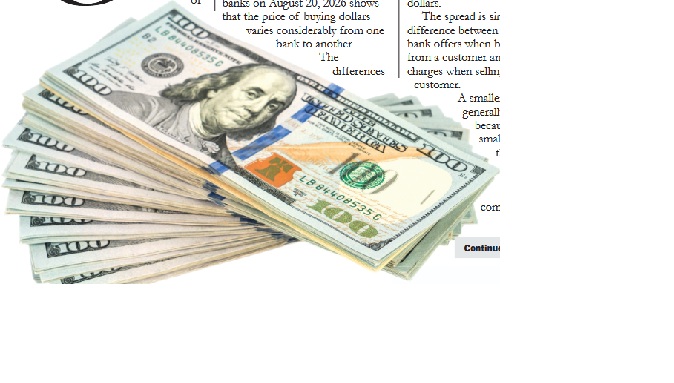
Ghanaians buying US dollars from banks could save hundreds of cedis on the same transaction simply by shopping around, with significant differences emerging in the exchange rates quoted by banks across the market.
A comparison of indicative US dollar-to-cedi rates quoted by 23 banks on August 20, 2026 shows that the price of buying dollars varies considerably from one bank to another.
The differences become particularly important for customers making large transactions, such as importers paying overseas suppliers, businesses settling foreign invoices, travellers buying foreign currency or individuals converting cedis into dollars.
The spread is simply the difference between the price a bank offers when buying dollars from a customer and the price it charges when selling dollars to that customer.
A smaller spread is generally seen as better because it suggests a smaller gap between the two sides of the transaction.
In the latest comparison, First National Bank had the narrowest spread at GH¢0.35. It was followed by First Atlantic Bank with GH¢0.40 and Société Générale with GH¢0.50.
At the other end of the scale was CalBank, which recorded the widest spread at GH¢1.35.
NIB followed with a spread of GH¢1.30, while FirstBank and Zenith Bank each recorded a spread of GH¢1.25.
Across the 23 banks, the median spread was GH¢1.05, meaning that for half of the banks the difference between their buying and selling rates was above that level and for the other half it was below it.
Those differences may appear small when expressed as the price of a single dollar. But they become much more significant when applied to thousands or even millions of dollars.
Rate matters when buying dollars
Founder and Lead Trainer at the International Data and Research Agency, Finex Skills Hub, Bernard Obeng Boateng, said for buyers of US dollars, the spread is not necessarily the most useful number.
“The key figure is the bank's selling rate— the amount of cedis the customer must pay to obtain US$1”.
This is where the comparison produces a striking difference.
First National's indicative dollar selling rate was GH¢11.20, while CalBank's was GH¢11.90.
That means a customer buying US$1,000 would pay GH¢11,200 at the First National rate, compared with GH¢11,900 at the CalBank rate — a difference of GH¢700.
For $10,000, the difference would rise to GH¢7,000.
And for a company buying $100,000, the difference would be GH¢70,000, before taking account of fees, commissions or any other transaction costs.
This is why simply comparing spreads can give customers the wrong impression.
First National Bank, for example, had the narrowest spread in the comparison, but the broader lesson is that customers still need to check the actual price they will pay for the dollars.
A bank with a wider spread may, in some circumstances, still offer a competitive selling rate, while a bank with a narrow spread may not necessarily be the cheapest place to buy dollars.
A banking consultant, Dr Richmond Atuahene, said banks might offer preferential rates to customers with strong relationships or large transaction volumes.
"If it is a very good and reputable customer, the banks may not charge the full margin," he said. "They may give the customer a margin of 0.50, 0.25 or another lower rate instead of the normal margin. It all depends on who the customer is."
Professor Peter Quartey, former director of the Institute of Statistical, Social and Economic Research, said variations in foreign-exchange rates were a normal feature of a market-driven economy.
"It is a market economy; the same way interest rates also have different rates," he said. "They also have different rates basically because they also try to make profit."
Why difference matters
Foreign exchange is an important cost for many businesses in the country.
Importers need dollars to pay suppliers abroad. Companies with foreign-currency loans or obligations need dollars to meet their payments. Airlines, hotels and travel companies also have significant foreign-exchange requirements.
For individuals, the amounts may be smaller, but the same principle applies to people travelling overseas, paying international school fees, making foreign online purchases or sending money abroad.
When the amount being converted is large, even a few pesewas difference in the exchange rate can translate into thousands of cedis.
That makes it worthwhile for customers to request the actual rate they will receive before completing a transaction rather than relying solely on a rate displayed on a bank's website, branch noticeboard or other published platform.
Published rates not final
There is another reason customers should be cautious about treating published rates as final.
The rates used in the comparison are indicative. The actual rate offered to a customer can change depending on the size of the transaction, the time of the day, market conditions and, in some cases, the customer's relationship with the bank.
Banks may also apply fees or other charges that affect the final cost of a foreign-exchange transaction.
For this reason, two customers looking at the same published exchange rate may not necessarily end up paying exactly the same amount.
Large corporate customers may also have more room to negotiate rates because of the size and frequency of their transactions.
BoG provides market benchmark
The Bank of Ghana's published foreign-exchange data provides an important benchmark for understanding movements in the cedi-dollar market.
The central bank publishes an official interbank foreign exchange rate based on reported spot US dollar/cedi transactions in the interbank market.
That rate helps provide a reference point for the broader market, but it should not be confused with the exact retail rate every individual customer will receive from a commercial bank.
The gap between the central bank's benchmark and individual bank quotations can reflect market conditions, transaction costs, liquidity and the pricing decisions of individual institutions.