
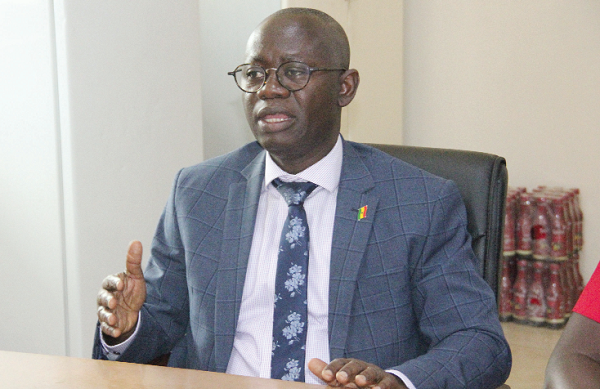
A former Director-General of the Ghana Education Service (GES), Professor Kwasi Opoku-Amankwa, has proposed the conversion of some day senior high schools (SHSs) into boarding schools to help ease pressure on highly sought-after schools.
He said about 160 days schools across Ghana had consistently recorded enrolment below their available capacity and could be used to accommodate more students if pupils who selected them as day schools were admitted as boarders.
Professor Opoku-Amankwa also proposed a 10-year national programme to upgrade under-resourced secondary schools, with successive governments committing to the programme regardless of political changes.
He made the proposals during a panel discussion on education reform aired on Channel One Television on Saturday (September 12, 2026).
The discussion came amid continuing efforts by parents and pupils to resolve placement challenges following the release of the 2026 Senior High School (SHS) placement results.
Double-track
Professor Opoku-Amankwa, who was involved in the introduction of the Free SHS policy during his tenure as GES Director-General said the government should retain the double-track academic calendar for the time being rather than scrap the system immediately.
He said removing the arrangement at this stage would leave large numbers of candidates without places in secondary schools.
According to him, students who had gone through the double-track system had performed well, and scrapping the arrangement purely “to win political points” would be counterproductive.
Boarding option
Professor Opoku-Amankwa said the GES should revive a scheme identified during his tenure involving about 160 schools nationwide that consistently attracted fewer applicants than their available capacity.
He explained that pupils who selected such schools as day students could instead be admitted as boarders to increase enrolment.
The former GES Director-General said the additional enrolment would provide justification for further investment in facilities at the schools without creating additional funding lines.
He said the approach had previously helped increase enrolment in some of the schools without requiring new funding lines.
10-year plan
Professor Opoku-Amankwa also backed a proposal for a 10-year national programme to upgrade secondary schools across the country.
He said the programme, which he attributed to one of his fellow panellists, should be sustained by successive governments, irrespective of which political party was in power.
Under the proposal, a fixed number of secondary schools in every region and district would be selected for upgrading each year.
Professor Opoku-Amankwa described the proposal as a national development programme rather than a political initiative.
He said such a programme would help narrow the gap between a small number of highly rated Category A schools and the hundreds of other schools struggling to attract students.
Public perception
Professor Opoku-Amankwa also called for a national orientation campaign to educate parents and pupils about the quality of teaching staff, laboratories and other facilities available at lesser-known schools.
He said public perception, rather than the actual quality of education, was responsible for the annual rush for a limited number of well-known schools.
Other panellists supported the proposals.
Former Director-General of the GES, Charles Aheto-Tsegah, said resources should be allocated according to the specific needs of individual schools instead of being distributed evenly.
Dr Peter Anti Partey, Executive Director of the Institute for Education Studies, called for greater transparency in the categorisation of schools and the placement process.
He said clearer information about how schools were categorised and how placement decisions were made would help reduce dissatisfaction among parents.
The General Secretary of the Ghana National Association of Teachers (GNAT), Thomas Musah, also supported sustained investment in school infrastructure.
He cited findings by the Auditor-General indicating that millions of Ghanaian schoolchildren continued to learn in under-resourced facilities across the country.
Placement challenges
The proposals come as the Ministry of Education continues to process outstanding placement cases arising from the 2026 Basic Education Certificate Examination (BECE).
More than a week after the release of the placement results, placement resolution centres were still receiving parents seeking changes to school assignments.
The continued pressure on the placement system has renewed calls for measures to spread enrolment more evenly across secondary schools and improve facilities in schools that attract fewer applicants.
