
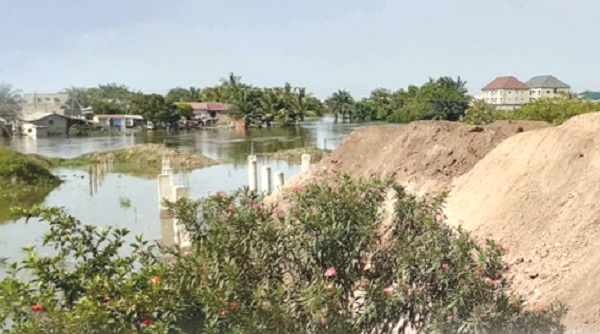
Some Metropolitan, Municipal and District Assemblies (MMDAs) are allegedly collecting penalty fees from developers instead of demolishing illegal structures built on wetlands, contrary to the country's physical planning laws.
The Local Government Service Association of Physical Planners (LoGSAPP) has described the practice as unlawful and warned that it was encouraging encroachment on protected lands and worsening the challenge of unplanned development.
The association has also called for investment in geospatial technology to strengthen the monitoring of illegal developments and improve enforcement across the country.
The National President of LoGSAPP, Planner Gifty Nyarko, and the National General Secretary, Planner Samuel Ansong, made the claims during a radio interview monitored by Graphic Online on Accra-based Joy FM on Tuesday, July, 7, 2026.
Nyarko said the law was clear on how assemblies should deal with structures erected without the required written development permit.
She said such structures were to be demolished and not regularised through the payment of penalties.
"The Act didn't say go and pay penalty," she said, adding that assemblies that accepted penalties without removing illegal structures were acting contrary to the law.
She alleged that some developers who had built on wetlands were paying penalties while the unauthorised structures remained standing.
Nyarko also alleged that some assemblies were demanding the full permit fee before applications had been considered by the Spatial Planning Committee.
She explained that under the law, applicants were expected to pay only a processing fee when submitting an application, while the permit fee became payable only after approval had been granted.
According to her, the practice pointed to a growing tendency among some assemblies to place revenue generation ahead of orderly physical development.
She said the issue was discussed during the association's most recent meeting held the previous Tuesday.
Enforcement challenges
Ansong said enforcement remained weak in many parts of the country even after illegal developments had been identified and rejected by the Spatial Planning Committee.
He cited the example of what he referred to during the interview as a "Ramsey site", which he described as a protected wetland area.
He explained that although applications to build in such areas would normally be rejected, some developers had obtained court orders preventing assemblies from carrying out demolition exercises.
Both planners also identified political interference as one of the factors affecting the enforcement of planning regulations.
Nyarko said some assemblies had previously discouraged monitoring exercises during election periods because of concerns that demolitions could affect the electoral fortunes of politicians.
She said enforcement of the law should not depend on political considerations.
She added that the recent demolition of unauthorised structures on wetlands in the Greater Accra Region, including properties owned by influential people, showed that the law could be enforced where there was the will to act.
Nyarko also cited the Kwadaso South Municipality as an example where the Municipal Chief Executive and the Coordinating Director had supported enforcement efforts in recent months.
Technology
Ansong said many MMDAs lacked the personnel and technology needed to monitor developments effectively.
He called for investment in geospatial intelligence and geo-information science to reduce reliance on manual inspections and improve the detection of illegal developments.
He said such technology was already being used in other countries and could be introduced without high cost, although he did not mention any specific technology or country.
Ansong also called for training for all members of the Spatial Planning Committee, including representatives of the Lands Commission, the Environmental Protection Agency and the National Disaster Management Organisation, instead of limiting training to physical planners.
Nyarko said effective enforcement also depended on the willingness of assembly chairpersons and District and Municipal Chief Executives to act against chiefs and family heads who allocated protected lands in breach of approved planning schemes.
She said the law prohibited landowners from subdividing or allocating land contrary to approved plans and expressed the view that applying the law consistently, regardless of a person's status, would help reduce encroachment on protected lands.
