
The Minister of Local Government, Chieftaincy and Religious Affairs, Ahmed Ibrahim, has warned that the country’s climate resilience efforts will fail without urgent and sustained financing for waste and sanitation infrastructure.
He explained that the nation’s recurring flooding and waste management challenges demonstrated that climate change was no longer theoretical but an urgent governance and financing crisis requiring immediate action.
“We generate about 20,000 tonnes of solid waste every single day.
Managing this growing volume of waste is not just a technical challenge; it is also a financial and institutional challenge, and for our future, a challenge.
Yet, beneath these challenges lies a tremendous opportunity to build a resilient, circular economy that creates jobs, protects the environment, and improves public health,” he said.
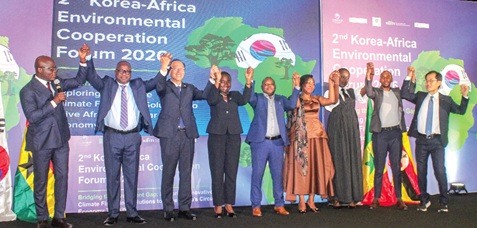
Mr Ibrahim was speaking at the opening of the 2nd Korea-Africa Environmental Cooperation Forum held in Accra yesterday.
Organised by the Korea Environmental Industry and Technology Institute (KEITI), the two-day event is on the theme: “Bridging the Investment Gap: Exploring Innovative Climate Financing Solutions to Drive Africa's Circular Economy Transition.”
It brought together representatives of African governments, civil society, experts, and other stakeholders to design practical climate finance solutions, close infrastructure funding gaps and accelerate partnerships for sustainable waste management and circular economy transformation.
Mr Ibrahim mentioned that the country lost an estimated $195 million to climate-related hazards in 2020 alone, adding that such losses underscored the urgency of building climate-resilient infrastructure.
He said sanitation must be treated as a core economic investment rather than a peripheral service, arguing that waste management projects were bankable and deserved the right funding.
“Waste is not waste. We can create employment and other things through waste.
But if you don't pay the little to manage the waste, you will pay much more to manage the post-flood and post-waste occurrence.
So better to spend a little to manage the waste than not pay the little by paying much after the event has occurred,” he said.
Government efforts
The minister disclosed that the government was advancing a National Sanitation Fund to provide predictable financing through blended capital involving public resources, private investment, and development partnerships, to support landfill development, transfer stations, recycling plants and modern waste treatment systems.
He also called for global financial institutions to redirect climate finance to local governments, where implementation actually takes place, lamenting that only a fraction of global climate funds reached frontline authorities.
“Korea is the best example to learn from.
A country where forests are created in mountains and where trees are planted on rocks.
So if Ghana wants to fight climate change, the best country to partner is the Republic of South Korea,” he added.
Shared crisis
The South Korean Ambassador to Ghana, Park Kyongsig, emphasised that climate change was a shared global crisis, citing floods and extreme weather across continents.
He stressed Korea’s industrial experience — both successes and environmental mistakes — as a lesson for Africa and called for cooperation, knowledge sharing, and joint responsibility to avoid repeating past environmental degradation while pursuing sustainable development.
The Chief Representative of KEITI in Ghana, Hong Seok Kim, outlined his organisation’s mandate to transfer Korean environmental technology and support the country’s transition to a circular economy.
He reiterated that waste contributed significantly to global emissions and urged the adoption of Korean systems such as extended producer responsibility.
He stressed that the Ghana-Korea cooperation was a model for carbon reduction and green industrial growth.
The Minister of State in charge of Climate Change and Sustainability, Seidu Issifu, said Africa’s climate transition was constrained by a widening investment gap, worsened by floods and disasters.
He called for blended finance, de-risked investment, and private sector participation, and emphasised turning waste into value.
He also urged partners to develop bankable climate projects linking adaptation, infrastructure, and economic transformation.
