

Ayensu Starch Factory bounces back
The Ayensu Starch Company Limited (ASCo) that became defunct in 2006, two years after it had been inaugurated, has been reactivated to create jobs and boost agriculture and industry.
Re-inaugurating the factory at Awutu Bawjiase last Friday, the Minister of Foreign Affairs and acting Trade Minister, Ms Hanna Serwaa Tetteh, said the challenges that plagued the factory when it was first inaugurated included the delay in the payment of outgrowers, as well as the unattractive price of cassava which did not encourage farmers to go into its cultivation.
She said in view of that, the factory incurred huge costs in production, which informed a partnership with the GGBL when she was the Trade Minister.
Ms Tetteh said a sliding scale policy was, therefore, adopted, which involved the reduction of excise duties for the GGBL and other breweries if they used local materials for production.
“We told them that the more local raw materials they used, the lower the excise tax would be,” she said.
She stated that it was because the government realised that the factory then did not have the capacity to produce starch in large quantities for the GGBL, textile and pharmaceutical companies, that needed starch in their production, that it sought an investor to re-capitalise ASCo.
Collapse
ASCo was inaugurated in 2004 as the hub for cassava production in Ghana and Africa. It, however, collapsed in 2006, after only two years of operation, as a result of inadequate raw materials supply, frequent power outages, the lack of spare parts and working capital, among other debilitating factors.
Not wanting such a huge investment to go waste, the government, through the Ministry of Trade and Industry (MOTI), in 2010 initiated plans to revamp the factory and, indeed, it began the production of starch in 2011.
However, that attempt also failed, as the company had lost most of its customers following its shut down for years.

An official from the factory explaining the production process to Ms. Hanna Tetteh
Reason for investment
In a speech read on his behalf, the Managing Director of ASCo, Mr He Shi, said: “Indeed, our desire to invest in this project is born out of our firm belief in the President of Ghana’s vision of revamping dying companies to create employment for Ghanaians and boost agriculture and industry.
“Our investment is to cater for the shortfalls of the factory in order to modernise and enhance its operational capacity.”
Mr Shi said the investment was also to enable the company to work with the farmers whose produce would feed the factory, while making farming attractive to the youth.
The Omanhene of the Awutu Traditional Area, Nai Aboukuadze Whettey Agyeman Otabil III, who stated that the revamping of ASCo was long overdue, registered his full support “not only to the management but also any related activities that will come to my attention as the Paramount Chief of the Awutu Traditional Area”.
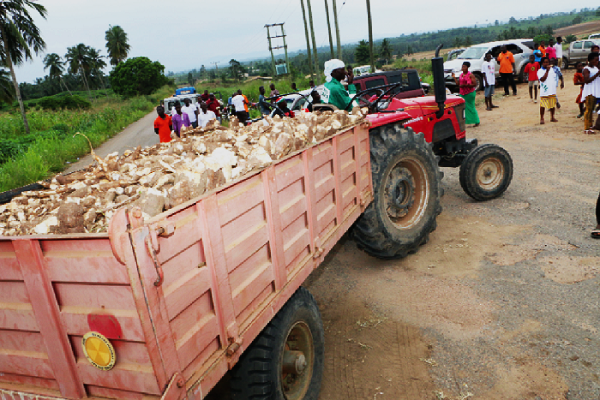
Cassava on its way to the starch factory
A new beginning
The factory currently directly employs 60 local and expatriate staff but also works with over 1,000 outgrowers who supply it with cassava.
The strategies responsible for the revival of ASCo include a public/private partnership (PPP) agreement entered into by the government of Ghana with Tiberias Ghana Limited, a wholly owned Ghanaian company which holds majority share of 70 per cent, while the government’s share is 30 per cent.
Another was the successful off-taker agreement signed with Guinness Ghana Breweries Limited (GGBL) in 2013 after it adopted starch from ASCo for the manufacture of its RUUT beer.
At full capacity, ASCo is set to produce 22,000 metric tonnes of cassava starch annually, and to sustain production, an innovative “farmer ownership” scheme called the Corporate Village Enterprise (COVE) model has been developed.
Under the scheme, 2,500 farmers have come together to set up a COVE to cultivate 5,000 acres of cassava, representing an average of two acres per farmer, and each farmer is required to deliver a minimum quantity of fresh cassava to the manufacturing plant for processing.
