
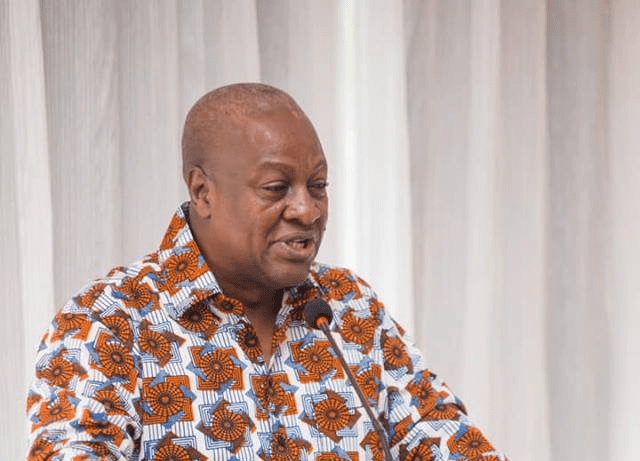
Three prominent civil society leaders have urged President John Dramani Mahama to clearly state his government’s position on the Office of the Special Prosecutor (OSP), cautioning that perceived inconsistencies between the Presidency and the Attorney-General could undermine public trust in the fight against corruption.
Speaking in a radio interview on Joy FM on Thursday, April 16, 2026, Dr Kojo Asante, Director of Policy Engagement and Partnerships at the Ghana Centre for Democratic Development (CDD-Ghana), Ms Mary Addah, Executive Director of Transparency International Ghana, and Mr Sulemana Braimah, Executive Director of the Media Foundation for West Africa (MFWA), called on the President to provide clarity.
Their appeal follows a ruling by the High Court’s General Jurisdiction Division 10 on Wednesday, April 15, 2026, in which Justice John Eugene Nyadu Nyante directed the Attorney-General to assume responsibility for all criminal prosecutions initiated by the OSP. The court held that cases commenced without prior authorisation from the Attorney-General lacked a constitutional basis and awarded costs of GH¢15,000 against the anti-graft body.
The OSP has rejected the ruling, insisting that its prosecutions remain valid under the Office of the Special Prosecutor Act, 2017 (Act 959), and indicating that it has initiated steps to challenge the decision.
The development adds to an ongoing constitutional case before the Supreme Court. A private legal practitioner, Mr Noah Ephraem Tetteh Adamtey, filed a writ in December 2025 challenging the prosecutorial authority of the OSP. In the case, Adamtey v. Attorney-General, Suit No. J1/3/2026, the Attorney-General, Dr Dominic Ayine, through his deputy, Dr Justice Srem-Sai, filed submissions on April 8, 2026, supporting the plaintiff’s argument that Section 4(2) of Act 959 is unconstitutional, on the grounds that prosecutorial powers are vested exclusively in the Attorney-General under Article 88 of the 1992 Constitution.
The civil society leaders noted that this legal position appears to diverge from earlier public comments by the President. In December 2025, President Mahama urged Parliament to withdraw a Private Member’s Bill seeking to repeal the OSP Act, describing the move as premature and affirming the relevance of the office in addressing corruption.
“The President was in France when this happened. He is now back. There has to be a pronouncement,” Dr Asante said, stressing that any shift in the government’s stance should be clearly communicated to the public.
He argued that recent developments — including the attempted repeal of the OSP law, the Attorney-General’s position in court and the High Court ruling — make it imperative for the President to clarify the government’s direction. “What is government’s position on the OSP? The Attorney-General has made his position clear. The President has also made a position that is different. If the President agrees with the Attorney-General, he should say so,” he added.
Ms Addah warned that the ruling could stall gains made in tackling corruption, recalling that the OSP was established to address longstanding concerns about the effectiveness of prosecuting corruption cases within the Attorney-General’s office. She urged the Special Prosecutor, Mr Kissi Agyebeng, to remain steadfast in his role.
Mr Braimah also pointed to what he described as a pattern of developments requiring explanation, noting that although the President had earlier called for the withdrawal of the repeal bill, subsequent legal and judicial actions suggested a different trajectory. “It does appear that a number of things are happening at the same time,” he said.
Dr Asante further argued that any concerns about the OSP law should be addressed through constitutional review processes rather than judicial actions that could disrupt ongoing prosecutions. He also questioned the High Court’s jurisdiction on matters of constitutional interpretation, which he said fall within the remit of the Supreme Court.
Ms Addah called on civil society, the media and the public to continue supporting anti-corruption institutions, and urged the government to act on recommendations from past governance reviews, including those under the African Peer Review Mechanism.
The OSP, established under Act 959 in 2017, was created to investigate and prosecute corruption-related offences, particularly those involving public officials, following years of advocacy for an independent anti-graft body.
