
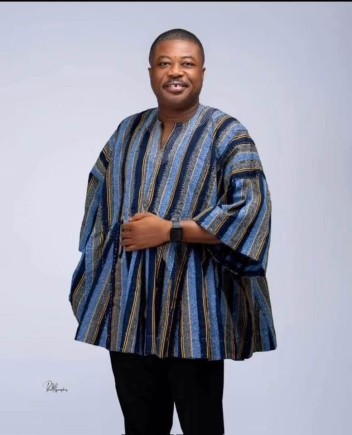
A member of the governing National Democratic Congress, Benjamin Essuman, has called on Ghana’s ambassadors to Southern Africa to seize a growing public conversation to actively promote the country’s traditional attire, including fugu, kente and batakari, across the sub-region.
Mr Essuman, who is a Special Aide to the Chief of Staff, made the appeal while commenting on a viral social media debate triggered by the appearance of President John Dramani Mahama in traditional Ghanaian dress during a recent visit to Zambia.
In a series of posts shared on his social media platforms, Mr Essuman argued that the attention generated by the debate presented a strategic opportunity for Ghana to expand the reach of its indigenous fashion industry into Southern African markets. He urged Ghanaian envoys, particularly those accredited to Zambia and other Southern African Development Community countries, to take the lead in marketing Ghana’s traditional garments as symbols of African identity and confidence.
“Obviously, we can conclude from today’s feedback that our Ghanaian Ambassadors to Zambia and other parts of the SADC region must embark on a campaign to promote our fugu, kente cloth, and batakari. Ghana stands ready to assist our Zambian brothers and sisters to emancipate their minds from seeing our impressive and elegant African prints as unworthy of presidential approval and international acceptance,” he wrote.
Mr Essuman placed the discussion within a broader historical and cultural context, recalling that fugu had long been associated with Ghana’s political leadership and national identity. He said the garment carried deep symbolism dating back to the country’s independence, when key figures of the liberation struggle deliberately chose indigenous attire to signal a break from colonial norms.
“In fact, at the dawn of the declaration of our independence, the great Osagyefo Dr. Kwame Nkrumah, together with his Cabinet, wore fugu. Fast-forward to the 90s, our former President Jerry John Rawlings became a champion of fugu and wore it the world over—even to the UN General Assembly on a number of occasions,” he said.
According to Mr Essuman, President Mahama has continued this tradition by consistently choosing Ghanaian-made outfits for both domestic and international engagements, thereby projecting the country’s cultural heritage on the global stage.
Turning his attention directly to Zambian audiences, Mr Essuman suggested that the reactions to President Mahama’s appearance in Lusaka reflected unfamiliarity with Ghana’s fashion culture rather than any inherent flaw in the attire.
“We can understand your amazement at the outfit of the Ghanaian President when he touched down in Lusaka today. He was different. We appreciate that. Walking side by side with your President, who was in a suit and tie, made it more obvious to you that the Ghanaian leader’s outfit was odd. That was a culture shock born out of ignorance of the fashion taste we have here in Ghana,” he stated.
He added that the garment worn by President Mahama was not a novelty but a long-established symbol of pride and cultural expression in Ghana.
“What you saw our President proudly wearing, amidst those majestic steps, is called fugu, and as a proud black people, we in Ghana have been showcasing it to the world since independence,” Mr Essuman said.
He further referenced President Mahama’s appearance at the United Nations General Assembly in September 2025, where the President wore fugu while delivering a speech on Pan-Africanism and reparations.
“As recently as September 2025, His Excellency President John Mahama again went to the UN General Assembly to deliver a widely celebrated speech on Pan-Africanism, wearing a beautiful fugu. Perhaps your TV stations did not broadcast that well-acclaimed speech on Africa’s transformation and the need for reparations to you,” he added.
