
The Executive Director of the Ghana Library Authority (GhLA), Ziblim Alhassan Betintiche, has revealed that at least 40 Ghanaian languages are on the verge of extinction, warning that urgent and deliberate measures are required to preserve the country’s linguistic heritage.
He stressed that language was not merely a tool for communication but the foundation of identity, culture and collective memory.
“Language is the vessel of our memory and the architecture of our worldview. When a language disappears, an entire system of knowledge, oral history, proverbs and indigenous wisdom vanishes with it,” he pointed out.
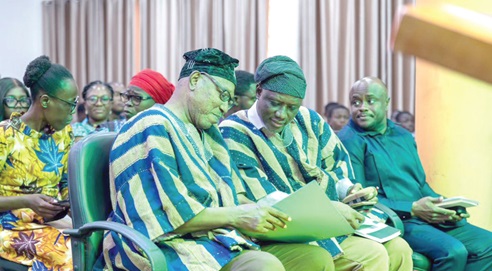
Mr Betintiche made the revelation at the authority’s maiden commemoration of the International Mother Language Day in Accra, held on the national theme: “Languages Preserved on Page”.
He said 70 African languages, including the Boro language in Ghana, had become extinct.
Additionally, Dompo, once spoken by a hunter-gatherer group in Bono East, is now confirmed extinct, with speakers having shifted largely to Akan.
Several other Ghanaian languages are critically endangered, including Nawuri in Northern Ghana, Tuwuli (or Bowiri) in the Oti Region, Chala (Tshala) in eastern Ghana, and certain dialects of Anufo (Chakosi) in the north.
Those languages, he said, were under pressure from dominant tongues, with younger generations increasingly abandoning them.
Mother Language Day
International Mother Language Day is a worldwide annual observance under UNESCO held on February 21 to promote awareness of linguistic and cultural diversity and multilingualism.
The event, held in Accra last Friday, brought together key stakeholders from the education, culture and heritage sectors, including representatives of UNESCO, the creative arts space, students and academia, language institutions, and professional library bodies.
The event featured a panel discussion on archiving and transmitting Ghanaian languages to future generations.
It also spotlighted Professor Lade Wosornu’s collection of translated poems.
The literary conversation underscored translation as a preservation tool, reinforcing the role of libraries and scholars in safeguarding indigenous expression through print and documentation.
Living archives
Mr Betintiche described libraries as “living archives of culture” that must move beyond being silent book repositories to active custodians of indigenous narratives.
He said the authority would expand the availability of Ghanaian language materials across regional and municipal libraries, intensify translation initiatives, and collaborate with traditional councils and creative arts stakeholders to promote community-based reading and storytelling festivals.
The Executive Director of GhLA said the authority would also partner the Bureau of Ghana Languages and the Ghana Institute of Languages to document vulnerable languages and stimulate public dialogue in indigenous tongues.
“When we preserve languages on pages, we secure identity against erosion and ensure that modernisation does not become homogenisation,” he said, calling for policy advocacy, publishing initiatives and academic research to prevent further linguistic decline.
Government role
The Deputy Minister of Education and Member of Parliament for Builsa South, Dr Clement Abas Apaak, reaffirmed the government’s commitment to mother tongue-based teaching at the foundational level.
He addressed a recent controversy on the use of local languages in education, explaining that from Kindergarten to Primary Three, Ghanaian languages would be used predominantly as the language of teaching and learning, with English and French introduced as subjects.
Dr Apaak said the ministry, in collaboration with the Ghana Education Service and the Bureau of Ghana Languages, was translating core materials in mathematics and science into selected Ghanaian languages to improve learning outcomes and reduce early-grade learning poverty.
Dr Apaak urged legislators, academics and community leaders to invest in developing and standardising their native languages, describing such efforts as a lasting national legacy.
He also called on young people seeking political careers to learn multiple Ghanaian languages to broaden their appeal, build trust and connect effectively.
Global crisis, past mistakes
The UNESCO Representative to Ghana, Edmond Moukala N’Gouemo, said globally, a language disappeared every two weeks, making preservation efforts imperative.
He emphasised that books — whether in print or digital form — remained humanity’s most resilient fortress against cultural amnesia.
Mr N’Gouemo advocated translating global classics into Ghanaian languages and vice versa to promote intellectual exchange while urging the digitisation of local languages to ensure relevance in the 21st century.
The acting Executive Secretary of the Creative Arts Agency, Gideon Aryeequaye, reflected on colonial-era restrictions that discouraged the use of vernacular in schools, describing the practice as an erosion of identity.
He said punitive measures once imposed on pupils for speaking indigenous languages had created generational stigma, and called for a cultural reset that restored pride in mother tongues through literature, performance and creative expression.
