
Artificial Intelligence tools rolled out to support agricultural, healthcare services
A suit of artificial intelligence-driven tools to support agriculture and healthcare in the country has been rolled out by the Council for Scientific and Industrial Research of the Institute for Scientific and Technological Information (CSIR-INSTI).
The tools include mobile and web applications that enable farmers to detect diseases in maize and tomato crops, and a microscope-integrated mobile application tool for early malaria detection.
The institute also introduced a national agricultural data platform and a soil testing device it was designing to help farmers make informed decisions.
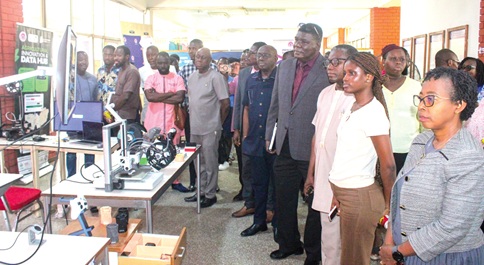
The CSIR-INSTI showcased the tools on an Open Day celebration held on its premises in Accra yesterday, with the theme: “Transforming innovation through AI, precision technologies and open scientific knowledge.”
In attendance were researchers, policymakers and industry stakeholders, who examined the innovations and their role in national development.
Platforms
The web-based applications form a comprehensive ecosystem that supports farmers and stakeholders across the agricultural value chain.
One of the core platforms, Cropping Calendar, provides step-by-step guidance on farming activities, including when to plant, irrigate, manage pests and handle post-harvest processes.
It uses location-specific inputs to deliver tailored advice that improves planning and productivity.
Another platform, the Extension Portal, serves as a communication platform for agricultural extension officers, enabling them to interact directly with farmers and other actors within the value chain. It supports the sharing of information in multiple formats and strengthens coordination between experts and farmers.
The Kuafo Marketplace operates as an e-commerce platform where participants in the agricultural sector can trade goods and services. It connects farmers, suppliers and buyers, facilitating transactions and improving market access.
The Agritech Mobile Advisor provides an interactive advisory service where users can submit questions and receive responses from agricultural professionals.
The platform functions as a knowledge support system, offering expert guidance on farming practices and challenges.
For disease detection and healthcare delivery, the CSIR designed a Maize Leaf Disease Detection App and a Tomato Leaf Disease Detection App to allow users to identify crop diseases by capturing images of plant leaves, enabling early diagnosis and timely intervention.
The institute had also developed a Malaria Detection App, which uses a smartphone camera integrated with a microscope, to analyse blood samples placed on slides.
The application identifies the presence of malaria parasites and supports diagnosis, particularly in areas with limited access to advanced medical facilities.
Rationale
The Director of CSIR-INSTI, Dr Paul Asante Danquah, said the systems were designed to improve real-time decision-making, disease detection and data-driven farming practices.
"These tools are designed to collectively improve efficiency, reduce human error and enhance productivity across sectors,'' he said.
Dr Danquah also said that the institute was focusing on artificial intelligence, precision technologies and open scientific knowledge that had become key enablers of progress in contemporary times.
He added that the applications were available for public use and could be accessed and downloaded through digital platforms, reflecting an open-access approach that promoted widespread adoption and utilisation.
Collaboration
The director added that the institute aimed at expanding its technological portfolio and deepening its impact through continuous research and collaboration.
He said the institute had recorded significant research output over the past six years, including 150 publications and dozens of technological solutions.
Dr Danquah expressed appreciation to local partners and international organisations for supporting the development and deployment of the institute’s technologies.
