
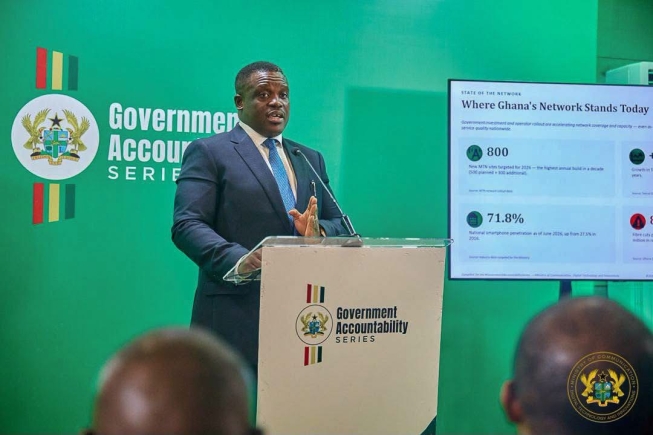
The Minister of Communication, Digital Technology and Innovations, Samuel Nartey George, has revealed that the country’s digital infrastructure is facing significant headwinds from rampant fibre optic cable cuts and instability in the national power grid, resulting in prolonged network outages.
"Fibre cuts are the most persistent of these threats. Industry projections put the number of fibre cuts nationwide in 2026 at 8,578, with 4,289 already recorded in the first half of the year alone, at an average repair cost of roughly US$2,045 per cut," he said.
The sector spent over US$20 million on fibre repairs in 2025, the minister added.
Presenting the ministry’s scorecard at the Government Accountability Series at the Jubilee House in Accra yesterday, Mr George acknowledged that despite significant gains in connectivity and reduced data costs, those challenges threatened to erode the quality of service for millions of citizens.
The minister mentioned uncoordinated excavation linked to road construction as the single largest cause, accounting for roughly half of all road-related fibre cuts each month.
For instance, a single incident on the Winneba–Mankessim corridor knocked out service for more than 17 hours across the middle belt, while the Ho–Ziope corridor suffered more than 19 hours of connectivity loss, degrading internet resilience nationwide.
Compounding the fibre cuts is the instability of the national power grid.
Mr George cited the Akosombo transmission fire incident of 23 April, this year’s flooding in the Greater Accra Region, and two nationwide grid outages on July 29 and August 20, which were all traced to faults on the Akosombo–Volta transmission corridor.
"Taken together, these incidents drove up to a 30 per cent increase in daily cell site outages during the periods in which they occurred," he said. 
Dig once policy
To tackle the menace of indiscriminate fibre cuts, Mr George announced that a joint Cabinet Memorandum between his ministry and the Ministry of Roads and Highways on a "Dig Once Policy" was awaiting approval at the next Cabinet sitting.
The policy would mandate fibre-optic conduits and access chambers to be embedded in every new road construction project at standardised, protected depths, ensuring that roads built to connect the nation would stop being roads that disconnect it.
"We are introducing enforceable cost-recovery penalties for third-party damage to telecommunications infrastructure," he added.
The minister also said that the National Communications Authority (NCA) was finalising a coordination framework that would require road agencies and contractors to formally interface with telecom operators before any excavation begins.
Network expansion
Despite these hurdles, however, Mr George said that network expansion had not slowed. MTN Ghana has committed more than US$1.1 billion over the next three years, including roughly US$380 million this year, to deploy 800 new cell sites, the highest annual build the company has undertaken in a decade.
Telecel Ghana has also raised its capital investment by 60 per cent, expanding to approximately 9,000 sites nationwide.
The minister said that rural communities were being prioritised for modernisation, with ageing 2G and 3G masts being upgraded to 4G-capable infrastructure to support mobile money, digital agricultural services, and e-learning.
On power resilience, he said his ministry was engaging the Ministry of Energy and GRIDCo directly.
"A communications network is only as stable as the grid beneath it, and citizens should not have to choose between a growing economy and a stable dial tone," the minister added.
