
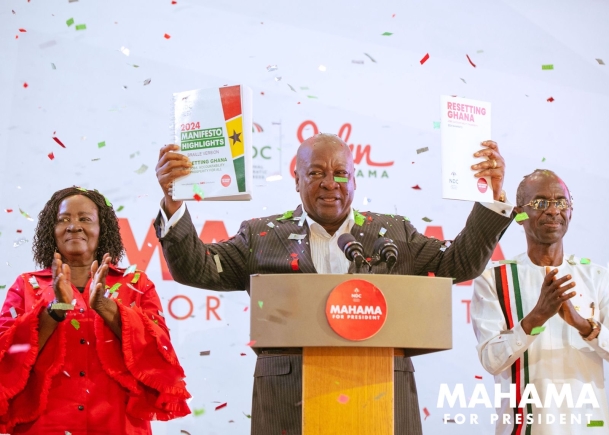
The government is in a good position to accomplish all its manifesto commitments to Ghanaians in the extractive sector within four years, a scorecard by civil society organisations (CSOs) on the government’s performance has revealed.
The study, which assessed the government's performance in the mining, petroleum, climate change and energy transition, environment, and anti-corruption sectors, found that the government had scored an average of 28.6 per cent of its overall commitments in all areas, except anti-corruption, where it scored 23 per cent, which fell below the required 25 per cent yearly threshold.
The study, conducted by the Alliance of CSOs, comprising five coalitions and nine CSOs across the extractive sector, was dubbed “Keeping faith with the voters.”
It was carried out to ascertain the extent to which the government was fulfilling its 2024 election campaign commitments to the citizens after taking office.
At the launch of the report on Tuesday [Dec 2], the Executive Director of the Centre for Extractive and Development Africa (CEDA), Samuel Bekoe, explained that the CSOs monitored policy announcements, government directives, and examined regulatory decisions and institutional actions before coming out with the findings.
He added that the CSOs tracked implementation of manifesto commitments, verified budget allocations and follow-through, and engaged stakeholders across ministries, agencies and affected communities.
Specifics
The Alliance of CSOs working in the extractive sector is an umbrella body that includes the Africa Centre for Energy Policy (ACEP), Imani Center for Policy and Education, Natural Resource Governance Institute (NRGI), the Centre for Extractives and Development Africa (CEDA) among others.
The report indicated that the government scored the highest mark of 37.5 per cent in the mining sector, followed by environment and forestry, which scored 30.2 per cent.
In the petroleum sector, the government scored 26.8 per cent, while it scored 25.6 per cent for climate change and energy transition.
For the anti-corruption track, the government scored 23 per cent, falling short of expectations by two per cent.
Satisfactory progress
Mr Bekoe described the government’s achievement in the first year as satisfactory progress, given that it has four years to deliver on all its manifesto commitments.
"It is expected that at a pace of 25 per cent implementation a year, the government would achieve full implementation in four years," the report said.
Touching on the mining sector, he said the government had rolled out specific policies to improve the industry.
He said, for instance, that the set-up of the Ghana Gold Board (GOLDBOD), tracking of excavators used for mining, establishment of the National Anti-Illegal Mining Operations Secretariat (NAIMOS), and the setting up of the Responsible Cooperative Mining and Skills Development Programme (rCOMSDEP) bore ample testimony to the achievements in the mining sector in terms of policy implementation.
Prospects
While commending the government for making satisfactory progress in achieving the extractive sector commitments, Mr Bekoe underscored the need for more efforts to be made in the area of anti-corruption, "as delays could have implications on successful implementation, with likely unfulfilled outcomes by 2028."
"This report is not a political judgment; it is not an attack on any institution or administration; rather, the scorecard is to serve as a guide on how well the government is doing in fulfilling the development aspirations of the Ghanaian voter," he said.
He stressed that the government needed to take steps to implement interventions that would help fight corruption and recover all the loot as promised in the 2024 election period.
Good initiative
The Country Manager of Natural Resources Governance Institute (NRGI), Patrick Stephenson, said the scorecard initiative was crucial to national development because it helped citizens to be abreast of the extent to which the government was keeping faith with its principles, particularly in the management of natural resources.
He added that the initiative would promote transparency and accountability in the implementation of government policies, and also strengthen policy reforms for the sustainable management of natural resources.
