
Improving cocoa production: Climate-smart project identifies 2 resilient varieties
The cocoa industry is one of the main pillars of the country’s economy, providing livelihoods for more than six million Ghanaians.
Although cocoa growth, development and yield largely depend on temperature and rainfall, climate change is causing seedlings and trees mortality, low yield, wildfires and short duration of harvest.
Sadly, the development of specific strategies for climate-resilient cocoa agroforestry remains inadequate, as different varieties respond differently to temperature and rainfall.
CLIMCARG project
Fortunately, in 2020, the Kwame Nkrumah University of Science and Technology (KNUST), in collaboration with the University of Aarhus (AU) and the University of Copenhagen (KU), both in Denmark, and the Cocoa Research Institute of Ghana (CRIG), launched the Climate-Smart Cocoa Agroforestry Research in Ghana (CLIMCARG) project.
It was financially supported by the Danish Ministry of Foreign Affairs through DANIDA Fellowship Centre (DFC).
The five-year project was carried out in the Offinso Municipality and Adansi North District in the Ashanti Region. The two areas were selected for their distinct qualities; whereas the Offinso area is dry, the Adansi North enclave is humid.
The study sought to assess the climate-smartness of existing cocoa varieties, nutrition, shade trees and farmers’ practices to enhance sustainable yield, livelihoods and improve climate resilience in cocoa landscapes in Ghana.
Achievements
The implementation of the CLIMCARG project has led to the discovery of two new climate-resilient cocoa varieties, making them potentially suitable for use by farmers towards improving the country’s cocoa production.
The two varieties, Amazon and Hybrid B, which are able to withstand heat and have some level of resistance to water stress, formed part of significant achievements chalked up at the end of the implementation of the project.
Similarly, the results uncovered climate-smart shade trees in cocoa farms such as Ofram, Emire, Pear and Odum, which also have some level of resilience for climate change, among others.
At least one soil amendment (half mineral fertiliser and compost) was found to have lower global warming potential, be cheaper to produce and produce higher yields compared to mineral fertiliser.
The compost would be able to improve cocoa yields and reduce the release of greenhouse gases into the atmosphere, leading to climate-change mitigation, in addition to supporting the training of four doctoral and four master’s students as researchers on the project to serve as human capital for institutions.
Close-out session
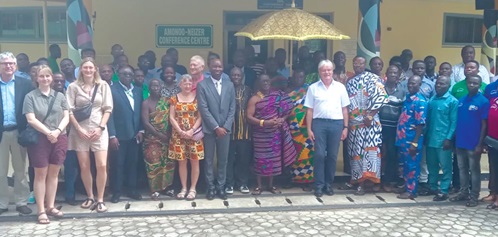
The Project Coordinator, Professor Victor Rex Barnes, disclosed the successes of the project at a close-out session at the Kwame Nkrumah University of Science and Technology (KNUST) last Monday.
It was attended by representatives of the partner universities, cocoa farmers and other players in the agricultural industry.
He said if the weather becomes too hot or too dry, the two new cocoa varieties can continue to thrive to secure the cocoa plants and farms, adding that if the planting material from the two new species were made available to farmers to begin to use, it would gradually phase out those that are less resistant.
“If we are able to spread the new compost across the farms and are able to reduce the greenhouse gas emission, the heat can come down, leading to a reduction in temperatures and growth in cocoa production as well,” he said.
Yield going down
He expressed concern about the decline in cocoa production for some years now due to several factors including illegal mining, stressing that “our cocoa yield keeps going which has been a worry to the Ghana Cocoa Board.”
He called on all stakeholders to put in place the necessary measures and interventions to safeguard the cocoa industry and enable the nation to maintain its enviable record as one of the leading producers of cocoa.
Security of agroforests
The Dean of the Faculty of Renewable Natural Resources at KNUST, Professor Emmanuel Acheampong, said climate change was currently the single most important threat to natural resources management in Ghana.
He said the productivity and security of many cocoa agroforests in the country and other tropical countries were seriously threatened due to climate change, saying that “it has adversely impacted soil, water and air quality.”
He added that climate-smart cocoa agroforestry research was timely and crucial for the provision of solutions to address challenges confronting the cocoa industry and its key players.
The Vice-Chancellor, KNUST, Professor Rita Akosua Dickson, said the serious menace posed by climate change to productivity in the cocoa sector cannot be ignored as many rural livelihoods and economic development of nations are at stake.
She added that the project is a very relevant intervention for cocoa farmers, as it worked with stakeholders who were provided with the knowledge to address the impacts of climate change in the cocoa sector.
She expressed gratitude to the Danish government, its Ministry of Foreign Affairs and DANIDA for providing the needed financial support for the implementation of the project for the past six years.
A representative of the Danish Ambassador to Ghana, Dr Finn Plauborg, said about six million Ghanaians were into cocoa cultivation, and continue to experience the impact of climate change.
He said: “The project concentrated on finding solutions to the devastating impact of climate change to improve the livelihoods of the people in the rural communities.”
In a remark, the Paramount Chief of the Offinso Traditional Area, Nana Dwamena Akenten II, underscored the importance of the cocoa sector to the growth of the Ghanaian economy and therefore called for the needed support to improve the sector.
Writer’s email;
