
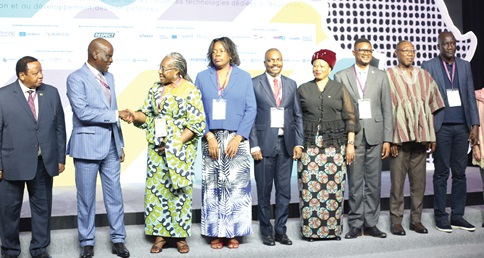
Let’s find answers to nagging questions on education — Haruna Iddrisu
The Minister of Education, Haruna Iddrisu, has challenged the 19th International Conference and Exhibition on Digital Education, Training and Skills Development to find answers to critical questions on Africa’s education future.
Opening the conference in Accra last Wednesday, Mr Iddrisu said the gathering must address “some nagging questions” confronting the continent.
“But it is my desire that this conference, this e-learning conference must find answers to some nagging questions. One, where is Africa’s place in the provision of robust infrastructure to support digital learning and information communication technology? Where is Africa’s place when it comes to the software market? Where are we? Are we there? Can we compete and can we cope? And where is Africa’s place when it comes to the soft skills? Are we there?” he asked.
He added that, if the conference was able to find answers to these questions, it would also find answers to living independently.
The three-day conference is on the theme “Learning for Sovereignty, Strength and Solidarity”. It saw participants from different parts of Africa.
Partnership
The minister said partnerships between the government and the private sector were now a global trend, and as such Africa must determine how far it was positioned in the e-learning market.
“We need to find answers even to how far is the reality of the global market with e-learning and e-learning products? Does local content matter and to whom? Does the curriculum and our curriculum define and relate to our reality of who we are as Africans?” he queried.
Mr Iddrisu said pedagogical changes must respond adequately to defining who the African was and how the African took advantage of information and communication infrastructure to provide education.
He said the theme reminded him of Africa’s history of slavery, colonialism and continuing global racism, and therefore, the continent must ask: “What kind of certificates do we issue?
Do the certificates connect to improving livelihoods and how do they?”
He said Ghana had improved its digital education ecosystem over the last decade, with every senior high school student and teacher now having access to tablets with embedded curriculum.
The Government, he added, was planning to extend the rollout from kindergarten to junior high school under President John Dramani Mahama’s agenda.
Mr Iddrisu said the Mastercard Foundation EdTech Fellowship had trained 36 Ghanaian EdTech ventures and supported over 690 learners, nearly half from rural communities, while the national curriculum microsite had recorded over 8.8 million downloads.
He, however, indicated that with about 60 per cent of Africa’s population under 25, only 38 per cent of Africans used the internet, while 70 to 80 per cent of young people in Sub-Sahara Africa lacked basic digital skills.
“Decisions regarding data, the cost of data, digital platforms and artificial intelligence are too often made outside the continent. African learning sovereignty – this should not be imported,” he said.
Deliberate Learning
For his part, a Professor of Computer Science and President of the Accra Institute of Technology, Prof. Clement Dzidonu, said Africa’s future of learning would not be accidental or imported, but must be deliberately designed around the “sovereign learner.”
Prof. Dzidonu said the continent must answer three questions: “Why this moment matters? Who is at the center? And how change can occur?”
“Africans’ future of learning depend not only on what systems provide, but on what awareness comes,” he said.
Prof. Dzidonu said millions of African youth were stepping into learning spaces with energy, aspiration and faith, but many current learning systems were “educating future-facing populations with past-oriented motives.”
He said the defining question for Africa was whether it would shape its own future of learning or accept a scenario designed elsewhere.
Prof. Dzidonu said the core shift must be from systems to the learner – from access to knowledge to experience, from instruction to capability and efficiency.
“This is where the idea of a sovereign learner becomes central. A learner who owns the ability, who adapts to change, who applies knowledge, who navigates complexity and shapes outcomes.
“The African sovereign learner is not simply prepared for the future.
The sovereign learner will be capable of shaping Africa’s future,” he said.
Proposal
To advance this, Prof. Dzidonu proposed a lens of “opportunity, possibility and difference.”
He said Africa must see clearly the opportunities in capability, technology, demography and the gaps between education and employment, then choose to design learning around capability, not just certification and integrate technology as a leader.
He called for action “not later, not incrementally, but now with intention,” saying transformation will begin where there is vision, condition and commitment.
