
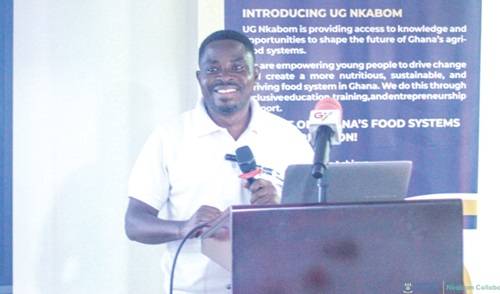
Nkabom Collaborative to generate jobs in agri-food sector
The Nkabom Collaborative has announced plans to support 3,000 enterprises and create 55,000 jobs in the agri-food sector over the next decade.
This move is meant to empower Ghanaian youth to take up opportunities and make innovative contributions that would transform Ghana’s agri-food sector in the long term.
Over its 10-year lifespan, Nkabom intends to train at least 2,100 people through short courses, hands-on programmes and degree pathways, averaging a minimum of 210 beneficiaries per year.
The collaborative’s broader aim is to enhance inclusion by ensuring access for young women, persons with disabilities and other underserved groups through scholarships, aid, mobility support and flexible learning systems.
Speaking to the Daily Graphic, the Education Pillar Lead, Dr Hayford Mensah Ayerekwa, stressed that the initiative was designed to enable young people to build sustainable agri-food businesses rather than receive short-term interventions.
“Nkabom’s long-term vision is to make agriculture an attractive, profitable and dignified career path for the youth, empowering them to innovate within the entire food value chain.
We measure progress not by the number of trainings conducted, but by the number of decent jobs created and enterprises established and sustained through this vision,” he said.
Initiative
Nkabom Collaborative is an inclusive, youth-oriented initiative aimed at transforming Ghana’s agri-food system by combining education, inclusion and entrepreneurship.
The initiative, which began globally in September 2024 and commenced its Ghana operations in March 2025, is already recording early gains as it expands training, funding and entrepreneurship support for young people. While still early in implementation, its vision anticipates thousands of jobs and enterprises over the next 10 years.
Dr Ayerekwa explained that since its launch, the programme had trained 144 beneficiaries under its education pillar, while 200 young entrepreneurs enrolled in its first entrepreneurship cohort.
“From this number, about 100 candidates were selected for further support, with approximately US$92,000 already disbursed as seed funding to promising agribusiness ideas.
“Each selected youth typically receives around US$1,000 in startup capital, together with coaching, mentorship and business development guidance,” he explained.
As part of strengthening higher education and research, the initiative currently supports 25 PhD candidates pursuing Sustainable Food Systems and related fields.
Beyond formal training, Nkabom has exposed young people to practical farm management through open-field and greenhouse farming experiences, with some already transitioning into roles as farmhands and greenhouse managers.
Pillars
Giving background, Dr Ayerekwa explained that the Nkabom Collaborative operated through three interconnected programme pillars that together drove its mission to transform Ghana’s agri-food sector.
“The Education Pillar provides experiential learning that blends theory with practical training in agri-food, nutrition and sustainable food systems,” he further explained.
Beyond formal degrees, the initiative provides short courses and micro-credential programmes in areas such as climate-smart agriculture, value-chain analysis, post-harvest management, value addition, aquaculture, aquaponics, data management and agri-food entrepreneurship.
The second pillar, which is the entrepreneurship pillar, focuses on empowering young people to establish and scale sustainable businesses within Ghana’s agri-food and nutrition sectors.
It addresses youth unemployment by creating an entrepreneurial ecosystem that links students, early-stage entrepreneurs and industry stakeholders.
The initiative remains inclusive and equitable with a focus on expanding opportunities for underserved or marginalised groups, particularly young women, persons with disabilities and internally displaced youth.
This structure, Dr Ayerekwa explained, was designed to enhance participation, retention and successful completion across the project’s offerings.
