
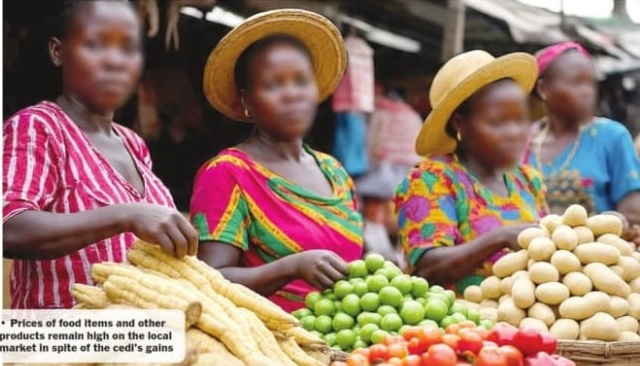
Ahead of the Christmas and New Year festivities, consumers have started mounting pressure on businesses, importers, wholesalers, retailers and general traders to reduce their prices to reflect the current gains in the economy.
The pressure comes in the wake of the strong appreciation of the cedi against major international currencies and the relative improvements in some major macroeconomic indicators.
As of November 2025, the cedi had appreciated by 32.2 per cent against the United States dollar, 26.4 per cent against the British pound, and 18.8 per cent against the euro, according to data from the Bank of Ghana.
For instance, the local currency appreciated against the US dollar from GH¢15.27 in November 2024 to GH¢11.12 in November 2025; improved against the British pound, moving from GH¢19.39 in the same period last year to GH¢14.55 in November 2025, and gained against the euro as well, appreciating from GH¢16.13 in November 2024 to GH¢12.80 in November this year.
Inflation, which stood at 23.8 per cent in December 2024, declined sharply to 8.0 per cent in October 2025, returning Ghana to single-digit inflation for the first time in four years.
In response, the Bank of Ghana (BoG) has reduced the monetary policy rate by a cumulative 1,000 basis points, from 28 per cent in May this year to 18 per cent as of the close of November this year, while maintaining a strong monetary anchor to prevent a resurgence of inflation.
These gains notwithstanding, the positive macroeconomic indicators have failed to impact local prices to bring some relief to consumers across the country.
Traders who used to complain about the impact of worsening macroeconomic conditions, including currency depreciation on their pricing decisions, have suddenly shifted the goalposts by referencing other factors such as the high cost of production underpinned by rising electricity, water and transportation costs.
In many markets in Accra, general prices of goods, particularly food items, have mainly remained unchanged, as though the cedi were still trading at GH¢16.35 to the dollar, with only a few products seeing marginal price reductions.
Food vendors
As the Daily Graphic observed during a monitoring tour across some popular eateries in Accra, the vendors have devised new ways to cash in on the economic gains without passing them on to consumers.
These food vendors, the team observed, have reduced the portion sizes of their meals while maintaining the same prices, or making only slight price reductions meant to appear sensitive to prevailing conditions.
“Attaa Maame, the portion of the fufu you sold to me at GH¢30 the same time last year has rather reduced in size despite the appreciation of the cedi; this is not fair,” a customer at a popular joint at Adentan complained.
The vendor responded that the appreciation of the cedi had no direct impact on the pricing of food, especially fufu, because plantain, cassava and other ingredients for preparing fufu were still expensive in the market.
Market visits
At major markets in Accra, including Kaneshie, Madina, Agbogbloshie and the Adentan Shopping Mall, food prices continue to fluctuate.
While some staple foods are recording steep price hikes, others are experiencing a marginal decline, a trend many traders attribute to seasonal factors.
Prices of tomatoes, onions, yams, plantain, cassava, eggs, oil, imported rice and other staples and common ingredients have either risen sharply in recent weeks or dropped slightly over the past three months.
For instance, a paint bucket of tomatoes that sold for GH¢150 last week now goes for GH¢130, with traders predicting an increase in December. Similarly, the price of 2.2 kilogrammes of onions imported from Niger has fluctuated between GH¢50 and GH¢80 in the last three months.
Live poultry — currently selling at GH¢220 for a broiler and GH¢150 for a layer — was priced slightly higher a few months ago, while frozen chicken now sells at GH¢40 per kilo for the broiler and GH¢50 per kilo for the layer.
A tomato seller at the Madina Market, who only gave her name as Afi, said the prices of food items had been fluctuating lately, indicating, however, that prices were likely to rise in December due to the festive season and the expected increase in demand.
GAMA’s position
The President of the Greater Accra Markets Association (GAMA), Mercy Naa Afrowa Needjan, said while retailers within the association were ready to significantly reduce their prices in response to the cedi’s recent appreciation, importers were unwilling to adjust their prices downward.
She explained that since traders imported goods in dollars, a stable or appreciating exchange rate should naturally reflect in lower prices, just as prices went up whenever the cedi depreciated.
“Now that the cedi is appreciating in value, prices should be dropping by the day,” she said.
GUTA’s disagreement
The President of Ghana Union Traders Association (GUTA), Joseph Obeng, said prices of items, especially imported goods, were dropping in the market in consonance with the cedi’s strong performance.
He stressed that nearly 80 per cent of items in the market had responded to the appreciation of the local currency.
“Spare parts, for instance, have dropped drastically, but very often people send their mechanics who often continue to cheat them by mentioning the old prices instead of the new reduced prices at the market.
“Others also come to the market, but buy from third parties and middle people who end up cheating them instead of buying from the shop owners; and so, I can say that prices of goods, including food products, have gone down in the market in relation to the gains with the local currency,” he added.
GNCCI’s position
Corroborating the remarks of the GUTA President, the Chief Executive Officer (CEO) of the Ghana National Chamber of Commerce and Industry (GNCCI), Mark Badu-Aboagye, stated that a reduction in inflation did not mean that prices of goods would go down.
Instead, he explained, it rather meant that the rate at which prices went up had slowed down.
“And so, inflation at 8.0 per cent in October this year means that prices have increased by only 8.0 per cent on average; it does not mean that prices will necessarily reduce.
“In the computation of prices, businesses and traders do not only use inflation and exchange rate; and if goods are still high, it means the other factors that contribute to the cost of doing business are still high, and if they have come down, we would have seen a massive reduction in prices,” he said.
He added that although the cedi’s appreciation would have an immediate pass-through effect on some goods, such as fuel and other imported items, the cost of producing locally manufactured goods would remain high.
Gradual approach
The President of the Ghana Vegetable Producers Association (GVA), Felix Yao Kamassah, said prices of imported items would go down gradually due to the fact that some of the items were imported before the cedi appreciated massively.
“Where the produce is coming from within the country is even a problem because the drivers and owners are charging the same price for transportation of the same load as last year, and that is the practical situation on the ground.
“And so, we think that it will take time for a drastic reduction in prices of goods, especially food items, to happen,” he added.
Changing the goalpost
The Chief Executive Officer (CEO) of the Consumer Protection Agency (CPA), Kofi Owusu Hene, popularly known as Kofi Kapito, who shared a different opinion, explained that the prices of goods, especially food items, had not gone down with regard to the massive appreciation of the cedi.
This, he said, was because the traders and vendors were not ready to reduce the prices of their products, and for that reason, were changing the goalposts to maintain their high prices.
“That excuse of traders saying we have imported after the appreciation of the cedi does not hold because we have seen the local currency appreciating since the beginning of the year. How many products have followed that path by dropping in a similar magnitude?
“Even kenkey, which was selling between GH¢5 and GH¢7, when did it reduce?
This is because the price of maize is still high, and nothing has been done about it, although we are celebrating the gains in the economy,” he said.
