
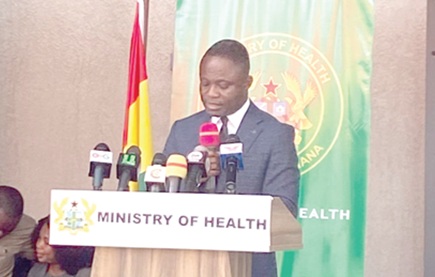
The Minister of Health, Kwabena Mintah Akandoh, has called on principals of nursing and midwifery training colleges to strictly adhere to admission quotas approved by the government and regulatory bodies or face sanctions.
“Everybody must strictly adhere to whatever the regulatory agencies will determine, whatever the ministry will determine, so that you don't give admissions based on your parochial interest,” he added.
The minister said exceeding approved quotas could undermine the quality of training in the institutions as the quotas were determined based on the capacity of each institution, including the number of tutors available, the strength of the faculty and facilities in each college.
He said two training institutions which breached the approved quota were currently under suspension for violating admission regulations, while others were undergoing administrative processes that could lead to sanctions.
“At the moment, about two of them are on suspension. Some are also going through the due process,” the minister said.
Mr Akandoh, who was speaking at the inauguration of advisory boards for health training institutions in Accra last Tuesday, added that “we will make sure that institutions admit according to their capacity. We will never allow any institution to admit beyond its capacity”.
Event
The inauguration of the boards across the country took place simultaneously.
Three main centres were used for the exercise — Accra, Kumasi and Tamale — with the Accra event covering about 28 institutions from the Volta, Oti, Eastern, Western and Greater Accra regions.

In all, more than 60 health training institutions were involved in the nationwide inauguration exercise.
Commitment
Mr Akandoh said the government was committed to strengthening the governance and quality of health training institutions to ensure that they produced competent professionals for the health sector.
He said the strength of the health system depended on the quality of its health professionals.
The minister said the government had shifted its focus from establishing nursing training institutions to expanding specialised nursing education since the country required health professionals with specialised competencies to deal with increasingly complex medical conditions.
As part of the initiative, specialised nursing programmes such as cardiology nursing, critical care nursing, nephrology nursing, oncology nursing and emergency nursing were being rolled out in selected training institutions to help address the growing burden of non-communicable diseases.
“Our goal is not only to train more nurses but to train the right mix of nurses with the right specialities,” he said.
Other initiatives include transitioning health training colleges to Bachelor of Science degree-awarding institutions and securing scholarship opportunities for tutors to pursue doctoral studies to enhance academic standards, among others.
Mr Akandoh said about 42 institutions had so far completed the necessary assessments and were awaiting accreditation to commence the degree programmes.
Advisory boards
The minister urged members of the newly inaugurated advisory boards to provide effective oversight and strategic direction to help improve the management and performance of the institutions.
He said the boards were expected to promote transparency, accountability and prudent management of institutional resources while supporting academic excellence and high standards of training.
“You are entrusted with an important governance mandate at a critical time in the development of our health professional education in this country,” the minister added.
Significance
Chief Director of the Ministry of Health, Desmond Boateng, said the inauguration of the advisory boards would help strengthen the country’s healthcare system.
He said health training institutions served as centres of academic excellence and were key to producing highly skilled, ethical and compassionate health professionals for the country.
He, therefore, urged the newly inaugurated advisory boards to support the institutions to improve training, promote research and innovation, and enhance access to quality healthcare services across the country.
