
President John Dramani Mahama has stated that the time is ripe for a bold reform and structural adjustments in how public sector emoluments are determined and managed, moving beyond the periodic incremental adjustments in salaries.
Consequently, he said the government would this year transition the Fair Wages and Salaries Commission (FWSC) into a new independent emoluments commission.
The President said the reform was not about dismantling progress achieved but would serve as the institutional core to bring about the transition.
“We will reinforce and reposition the Commission — both financially and in terms of human resources — so that it becomes the technical cornerstone of a modern, independent national authority capable of managing public sector pay with professionalism, independence and credibility,” he said.
The President acknowledged persistent challenges within the public sector, including disparities in pay, frequent labour disputes, and a remuneration framework that struggled to balance fairness with the country’s fiscal constraints.
He therefore said it would be designed to operate as a transparent, rule-based, and evidence-driven authority for setting public sector pay.
He assured labour leaders that the reform process would be implemented in phases and carried out in full consultation with organised labour.
Dialogue
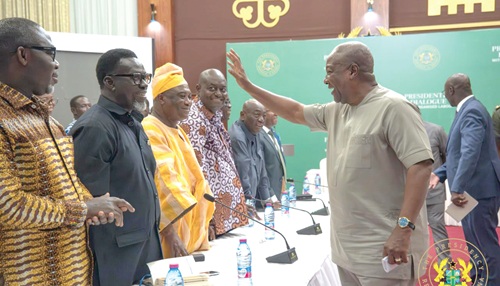
The President made these commitments during the Presidency Dialogue with Organised Labour at the Jubilee House in Accra last Tuesday.
It is designed to provide a platform for open dialogue between the government and labour unions.
It was to offer an opportunity for labour representatives to openly share their views on the performance of the government, the current state of the country, and practical suggestions for improving socio-economic conditions.
It was also to raise concerns about their welfare and working conditions.
The meeting brought 43 labour groupings under three major umbrella bodies, including the Trades Union Congress (TUC), the Ghana Federation of Labour, and other labour associations, together.
It forms part of ongoing efforts by the government to deepen stakeholder consultation and build consensus on policies to stabilise the economy and improve the welfare of Ghanaian workers.
As part of immediate measures, the President disclosed that 2026 would not see full-scale renegotiation of conditions of service across the public sector.
Instead, he said the government would introduce targeted and modest adjustments to specific allowances as an interim step to maintain macroeconomic stability.
“This is not a withdrawal from engagement with labour. It is a strategic effort to address the structural foundations of our compensation system in the interest of all,” he explained.
Pensions review
On pensions, Mr Mahama announced that the Ministry of Finance had been tasked to oversee a thorough review of the pension structure.
The review, he said, would expand coverage, especially to the informal sector, by modernising contribution systems and strengthening governance and investment management.
He said the pension system stood at a critical crossroads, as nearly two decades after the introduction of the three-tier pension system, coverage remained limited.
Mr Mahama revealed that out of an estimated 10 million workers, fewer than 2 million were active contributors, with pension assets representing only about seven per cent of GDP — well below continental benchmarks.
“If we fail to act, the imbalance between contributors and retirees will continue to deepen, threatening the system’s sustainability and the dignity of our future retirees,” he added.
The President urged organised labour to support the reform agenda, describing it as a shared national responsibility rather than a government-only initiative.
“We stand at a defining moment.
We can either continue with a system that produces tensions and unsustainable outcomes, or work together to build a modern, fair, and resilient framework,” he said.
The Minister for Labour, Jobs and Employment, Dr Rashid Pelpuo, assured labour leaders that the government would remain transparent, pledging to openly present details of the economy, salary frameworks, and the rationale behind policy interventions.
“We will open up clearly to you. You will understand the economy, the salary structures within which we operate, and the need for policy interventions,” he said.
The Chief Executive Officer of the FWSC, Dr George Smith-Graham, said the country continued to pay a heavy price for labour disputes as strikes in recent years had resulted in significant financial losses.
He said Ghana recorded 22 strikes in 2024, costing the state approximately GH¢1.47 billion, while eight strikes in 2025 led to a loss of about GH¢635 million.
He said the Single Spine Salary Structure was originally introduced to correct major distortions in public sector pay and had achieved considerable success in its early stages; however, the system had deteriorated.
He therefore welcomed the President’s proposal to establish an Independent Emoluments Commission, describing it as a necessary step towards restoring fairness, transparency, and consistency in the pay system.
“The Commission is ready for this transformation and will work closely with all stakeholders to ensure its success,” he said.
Concerns
Speaking on behalf of the TUC, Joshua Ansah raised concerns over what he described as persistent distortions in public sector compensation, urging greater transparency and fairness in how wage allocations were determined.
He questioned the composition of the government’s compensation budget, adding that while a significant percentage of national expenditure was allocated to wages, the distribution appeared skewed.
He said the daily minimum wage translated into less than GH¢600 a month, an amount which cannot meet the cost of food, rent and utilities.
“Even for basic meals, this income is barely sufficient,” he said, adding that workers on the Single Spine Salary Structure were not significantly better off, with the lowest earners taking home about GH¢809 monthly.
He urged the government to expedite negotiations on conditions of service, adding that delays by key institutions, including the FWSC and the Ministry of Finance, were increasing agitation among workers.
He welcomed plans to establish an Independent Emoluments Commission, but cautioned that the move alone would not resolve the deeper issue of low wages.
He called for the adoption of a national “living wage” policy to ensure workers met their basic needs.
On pensions, organised labour expressed deep concern over inequities within the system, noting that many retirees under the current three-tier scheme received significantly lower benefits compared to previous regimes.
He revealed that some pensioners received less than GH¢500 a month, while others received thousands of cedis, describing the disparity as unfair.
He urged the President to adopt a policy requiring employers to provide a reason for terminating a worker’s appointment, and incorporate that policy into the new labour law.
