
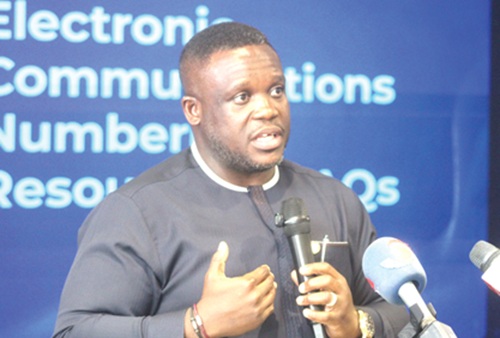
The Minister of Communication, Digital Technology and Innovations, Sam George, has assured Ghanaians that the upcoming SIM registration exercise will be the last, as the government rolls out a more robust, technology-driven system designed to enhance convenience and eliminate fraud.
He said the new process was fundamentally different from previous exercises, addressing longstanding concerns about inefficiencies, weak verification systems and public frustration.
“The fact that you have multi-agency collaboration on this is something that you didn’t see in previous times.
You have the NIA (National Identification Authority) being our single source of truth when it comes to IDs, the NCA (National Communications Authority), the ministry, Immigration Service, Ministry of Foreign Affairs, and other agencies all working together.

“What you see today is the product of very hard and difficult conversations, and that gives me the confidence that if we execute this right, this will be the final SIM registration exercise,” Mr George explained.
The minister was speaking at a stakeholder engagement with the media in Accra yesterday.
He stressed that the new regime would rely heavily on communication and public education to ensure smooth implementation, designed to correct flaws in earlier registrations, particularly the absence of proper biometric verification.
“This registration is 75 per cent communication and 25 per cent technology,” he said, emphasising that lessons from the past, where people faced difficulties, had informed a more user-friendly and transparent approach.
Verifications
Mr George also disclosed that the exercise would incorporate advanced biometric verification, including a “liveliness test”, that would capture facial features to authenticate users against the NIA database.
He explained that this would prevent the use of photocopied or fraudulently acquired Ghana Cards, which undermined the integrity of previous registrations.
The minister also ruled out the automatic migration of existing SIM data into the new system, despite a significant portion of previously registered numbers passing verification checks, explaining that such a move would only transfer existing flaws into the new system.
“You are not cleaning up. You are actually migrating the viruses.
You have infected files, and you are migrating them onto a new system.
You are basically replicating the problems of the old system.
And that's part of the reason why we can't do a wholesale migration. And that's cured today by NIA's solution that they are offering to us based on the collaboration we are having with them,” he said.
Comfort, advantages
On convenience, Mr George indicated that the process would allow for self-registration using smartphones, enabling users to complete the process from the comfort of their homes without the need to queue at service centres.
He added that an appointment system would also be introduced for those requiring in-person assistance, while mobile registration teams would be deployed nationwide.
The minister further revealed that Ghana Post offices and Community Information Centres would be leveraged to expand access, particularly in rural areas.
He also indicated that the rollout of the new SIM registration exercise would commence only after the completion of the legal framework, which was currently undergoing review and would be laid before Parliament.
He gave an assurance that extensive stakeholder consultations would continue to ensure a smooth and widely accepted implementation.
Mr George warned that individuals whose Ghana Cards were linked to fraudulent SIM registrations risked being blocked from accessing telecom services if found culpable more than once.
He said the government was determined to strengthen trust in digital services, reduce mobile money fraud and improve the overall integrity of the telecommunications ecosystem.
The Director-General of the NCA, Edmund Yirenkyi Fianko, said the new exercise aimed to create a more inclusive, efficient and secure SIM registration system intended to build a credible and trustworthy national SIM register.
He explained that the initiative would be supported by a Central Equipment Identity Register (CEIR), which would enable the blocking of stolen or illegal mobile devices across all networks.
Mr Fianko explained that the system would discourage phone theft and prevent unauthorised devices from operating on the country’s telecom networks.
He also emphasised the importance of protecting personal identity, cautioning the public against registering SIM cards on behalf of others.
“All we are doing is trying to strengthen confidence in the mobile ecosystem through the registration of numbers and linking them to the central identity register so that we can also protect the devices.
“We are still at the stakeholder stage, taking feedback, and technical engagements going on behind the scenes, and will eventually come out with more communication,” Mr Fianko added.
