
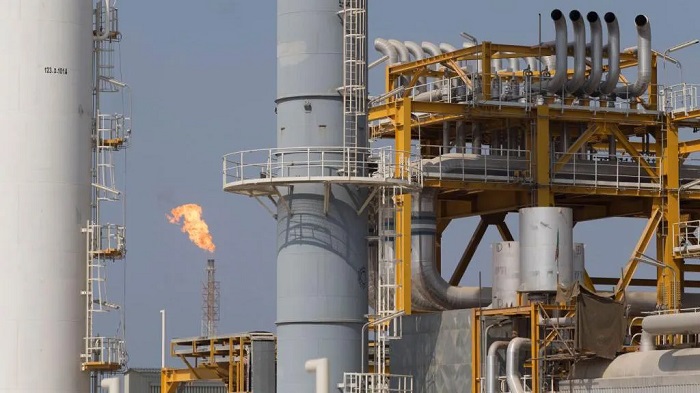
Oil and gas prices have risen sharply after fresh strikes hit energy infrastructure in the Middle East, including Qatar's main gas facility.
Gas prices were up nearly 25% on wholesale markets in the UK and Europe in early trading, before easing slightly.
The price of gas in Europe is more than double the level seen before the US-Israeli war with Iran began.
Oil is also trading higher, with Brent crude soaring past $115 a barrel, a rise of 7%.
UK gas prices are currently up by 23% to 171p per therm.
The jump comes after Iran's South Pars gas facility – one of the world's largest natural gas fields – was hit on Wednesday evening.
Iran retaliated by targeting a major liquefied natural gas export facility in Qatar, causing "extensive damage", raising concerns over the global energy supply.
The strikes on Ras Laffan follow reports that Israel hit Iran's petrochemical complex on the South Pars gas field.
The latest news rattled stock markets, as investors become increasingly concerned of the potential economic impact of a prolonged conflict.
In Japan, the Nikkei share index closed down 3.4, and in London the FTSE 100 was down 1.7% on Thursday morning.
Matthieu Favas, commodities editor at The Economist, told the BBC's Today programme that the rise in gas prices was "huge".
"This is on account of the attack of the gas facility in Qatar, which was offline, but the hope would be that it would be restarted within weeks, but the attack now - several missiles aimed at this facility, one of them hitting directly - makes it clear that this is unlikely to happen.
"This could last months and these facilities provide a fifth of the global supply of liquid natural gas, which is why the market is reacting the way it is now, it's pricing in long-lasting disruption."
However, he said prices were still a long way off the peaks seen in the aftermath of Russia's invasion of Ukraine.
Iran's military had warned it would take "decisive action" in response to the strike on its energy infrastructure.
"As previously warned, if the fuel, energy, gas, and economic infrastructures of our country are attacked by the American-Zionist enemy, in addition to a powerful counterattack against the enemy, we will severely strike the origin of that aggression as well," the military said in a statement published by Tasnim, a news agency affiliated with the Islamic Revolutionary Guard Corps.
"We consider targeting the fuel, energy, and gas infrastructures of the countries of origin legitimate and will retaliate strongly at the earliest opportunity."
Qatar also operates facilities on the gas field, which it calls North Dome.
But the country, which produces a fifth of the world's liquefied natural gas, had halted production earlier in March in response to the conflict.
Ras Laffan was among the sites listed by Iran as a possible target following the attack on the South Pars gas field.
Just after 19:00 GMT on Wednesday, Qatar's interior ministry said that it had "initially brought the fire in Ras Laffan under control, with no injuries reported".
'Energy markets will likely remain volatile'
AJ Bell's head of financial analysis Danni Hewson said the attack and retaliation by Iran had "helped dial up the temperature once again and put renewed upward pressure on oil prices".
"Any solution to the blockage of the Strait of Hormuz looks pretty distant at this point and until there is progress on that front, energy markets will likely remain volatile," she added.
The White House on Wednesday responded to the rising oil price by saying it was suspending the Jones Act — a 1920 law that says only American-made ships can be used to transport goods between US ports.
US Press Secretary Karoline Leavitt said the 60-day waiver of the rules, which are intended to boost shipbuilding, will allow "vital resources like oil, natural gas, fertiliser, and coal to flow freely" as non-American-made ships can now be used.
However, maritime groups in the US said the effect would be minimal, noting that oil prices, not shipping costs, are behind rising prices at the pump.
Experts say earlier efforts by world leaders to ease price pressures, including an unprecedented release of oil reserves, have done little to reduce oil prices.
Meanwhile, Iran has also suspended the flow of gas to Iraq to shore up domestic supplies, a senior Iraqi official told Reuters.
The vast majority of Iran's gas supply - 94% - is used domestically, according to data from the Gas Exporting Countries Forum.
