
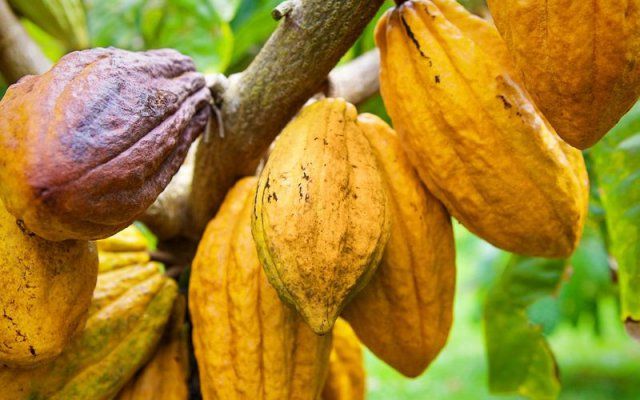
The government has decided to stop foreign funding for cocoa purchases and instead use domestic funds to buy the crop.
President John Dramani Mahama, who reiterated the Cabinet decision taken last Wednesday, explained that the move was aimed at boosting local processing and economic growth.
Speaking at the Accra Reset Summit, a high-level side event at the 39th AU Summit in Addis Ababa, Ethiopia, last Saturday, President Mahama revealed that the nation had sufficient capacity to process 400,000 tonnes of cocoa beans locally, but current arrangements compelled the shipment of the beans abroad due to collateralisation.
“We're going to raise domestic funds.
We have enough cedis in Ghana to pay for it; we're going to raise domestic funds and buy our own cocoa,” the President stressed.
“We don't need to collateralise the beans. You know the interesting fact, we have the capacity to process 400,000 tonnes of those beans in Ghana, but because the beans are collateralised, we cannot even allocate those beans to the local processors. We have to ship all the beans outside,” he added.
Accra Reset
The Accra Reset is an Africa-led initiative calling for a reimagined global order that empowers nations to lead resilient and self-sustaining responses in health.
It was launched by President Mahama last year on the sidelines of the 80th UN General Assembly.
Last Saturday’s event in Addis Ababa was graced by some former Heads of State and delegations across the world, including a former Nigerian President, Olusegun Obasanjo; former President of Liberian, Ellen Johnson Sirleaf; the Secretary-General of the African Continental Free Trade Area (AfCFTA) Secretariat, Wamkele Mene; the Minister of Foreign Affairs, Samuel Okudzeto Ablakwa; the Minister of Local Government, Chieftaincy and Rural Development, Ahmed Ibrahim, and the Minister of Works and Housing, Kenneth Gilbert Adjei.
Explaining the circumstances leading to the current crisis in the cocoa sector, President Mahama said the government had set the producer price at 70 per cent of the world market price, which was $7,200 per tonne at the time.
However, with the international price plummeting by nearly 42 per cent, coupled with the appreciation of the cedi, a significant gap has been created, which the government has to absorb.
“The cedis’ value was GH₵11.50 for $1 when we set the price.
After we set the producer price, the world market price has declined to $4,200.
The cedi has shifted its value to GH₵10.70. So, suddenly it means that for every tonne you buy at the producer price, you have a gap, and so we'll be losing,” President Mahama said.
Local processing impact
The President affirmed that local processing was key to driving economic growth and development, saying, "that is the only way we can provide opportunities for our young people".
The measure is expected to increase local processing capacity, create jobs, boost economic growth, and strengthen the nation’s position as a major player in the global cocoa and minerals markets by adding value to its raw materials.
The President stressed that Africa’s youth were calling for progress and prosperity, hence the need for nations to implement strategies that would create the needed opportunities for them and avert the tragedies associated with crossing the Mediterranean Sea to seek greener pastures in Europe.
“Our young people are not as patient as our generation.
They want to see that progress and prosperity today.
“That is why the country has that tendency that we need to implement in order that we stop our young people from brazing the dangers of the Sahara and the Mediterranean, trying to get to Europe to look for opportunity,” President Mahama said.
He urged African leaders to start implementing the initiative to give Africa the opportunity to thrive and create better opportunities for its people.
Internal funding
For his part, former President Obasanjo urged African leaders to mobilise funds internally for the continent’s development, although external resources were also available to the continent.
“Both internally and externally, the money to develop Africa is there.
The problem is mobilising the internal resources adequately, without corruption, without risk, without unnecessary non-self-help, and to channel them to development. We've been told that we can mobilise up to $4 trillion internally,” he said.
The former Nigerian President called for practical action to implement the African Union's Free Movement Protocol, saying the continent should start with countries that already offer visa-on-arrival to citizens.
He indicated that even AU officials, including the Chairperson of the AU Commission, did not have an AU passport, which was planned to be rolled out, underscoring a gap between policy and implementation.
Former President Obasanjo proposed that interested countries should form "Leagues of African Free Movement Countries", abolish visa requirements and gradually expand the league to include more nations.
He also advocated transactions in local currency to simplify trade and boost intra-African trade and economic integration.
Former President Obasanjo also commended President Mahama for the great effort he had made in drawing the Accra Reset Agenda, a tool for Africa to be self-reliant.
