
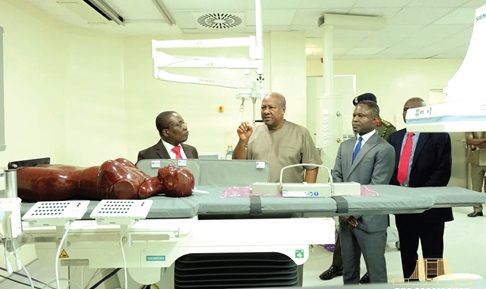
President John Dramani Mahama yesterday commissioned a new ultramodern cardiac catheterisation laboratory at the National Cardiothoracic Centre Korle Bu Teaching Hospital (KBTH), describing the facility as a significant milestone in Ghana's quest to build an equitable, resilient, and responsive healthcare system.
The facility, funded through the Ghana Medical Trust Fund, replaces the previous laboratory destroyed by fire in March 2025.
It becomes the first of such centres being constructed in major public hospitals in the country after a medical doctor, Dr Kwame Adu Ofori, formerly of the Komfo Anokye Teaching Hospital (KATH) in Kumasi, suffered a myocardial infarction that required percutaneous coronary intervention (PCI), a service provided by a catheterisation laboratory, and died before emergency services could be accessed for him in Accra.
The country has since embarked on a drive to construct such laboratories at Kath in the Ashanti Region, the Tamale Teaching Hospital in the Northern Region, and at KBTH.
The new laboratory comes with advanced technology capable of diagnosing and treating complex cardiovascular conditions, including coronary artery disease, structural heart disease, and peripheral vascular diseases.
Speaking at the commissioning ceremony, the President emphasised that the Ghana Medical Trust Fund, initially conceptualised to address the financial burden of non-communicable diseases, had evolved into a comprehensive nation-building instrument.
"When we conceptualised the Ghana Medical Trust Fund, our initial focus was on the financial burden patients faced in accessing diagnosis and treatment for non-communicable diseases," the President stated.
"However, we soon realised that the challenge extended beyond financing," he added.
Specialised care
President Mahama said the fund’s GH¢2.3 billion allocation now supported not only diagnosis and treatment, but also healthcare infrastructure development and the training of skilled personnel to deliver specialised care.
"Healthcare delivery requires more than financing treatment and providing medical equipment. It requires skilled healthcare professionals who are capable of operating those facilities and providing quality care to patients," he explained.
In a move to address the shortage of specialised healthcare professionals, the President announced that the first nursing training facility at Korle Bu Teaching Hospital had already commenced training critical care nurses in nephrology, cardiovascular care, oncology, and other specialised fields.
He said Cabinet had approved the recruitment and training of 500 additional nurses, with the next training centre to be established at KATH.
Drawing lessons from past experiences, the President revealed a new sustainable approach to healthcare equipment management, saying Cabinet had approved the establishment of the Ghana Medical Equipment Services Limited as a subsidiary of the Ghana Medical Trust Fund.
"During my tenure as Vice-President under the late President Professor John Evans Atta Mills, we invested about $250 million to retool major regional and teaching hospitals across the country. However, a few years later, we discovered that much of the equipment had broken down due to inadequate maintenance," President Mahama recalled.
He added that "The company (for medical equipment) will consist of specialised biomedical engineers responsible for supervising the use, maintenance and management of medical equipment.
Where equipment becomes obsolete or cannot be repaired, the Ghana Medical Equipment Services Limited will serve as the vehicle for replacement".
Broader strategy
The President outlined the government's broader strategy to strengthen specialised healthcare delivery across the country, revealing that comprehensive cardiology centres would be established at KATH and Tamale Teaching Hospital, bringing specialised cardiovascular care closer to millions of Ghanaians in the middle and northern parts of the country.
"Healthcare must never depend on geographical location. Every Ghanaian deserves equal access to quality specialist services," he said.
Similar facilities will also be established at Effia Nkwanta Hospital in Takoradi and Ho Teaching Hospital in the Volta Region.
The President indicated that Ghana's disease profile had changed considerably over the years, with non-communicable diseases such as cardiovascular diseases, strokes, cancers, kidney failure, diabetes, and hypertension now contributing substantially to premature deaths and long-term disabilities.
"Many families have exhausted their savings, sold valuable assets or abandoned treatment altogether because specialised healthcare was beyond their financial means. No responsible government can ignore this reality," he said.
Maternity block
The President also announced that the government was progressing with procurement arrangements for the construction of a new maternity block for the KATH, with plans to demolish the old Guggisberg building, which had become unsafe.
"Every day, our mothers continue to give birth in that building, and we cannot allow such a situation to continue," he said.
The President commended doctors, nurses, pharmacists, biomedical engineers, laboratory scientists, technicians, and all healthcare workers whose dedication makes these achievements possible.
"While modern equipment is important, it is your knowledge, compassion and professionalism that ultimately save lives," he said.
He also acknowledged the board and management of the Ghana Medical Trust Fund, the Ministry of Health, the management of KBTH, the National Cardiothoracic Centre, the contractor, and all partners who contributed to the project.
The President emphasised that the true measure of the facility would not be the sophistication of its equipment but the lives it saved, the families it kept together, and the hope it restored to the nation.
