
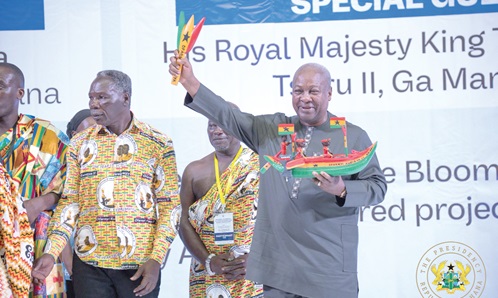
President unveils measures to safeguard fisheries sector
President John Dramani Mahama has announced a series of decisive measures to safeguard Ghana’s fisheries, including the creation of the nation’s first Marine Protected Area and the extension of the inshore exclusive zone for artisanal fishing.
He explained that the new initiatives were part of a broader strategy to develop a “sustainable, modern fisheries sector rooted in science, tradition and community participation.”
These include the passage of the Fisheries and Aquaculture Act and the creation of the inshore exclusive zone.
Addressing a gathering of traditional leaders and stakeholders at the National Chief Fishermen and Fishmongers Conference in Accra yesterday, President Mahama said the initiatives also reaffirmed the shared commitment to safeguarding Ghana's fisheries and enhancing the fisheries sector.
Event
The event was attended by the Ga Mantse, King Tackie Teiko Tsuru II; the Minister of Fisheries and Aquaculture, Emelia Aurthur; the Greater Accra Regional Minister, Linda Obenewaa Akweley Ocloo; the Minister of Local Government, Chieftaincy and Rural Development, Ahmed Ibrahim; members of the clergy and international partners.
Some of the critical topics examined included understanding the new Act 1146 and the roles of chief fishermen and fishmongers; community-driven monitoring of Ghana's inshore exclusive zone;combating illegal fishing, national unreported and unregulated fishing; integrating traditional knowledge with modern science, transparency and accountability in community resource management.”
It was convened to coincide with World Fisheries Day on November 21.
Interventions
President Mahama emphasised that these key interventions were to address the challenges confronting the sector.
He mentioned some of the challenges to include illegal, unreported and unregulated fishing with unapproved gear, light fishing, transshipment at sea known as ‘saiko’ which continues to undermine the fish stocks.
Additionally, the impact of climate change which was intensifying these threats with the warming waters, changing patterns of fish migration, and increasing coastal erosion, “leading to declining catches, falling incomes, worsening poverty, and growing uncertainty for many families whose livelihood depends on the sea,” he stated.
The passage of the Fisheries and Aquaculture Act 2025, which is Act 1146, was therefore, key to resolving these challenges, describing it as a landmark legislation with the key innovation being the “extension of the inshore exclusive zone from six nautical miles to 12 nautical miles to protect artisanal fishes.”
He said the Act also provided “enhanced penalties for IUU fishing and related offences” and a “strengthened co-management framework that places chief fishermen and queen fishmongers at the heart of decision making.”
Beyond the Act, President Mahama said Cabinet recently approved the creation of the Cape Three Points Marine Protected Area.
“This area will serve as a sanctuary for rebuilding fish stocks, protecting biodiversity, and ensuring a long-term ecological balance of our ocean,” he said, among other initiatives such as the National Blue Economy Strategy, which he said was taking shape.
The forthcoming strategy, the President said, “is built on six key pillars. Blue wealth, blue health, blue knowledge, blue finance, blue equity, and blue safety and security.
This will harness Ghana's marine and coastal resources for sustainable and inclusive national growth,”he stated.
Recognition
Directly addressing the chief fishermen and queen fishmongers, President Mahama pledged the government’s support, stating, “I pledge that this government will restore respect and formalise your roles.”
He referred to the theme for the conference, “Resetting Fisheries, Chief Fishermen and Fishmongers as Guardians and Partners in Sustainable Fisheries Management,” as “timely and visionary,”explaining that “It places our traditional leaders, that is our chief fishermen and queen fishmongers, at the very front in order to ensure our ever-changing fishing and fishery activities.”
Transformation
The Fisheries Minister described the gathering as both “historic and necessary,” noting that “the transformation we seek in the fisheries sector depends on the leadership, experience and authority of our traditional custodians, those who preserve discipline, cohesion and indigenous knowledge within our coastal communities.”
Ms Arthur noted that the presence of the President and the Ga Mantse “highlights the national importance of fisheries to our economy, food security and cultural identity and affirm the central role of traditional leaders in safeguarding this heritage.”
She stressed that with the passage of the new Fisheries and Aquaculture Act 2025, Act 1146, “it is timely and essential that key actors come together to understand the law, clarify their responsibilities and strengthen the partnership between communities and government.”
The minister noted that “only through shared stewardship, can we ensure compliance, transparency and sustainable recovery of our fisheries.”
