
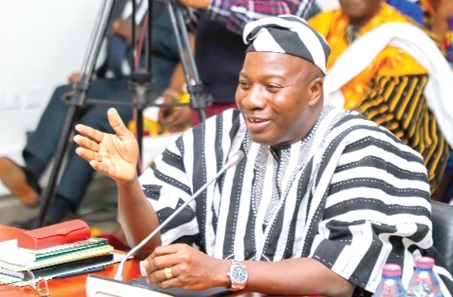
The Minister designate for Local Government, Chieftaincy and Religious Affairs, Mahama Ayariga, has said he will introduce a technology-driven system to help Metropolitan, Municipal and District Assemblies (MMDAs) identify, value and collect property rates to boost local revenue.
He said the initiative could unlock an estimated GH¢20 billion annually in property rates alone, describing the potential revenue base of the assemblies as enormous.
Mr Ayariga, who is also the Member of Parliament (MP) for Bawku Central, was responding to questions from Parliament’s Appointments Committee during his vetting yesterday.
Untapped potential
Mr Ayariga said the 1992 Constitution envisaged assemblies as largely self-financing entities, with the District Assemblies Common Fund intended primarily for development.
However, he said that objective had not been achieved because many assemblies had failed to fully exploit their revenue potential.
The outgoing Majority Leader cited property rates, basic rates, market tolls and lorry park fees among the revenue sources available to assemblies.
According to him, conservative estimates showed that property rates alone could generate about GH¢20 billion annually.
Digital system
Mr Ayariga said his first major intervention, if approved, would be to establish an infrastructure to identify all ratable properties across the country.
He explained that the existing street naming and property addressing system only located properties, but did not provide information on their nature or value for taxation purposes.
The Local Government Minister designate, therefore, proposed a nationwide exercise to properly identify, describe and value properties to enable assemblies to levy appropriate rates.
He also promised measures to strengthen transparency and prevent revenue collected by assemblies from being misappropriated.
Responding to a request from the Chairman of the Committee, Bernard Ahiafor, to clarify his earlier comments on the utilisation of the DACF and the role of MPs, Mr Ayariga stressed that MPs were not entitled to the entire Common Fund of an assembly.
He said its use was guided by ministry guidelines and decisions of the respective assemblies on the projects to undertake, their locations and execution.
Mr Ayariga explained that Parliament allocated only a small amount within the formula for MPs to identify priority projects in their constituencies.
The Bawku Central lawmaker added that the money remained in the assembly’s account, with MPs only directing which projects should be undertaken, including emergencies such as storm-damaged schools or shortages of basic amenities at health facilities.
The assembly handled procurement, engaged contractors and made payments upon completion and certification, the Local Government Minister designate stated.
“The MP's only role is in directing which project to do with the small amount, not that the money is given to the MP,” he said.
MMDCE Elections
When he was asked about local government reforms, Mr Ayariga said reforms to local governance must balance local participation with the President’s executive authority.
He supported a system where MMDCEs would be accountable directly to voters, while warning that fully open elections also could create conflicts, unless the spheres of authority between the President and local executives were clearly defined.
Galamsey
Answering a question on small-scale mining and the illegalities associated with it, the nominee advocated a shift from treating all informal mining as criminal activity and that the state should strengthen and regulate legal small-scale and artisanal mining.
Mr Ayariga proposed greater investment in the Environmental Protection Authority (EPA) and the Minerals Commission, including the recruitment of more district-level mining engineers, to monitor operations, enforce environmental standards and ensure land reclamation.
He stressed that mining in water bodies and cocoa farms must not be allowed.
National Cathedral
On the National Cathedral, he described the idea of a National Cathedral as worthwhile, given the country’s religious character, but said the previous project was poorly executed.
Mr Ayariga questioned its location and the demolition of existing facilities, and argued that greater private and philanthropic funding should have been mobilised.
If approved as Minister, the Bawku Central MP said he would support efforts to revive and complete the project.
Chieftaincy
The Local Government, Chieftaincy and Religious Affairs Minister designate pledged a listening and conciliatory approach to chieftaincy affairs, stressing that ministers had no constitutional mandate to interfere in chieftaincy disputes.
The role of the minister, Mr Ayariga stated, was to support traditional institutions with resources and facilitation, while disputes remain the preserve of the Houses of Chiefs and the Supreme Court.
