
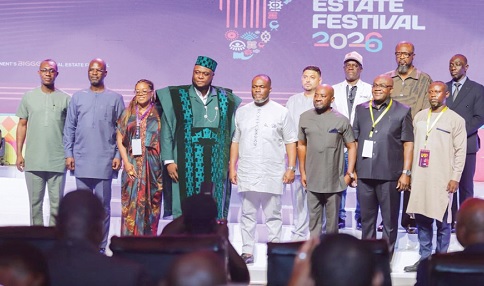
Real estate must go beyond land, buildings — Housing Minister
The Minister of Works, Housing and Water Resources, Kenneth Gilbert Adjei, has declared that Africa’s next housing and urban development must deliver affordability, liveability and resilience.
He, therefore, urged stakeholders to rethink real estate beyond land and buildings, adding that innovation must not come at the cost of identity.
Speaking at the inaugural Africa Real Estate Festival (AREF) 2026 in Accra last Saturday, he said, “real estate is about the spaces where people live, work and connect. It influences safety, dignity, productivity and social cohesion, while also reflecting our cultural identity. In essence, real estate is about place, not just property,” he said.
The two-day event brought together state regulators, diaspora investors and industry titans on the theme: “Innovation Meets Identity: Designing Africa’s Next Living Experience.”
It was organised by AREF in collaboration with Nilex Properties, Goldkey Properties, the Ministry of Works and Housing and the Real Estate Agency Council (REAC).
Private sector
Mr Adjei stated that in Ghana, the private sector delivered nearly 90 per cent of housing, according to the Ghana Statistical Service.
“The government alone cannot close the housing gap. We, therefore, call on the private sector to scale up investment, adopt innovative delivery models and align with national housing priorities,” he added.
He outlined a series of government policies and reforms aimed at transforming the housing sector, such as repositioning the National Affordable Housing Programme to support large-scale, mixed-income housing through public-private partnerships and decentralising housing delivery so that every district contributes to reducing the national deficit.
According to him, the Rent Act was under review to improve fairness, strengthen tenant protection and create a more stable rental market.
In partnership with the Lands Commission, Mr Adjei said the government was advancing land administration reforms to streamline land acquisition, strengthen title security and reduce delays.
He further announced the promotion of local building materials and green construction methods to cut costs, support sustainability and lower carbon emissions.
Additionally, he said innovative housing finance solutions were being developed with financial institutions to expand access to mortgages and long-term housing finance.
Industry players
Earlier, the AREF Founder and Chief Executive Officer (CEO), Desmond Kwesi Oteng, said that for too long, the most important conversations regarding African land and luxury had taken place in boardrooms in London, Dubai or the United States of America.
Therefore, he said, the convening of AREF on African soil signalled an end to “narrative outsourcing,” challenging the 1,500 delegates with a provocative question: “Who builds Africa?”
He applauded the ministry’s leadership, noting that the most powerful signal a government could send was not just incentives, but “certainty.”
The REAC said a transparent market was sustained through professional standards and effective policy and reminded practitioners of the ban on cash transactions under the Real Estate Agency Act, 2020 (Act 1027) – a move to eliminate fraud and money laundering.
The Legal and Corporate Affairs Director of Nilex Properties, Alex Kofi Osei-Owusu, shared the story of the company’s 19-storey ocean-front development as proof of what African capital and bold architectural vision could achieve.
Notably, he said Nilex Properties paired technical expertise from Mumbai with a dedicated team of local Ghanaian architects, adding that “we want to work with local architects.”
