
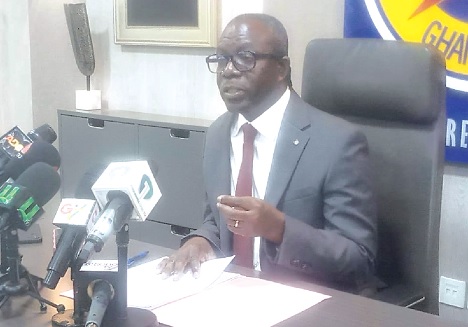
The Electricity Company of Ghana (ECG) has developed a comprehensive programme to address the reliability challenges and transform its network capacity, the acting Managing Director (MD), Kwame Kpekpena, has said.
The programme, valued at GH¢3.46 billion, has been structured into five categories based on how urgent they are and the timeline for implementation.
“I’m happy to announce that with the support of the Ministry of Energy and Green Transition, we are committed to executing this investment programme,” Mr Kpekpena said at a news conference in Accra yesterday.
Breakdown
Mr Kpekpena said the first category of GH¢278 million investment consisted of actions that needed to be implemented immediately to stabilise supply and improve voltage quality.
Under this category, the company is installing 2,500 transformers to relieve the overloaded ones in the system.
That comprised the replacement of 1,600 rotten poles in the low-voltage network under Operation Keep the Lights On (OKLO), installation of 2,500 11-meter treated poles for network reinforcement under OKLO, provision of cable termination and joint kits for underground cable fault rectification, including 33 kilovolts (kV) and 11kV cable systems.
Others are the replacement of rectifiers and protection systems at substations across the Accra East, Accra West, Ashanti, Tema, Western, and Volta regions, and the distribution of 28,000 fuses and 240 distribution panels to restore and protect low voltage (LV) networks.
Mr Kpekpena said the next phase of the programme, which is from six months to 12 months at the cost of GH¢1.2 billion, involved more substantial network construction and reinforcement.
Construction
Mr Kpekpena said it covered the construction of new Distribution Control Transfer Links (DCTLs) to provide alternative supply paths, continuation and completion of stalled primary substation projects, continuation of the Regional System Improvement Projects (RSIPs) across all regions, injection of additional distribution transformers, upgrade of undersized conductors to improve system voltages and the replacement of damaged and multi-jointed underground cables.
It will also include the installation of network control equipment, including Vacuum Interrupter Technologies, isolators and reclosers.
Category three, Mr Kpekpena said, was the backbone infrastructure, which would take 12 to 18 months to complete at the cost of GH¢1.93 billion.
“These are the backbone investments that will permanently transform ECG's capacity to deliver reliable power,” the acting ECG MD stated.
Projects
Category four will cater for other backbone projects covering 18 to 24 months and is expected to cost GH¢58.2 million, which the MD said would include the construction of a sub-transmission link from Station E (Graphic Road) to Station D (Avenor) in Accra, re-insulation of selected feeders, including Afram Plains and Prampram, from 11kV to 33kV, reconfiguration of the Asesewa 33kV feeder, Suhum-Nsawam feeder works, and construction of substations in the LETAP, Bel Aqua, and Borteyman areas.
For Category five, which is for project support resources, Mr Kpekpena said it would cover a period of up to six months, costing GH¢32.2 million.
“To deliver these projects at speed, ECG is also procuring critical field resources, including 14 pick-up vehicles, 50 boom trucks (three-tonne and 10-tonne), four bucket trucks, and 104 chainsaws, equipment essential to enabling our field teams to execute works efficiently across all operational areas,” he said.
Area-specific intervention
Mr Kpekpena said there was also area-specific intervention in place.
“We recognise that behind every outage statistic is a household, a business, a school or a clinic,” he explained.
The Ashanti Region, for instance, was experiencing one of the most severe episodes of supply deterioration among the major cities ECG serves.
He added that the challenges were structural: both the medium-voltage and low-voltage distribution networks were heavily overloaded at multiple points across the city.
“ECG is implementing a multi-pronged strategy for Kumasi.
An aggressive preventive maintenance programme is ongoing to identify and address defects before they escalate.
On transformer injection, ECG needs to inject over 300 additional distribution transformers in the Kumasi network alone.
“The injection programme has commenced and will be accelerated as procured equipment is delivered,” the ECG MD stated.
The scope of work in Kumasi includes nine major network reinforcement and construction projects valued at GH¢1.11 billion, and 64 minor projects valued at GH¢17.9 million, Mr Kpekpena said, adding that ECG had re-engaged contractors to remobilise to those project sites, with construction expected to resume from next month.
Ultimately, Kumasi also requires a third Bulk Supply Point (BSP), a medium-to-long-term initiative being planned jointly with Ghana Grid Company (GRIDCo), he explained.
Volta, Oti regions
The Volta and Oti regions, he said, were the hardest hit by low voltages in the ECG operational areas, and the challenge was essentially from the national transmission grid.
He revealed that GRIDCo was leading the effort to upgrade the transmission system voltage from 69kV to 161kV.
“With government support, planning and procurement for Phase 1 of what is dubbed the Eastern Corridor Transmission Project have begun in earnest.
“It involves the construction of a 45km 161kV transmission line from Asiekpe to Ho and a new Bulk Supply Point (161/34.5 kV) substation at Ho,” Mr Kpekpena stated, saying that would improve voltages along the entire transmission corridor from Asiekpe to Kedjebi within standard values.
The ECG MD mentioned other areas of intervention as Enchi, Dadieso, Juaboso, Mpohor, Accra East, Lakeside, Teiman, Kasoa and Lashibi.
“ECG has developed a detailed Activity Schedule for Network Interventions covering April to September 2026.
This schedule tracks the mobilisation and planning phase, procurement and logistics, phased transformer replacements across all operational areas, rotten pole replacement, cable works, and protection system replacements.
“To every Ghanaian customer who has endured inconvenient and prolonged power outages, we sincerely apologise.
We want you to know that we have heard your voice, and that addressing the reliability challenges is our singular operational priority,” Mr Kpekpena stated.
