
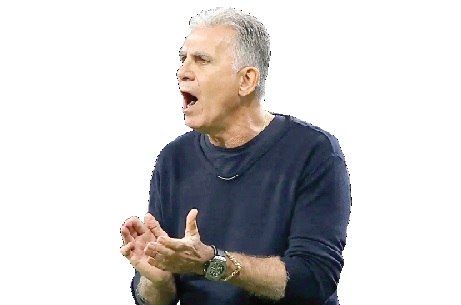
Sports Editorial: Queiroz must fix broken Black Stars or Ghana’s World Cup dream collapses
Ghana’s decision to hand the Black Stars to Carlos Queiroz on the eve of the 2026 FIFA World Cup is not merely bold — it is a high-risk, time-compressed gamble that leaves no margin for hesitation.
This is not a rebuilding project. It is a rescue mission. And the overriding imperative is brutally clear: hit the ground running or fail.
With barely weeks between appointment and Ghana’s opening fixture against Panama, Queiroz does not have the luxury of extended training camps, tactical experimentation or gradual cultural imprinting.
The traditional rhythms of national team preparation have been replaced by urgency. Every decision — from squad selection to tactical structure — must be decisive, efficient and immediately translatable to performance.
The data underpinning his appointment is damning. Ghana arrive at the tournament off a run of defensive collapse and attacking bluntness — 11 goals conceded in five matches, just two scored. This is not a team lacking talent; it is a team lacking structure, cohesion and clarity.
Queiroz’s mandate is therefore surgical: restore defensive organisation, impose tactical discipline and stabilise a fragile system before it unravels completely.
His first priority must be defensive integrity. Ghana’s recent performances have exposed systemic weaknesses — poor positional awareness, slow defensive transitions and a lack of midfield shielding.
Queiroz’s career has been built on correcting precisely these deficiencies. His compact defensive blocks, controlled pressing triggers and structured midfields are designed to reduce chaos. That alone could make Ghana competitive again.
Second is clarity of roles. With limited preparation time, complexity is the enemy. Every player must understand their function both in and out of possession.
Queiroz’s systems thrive on collective discipline, with players knowing when to drop, when to press, when to hold shape. In a compressed timeline, simplicity executed perfectly will outperform ambition executed poorly.
Third is transition efficiency. With key attacking uncertainties, including injuries and inconsistent form, Ghana cannot rely on expansive attacking football. Instead, they must maximise moments: quick transitions, exploitation of wide areas, and ruthless use of second balls.
This is where individual quality in Antoine Semenyo, Jordan Ayew and Thomas Partey must be channelled into a coherent attacking outlet.
However, the tactical dimension is only half the equation. The more decisive variable may lie in governance and stakeholder alignment. Queiroz’s history is clear: he demands authority, structure and professionalism.
Where those conditions are absent, conflict follows. Ghana cannot afford institutional friction at this stage.
The Ghana Football Association, government stakeholders and the playing body must operate with unusual cohesion.
Administrative delays, selection interference or logistical inefficiencies will not just undermine preparation because they will sabotage the entire project.
This is a short-term, high-stakes alignment exercise. Everyone must pull in one direction.
There is also a psychological reset required. Queiroz’s “siege mentality” — us against the world — may be precisely what this team needs.
In a hostile tournament environment, unity, discipline and emotional control often compensate for preparation deficits.
Ultimately, this is not about perfection.
It is about competitiveness. Ghana do not need to dominate games; they need to survive them, control key moments and remain structurally intact long enough to exploit opportunities.
Time is the one resource Queiroz does not have. But clarity, discipline and alignment are still within reach.
If those elements are delivered, quickly and without compromise, this 11th-hour experiment could yet transform from a desperate gamble into a calculated recovery.
If not, it will unravel just as quickly as it was assembled.
