
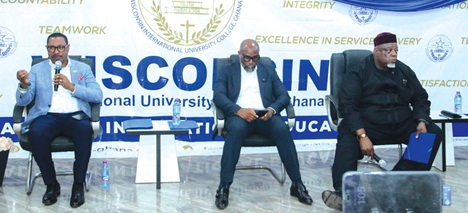
The Chief Executive Officer (CEO) of Dalex Finance, Joe Jackson, has called for the unlocking of more than GH¢60 billion in local pension funds to finance the government’s 24-Hour Economy programme.
Speaking at a seminar organised by the Wisconsin International University College Ghana Business School in Accra last Tuesday, he argued that funding was not the primary constraint to the policy’s success, saying there was sufficient domestic liquidity, which needed alignment, coordination and disciplined execution to drive structural transformation.
“Everywhere you go, pension funds fund the country's development.
In Ghana, the pension funds are locked away because they can only buy treasury bills. Let’s release pension funds.
The sad thing is that when the Europeans give us money in the Eurobond, it is somebody's pension fund.
We sit here, we have billions in pension funds, and yet, go and get somebody else's pension fund,” Mr Jackson said.
The seminar was on the Theme: “Building Ghana's 24-Hour Economy: Challenges and Opportunities”.
It formed part of the university’s Business Week celebrations, and brought together participants from academia, business and government for discussions and networking.
Discipline, coordination
Mr Jackson described the 24-Hour Economy as one of the most coherent industrial policy architectures since the structural adjustment era, saying it correctly diagnosed the country’s dependence on raw material exports, weak production systems and logistics bottlenecks.
He, however, warned that the greatest obstacle to the policy was not the quality of the framework or the availability of funding, but poor alignment and weak execution across institutions.
Mr Jackson added that the plan itself was structurally sound and intellectually coherent, yet implementation could falter because key actors — such as government agencies, regulators, financial institutions, and private sector partners — might not coordinate effectively.
The Head of Innovative Finance at the 24-Hour Economy Secretariat, Dr Ishmael Nii A. Dodoo, said the policy sought to reverse the country’s “jobless growth” by creating 1.7 million jobs through industrialisation and export promotion.
He explained that the programme was anchored on three pillars, namely production transformation, market systems efficiency and human capital development, supported by eight integrated initiatives spanning agriculture, manufacturing, infrastructure and financing.
Dr Dodoo enumerated plans to develop agro-ecological parks and industrial corridors along the Volta Basin to add value to cocoa, cassava, oil and other resources.
He said the country needed to shift from exporting raw materials to building value chains that retained wealth and generated employment locally.
“Nations are built by people that are creative, that are imaginative, are self-disciplined, and able to harness resources; and that is what we want to stimulate.
So, the private sector must drive the trend for the economy. It's not a project for the government.
It's not a project for (the governing) NDC to give it to grassroots,” he stated.
University president
The President of Wisconsin International University College, Dr Lawrence Kannae, emphasised the significance of the forum as a rare convergence of policymakers, industry leaders, academics and students to interrogate a single national issue from multiple perspectives.
“This unique convergence of minds reflects the seriousness of the subject matter before us, and affirms the role of the university as a neutral and credible institution for policy dialogue,” he said.
Dr Kannae stressed that the country’s economic expansion must now be driven by productivity, innovation and efficient use of resources, adding that the 24-hour economy remained directly related to job creation, value chain expansion and global competitiveness, making the discussion both strategic and urgent.
Problem solvers
The Executive Chairman of the McDan Group, Daniel McKorley, urged the private sector to take advantage of opportunities within the 24-Hour Economy framework, stressing discipline and determination as factors critical for success.
He announced that his company had acquired two vessels to strengthen regional cargo movement, describing logistics as central to unlocking new markets.
Mr McKorley argued that Ghanaians must expand their presence in sectors such as shipping, manufacturing and aviation to reduce foreign dominance.
He encouraged students to become problem-solvers and entrepreneurs capable of building globally competitive local enterprises under the new economic model.
The Dean of the Wisconsin Business School, Dr Bright Mawudor, said the business school had a responsibility to create a strategic platform where policy, industry and academia would engage critically on pressing national economic issues.
He explained that the Business School Week was designed to interrogate ideas such as the 24-Hour Economy, and move them from political discourse to measurable economic structures.
“Across our nation, we are debating and discussing debt restructuring and repayment, industrial transformation, private sector growth, the big push agenda and the mother of all initiatives: the 24-Hour economy.
These are not abstract conversations.
They are topical and forward looking national issues that deserve the attention of all patriotic citizens,” he said.
Dr Mawudor stressed the need to examine implementation indicators, macroeconomic conditions and the role of the financial sector in enabling enterprise transformation.
