
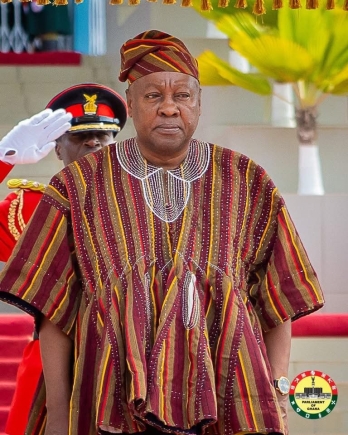
President John Dramani Mahama has described the energy sector as having been in a severe financial crisis, burdened by roughly GH¢80 billion caused by prolonged non-payment for gas, high commercial and technical losses in distribution, and weak collections by the Electricity Company of Ghana (ECG).
Delivering his second State of the Nation Address on Friday, February 27, he outlined the government’s comprehensive efforts to stabilise the sector.
As part of this process, he explained that the government has fully repaid and restored a $500 million World Bank partial risk guarantee and settled outstanding gas invoices, amounting to approximately $500 million, owed to ENI, bringing Ghana up to date with its gas obligations and reinstating credibility with international partners.
To secure the sector’s operational viability, President Mahama emphasised that the government is now “paying for every gas we are consuming today” and has made budgetary provision in the 2026 budget to ensure timely future payments for liquefied natural gas.
He noted that engagements with upstream oil and gas partners have produced a roadmap to guarantee full payment for gas consumed and have helped increase domestic gas production, with the aim of reducing reliance on expensive liquid fuels and improving nationwide electricity generation reliability.
On revenue management and leak reduction, the President highlighted institutional reforms, including a single ECG holding account jointly overseen by the Ministry of Energy and the Public Utilities Regulatory Commission, which has significantly reduced revenue leakages.
The government has also implemented a cash-waterfall monitoring framework and renegotiated power purchase agreements with independent power producers, actions that produced an immediate $250 million in savings and restructured approximately $1.1 billion of legacy debt for repayment between 2026 and 2028, with the revised agreements slated for Cabinet and Parliamentary ratification.
To address technical and commercial losses in distribution, reported at around 25 per cent of generated power, the President advocated adopting private-sector participation in billing and collection. He noted that this approach has significantly reduced revenue leakages, which is why the government has approved the multiple lease method for concessions in the distribution utilities.
He added that progress on access and renewables continues, with 200 of 400 targeted communities connected to the national grid and a further 100 underway. National electricity access is now reported at approximately 89.05 per cent, with the government aiming for near-universal access, targeting 99.98 per cent by 2030.
President Mahama explained that renewable initiatives include an additional 50 MW of solar power, comprising 30 MW from rooftop installations, bringing total solar capacity to approximately 250 MW, or roughly 5 per cent of the generation mix.
